
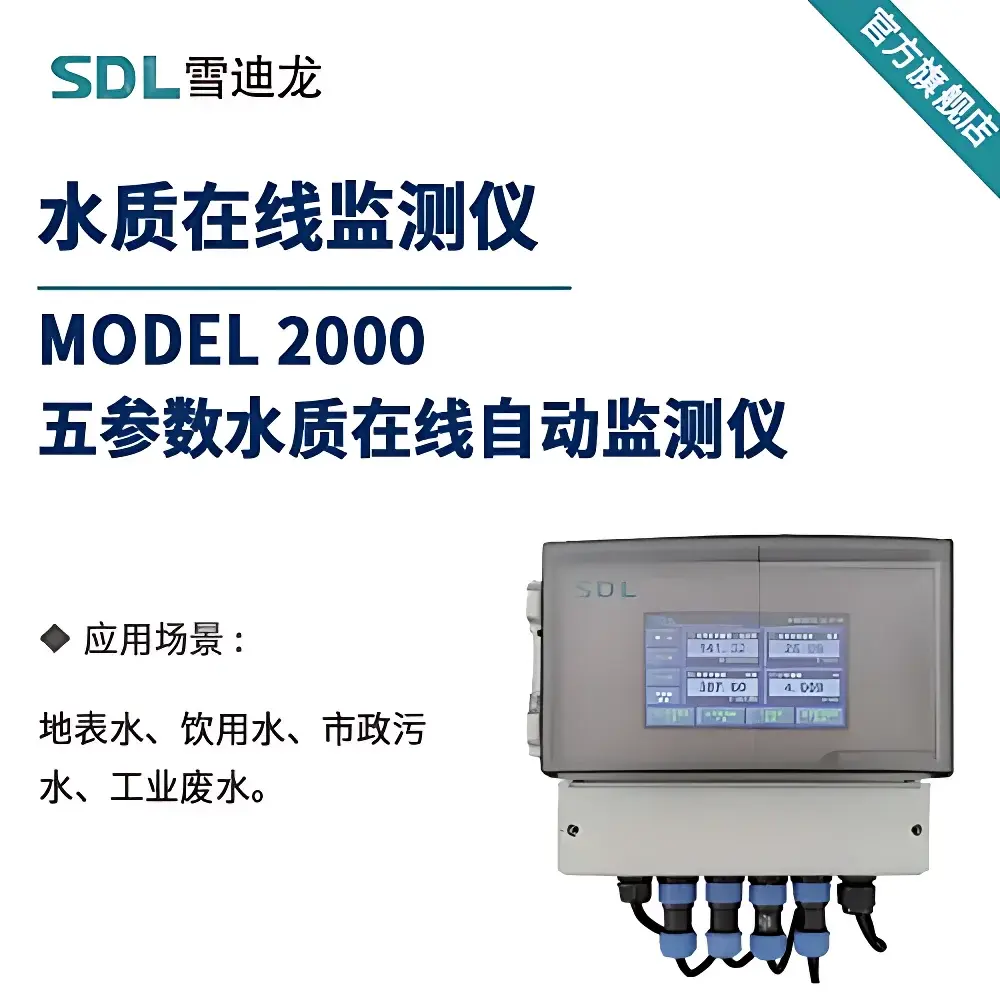
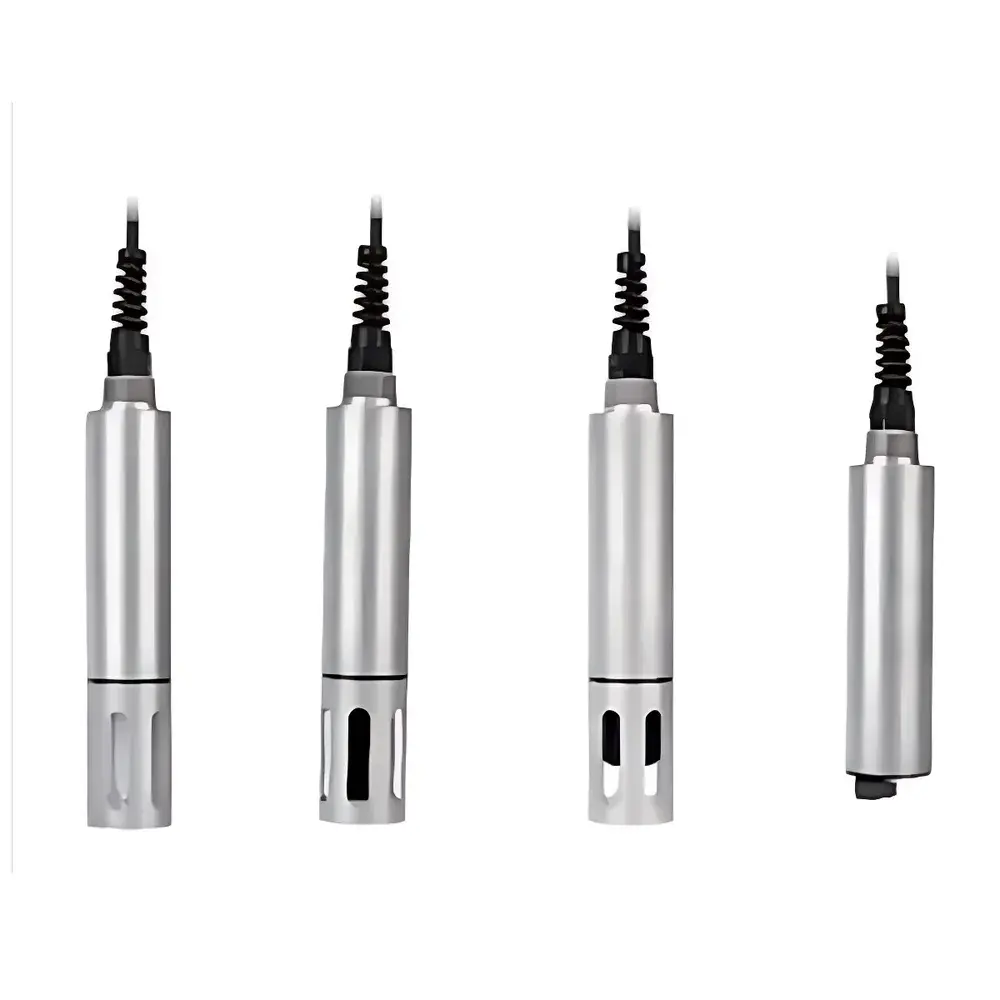
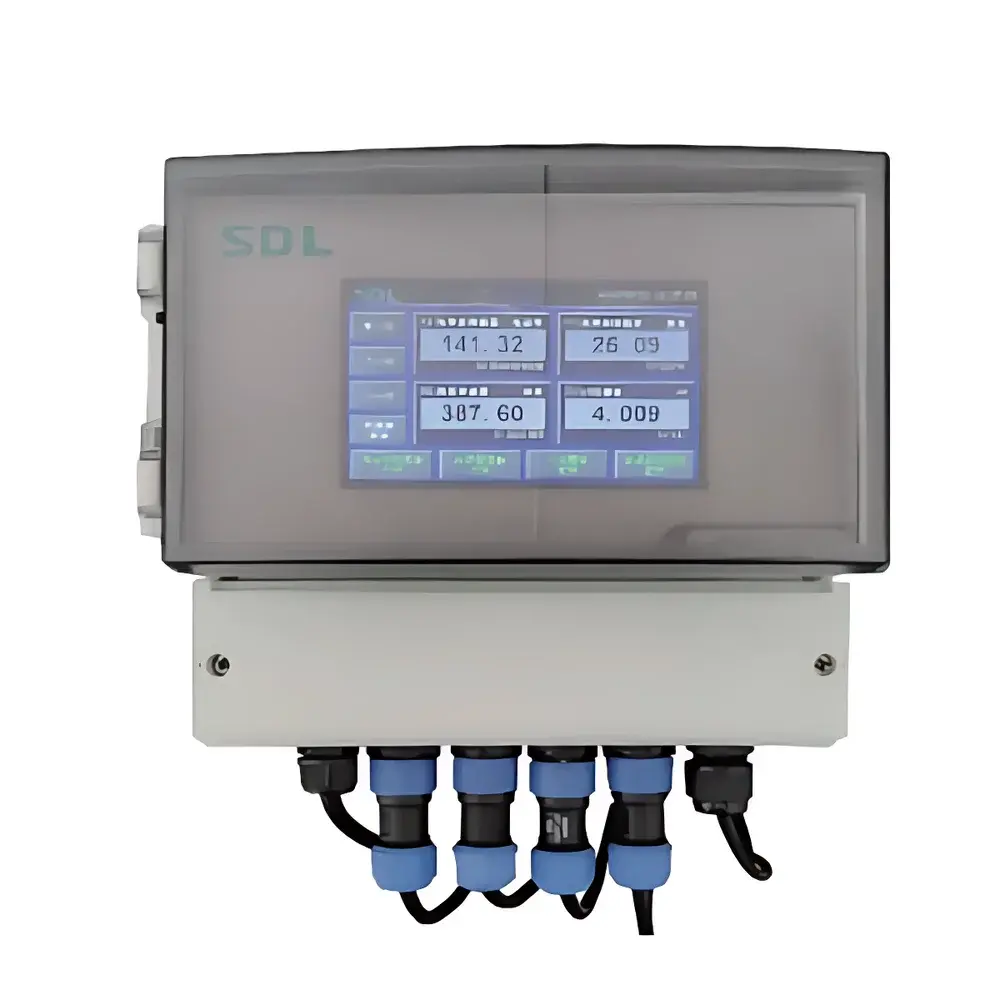
SDL MODEL2000 Five-Parameter Online Water Quality Analyzer
| Brand | SDL |
|---|---|
| Origin | Beijing, China |
| Manufacturer Type | Original Equipment Manufacturer (OEM) |
| Country of Origin | China |
| Model | MODEL2000 |
| Instrument Type | Online Water Quality Analyzer |
| Measured Parameters | Temperature, pH, Electrical Conductivity, Turbidity, Dissolved Oxygen |
| Certification | CCEP Certified (China Environmental Protection Product Certification), Applicability Test Report Issued by National Environmental Monitoring Instrument Quality Supervision and Inspection Center |
| Compliance | Meets GB/T 32205–2015, HJ/T 96–2003, HJ/T 99–2003, HJ/T 106–2003, and HJ/T 107–2003 |
Overview
The SDL MODEL2000 Five-Parameter Online Water Quality Analyzer is an integrated, fixed-station environmental monitoring instrument engineered for continuous, unattended measurement of five critical water quality parameters: temperature, pH, electrical conductivity (EC), turbidity, and dissolved oxygen (DO). Designed in accordance with Chinese national standards for environmental monitoring instrumentation—including GB/T 32205–2015 (General Technical Requirements for Online Water Quality Analyzers) and multiple HJ/T series specifications—the MODEL2000 employs a modular sensor architecture grounded in electrochemical, optical, and thermistor-based transduction principles. Its pH and DO sensors operate via potentiometric and galvanic membrane diffusion methods respectively; EC is measured using a four-electrode conductivity cell with automatic temperature compensation (NTC30K); turbidity relies on 90° scattered light detection through a sapphire optical window; and temperature is acquired simultaneously via embedded thermistor elements. This multi-parameter fusion design enables synchronized, time-aligned data acquisition—essential for trend analysis, early warning systems, and regulatory compliance reporting in dynamic aquatic environments.
Key Features
- Modular plug-and-play electrode system with non-contact electrical coupling—eliminates moisture ingress risks at connection points and enhances long-term field reliability.
- Turbidity sensor equipped with a sapphire optical window (Vickers hardness ≥ 2000 HV), offering exceptional scratch resistance, chemical inertness, and zero minimum flow requirement—enabling stable operation in low-velocity or static water bodies.
- Dissolved oxygen sensor features a replaceable membrane cap with >24-month operational lifespan under typical ambient conditions (20°C, 80% RH), minimizing maintenance frequency and total cost of ownership.
- Four-electrode conductivity cell integrated with NTC30K temperature sensor ensures high-accuracy EC measurement across wide salinity ranges (0–200 mS/cm) with ±0.5% full-scale linearity and automatic thermal compensation (0–50°C).
- Standardized digital and analog I/O interfaces—including RS-485 (Modbus RTU), 4–20 mA outputs (per parameter), and dry-contact alarm relays—support seamless integration into SCADA, DCS, or third-party telemetry platforms.
- IP66-rated enclosure with corrosion-resistant aluminum alloy housing and UV-stabilized polycarbonate display panel—certified for outdoor deployment in industrial, municipal, and riparian environments.
Sample Compatibility & Compliance
The MODEL2000 is validated for use in natural surface waters (rivers, lakes, reservoirs), potable water distribution networks, municipal wastewater treatment influent/effluent streams, and industrial process effluents with suspended solids ≤ 100 mg/L and chloride concentration < 5,000 mg/L. It complies with China’s mandatory environmental monitoring instrument verification protocols and holds formal applicability certification from the National Environmental Monitoring Instrument Quality Supervision and Inspection Center. The unit satisfies the technical requirements outlined in HJ/T 96–2003 (pH), HJ/T 99–2003 (turbidity), HJ/T 106–2003 (conductivity), and HJ/T 107–2003 (dissolved oxygen). While not CE- or EPA-certified, its measurement methodology aligns with ISO 7888 (conductivity), ISO 5667-22 (field sampling for online sensors), and ASTM D3370 (grab sample correlation for DO and pH).
Software & Data Management
The analyzer includes embedded firmware supporting local data logging (up to 30 days at 15-minute intervals) and real-time transmission via Modbus RTU or optional GPRS/4G module. Configuration and calibration are performed via a password-protected web interface accessible through Ethernet or Wi-Fi (optional). All calibration events, sensor diagnostics, and alarm triggers are timestamped and stored with audit trail capability—supporting GLP-aligned recordkeeping. Raw sensor outputs are linearized and temperature-compensated onboard prior to export, ensuring traceable metrological integrity. Export formats include CSV and Modbus register mapping tables compatible with industry-standard SCADA historians (e.g., Ignition, Siemens Desigo, Wonderware).
Applications
- Real-time surveillance of drinking water source protection zones and intake points.
- Compliance monitoring at municipal wastewater treatment plant discharge outfalls per local environmental permits.
- Process control feedback in industrial cooling towers, boiler feedwater systems, and aquaculture recirculation units.
- Long-term ecological assessment of eutrophication dynamics in lakes and reservoirs via diurnal DO/pH cycling analysis.
- Early detection of accidental spills or illicit discharges in urban stormwater networks through anomaly detection algorithms applied to multi-parameter deviation thresholds.
FAQ
What is the recommended calibration frequency for each parameter?
pH and DO sensors require quarterly calibration under normal operation; conductivity and turbidity modules are factory-calibrated and typically need verification every six months unless exposed to abrasive or fouling-prone matrices.
Can the MODEL2000 be deployed in seawater or brackish environments?
It supports conductivity measurements up to 200 mS/cm but lacks antifouling coatings optimized for marine biofilm; extended use in salinities >35 ppt requires enhanced cleaning protocols and optional ultrasonic probe cleaning accessories.
Does the system support remote firmware updates?
Yes—secure HTTP-based firmware upgrades are supported via authenticated web interface, with rollback capability and SHA-256 signature validation.
Is there built-in data backup during power interruption?
All configuration settings and logged data are preserved in non-volatile flash memory; runtime clock maintains accuracy within ±2 seconds/month without external time sync.
How is sensor drift compensated over time?
The firmware implements adaptive baseline correction for turbidity and DO based on periodic zero-point checks (via air calibration or clean-water reference), and slope tracking for pH and EC electrodes using dual-point calibration history.







