
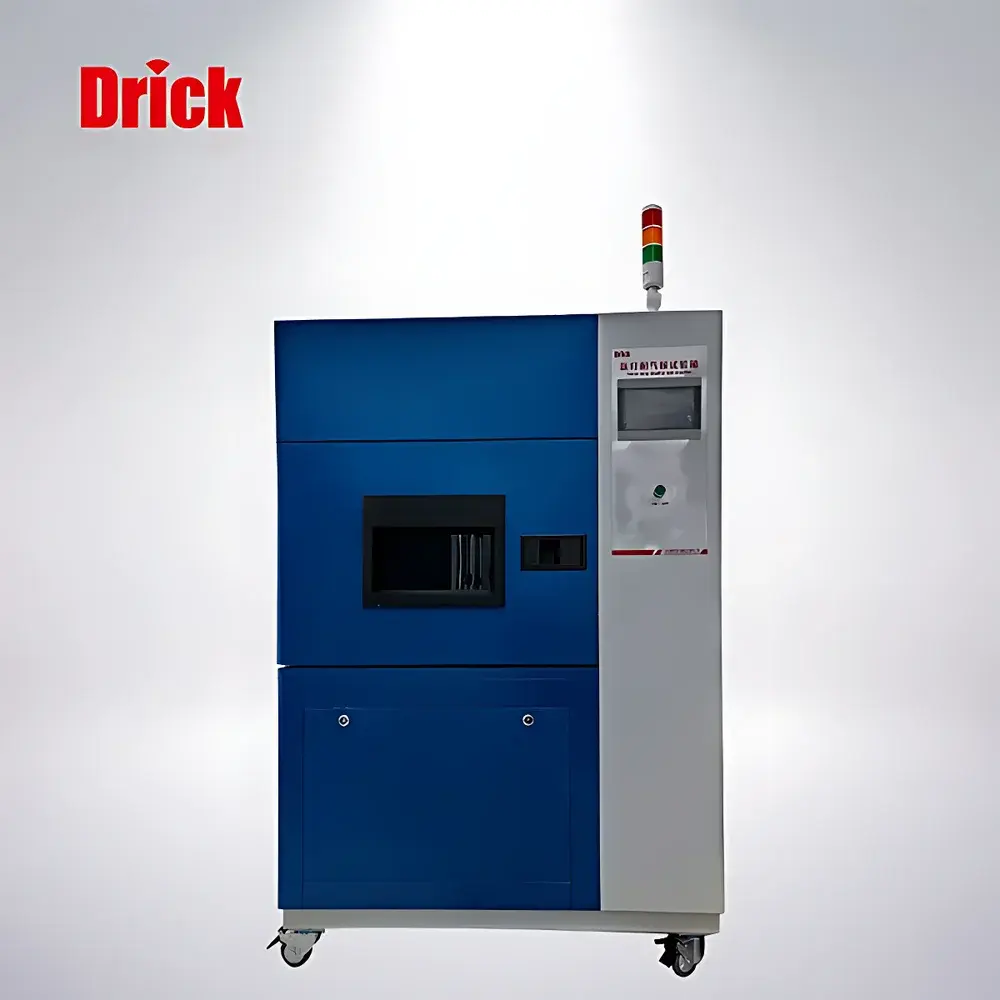
Drick DRK646 Benchtop Xenon Arc Weathering Test Chamber
| Brand | Drick |
|---|---|
| Origin | Shandong, China |
| Manufacturer Type | Direct Manufacturer |
| Country of Origin | China |
| Model | DRK646 |
| Xenon Lamp Power | 1.8 kW per lamp |
| Illumination Wavelength Range | 290–800 nm |
| Irradiance (290–800 nm) | 550 W/m² (average) |
| UV340 Irradiance | 0.51 W/m² |
| Black Panel Temperature Range | 40–80 °C ±3 °C |
| Chamber Temperature Range | Ambient to 80 °C |
| Temperature Uniformity | ±2.0 °C |
| Temperature Stability | ±0.5 °C |
| Humidity Range | 50–95 % RH adjustable |
| Sample Tray Dimensions | 450 × 300 mm (effective irradiation area) |
| Lamp-to-Specimen Distance | 230–280 mm (adjustable) |
| Illumination Cycle | 1–999 h/min/sec (continuously adjustable) |
| Cooling Method | Air-cooled lamp |
| Filter Options | Optional quartz or borosilicate glass filters |
| Spray Function | Automatic water spray system |
| Heating Power | 1.0 kW |
| Humidification Power | 1.0 kW |
Overview
The Drick DRK646 Benchtop Xenon Arc Weathering Test Chamber is an engineered solution for accelerated environmental aging simulation under controlled solar radiation exposure. Based on xenon arc lamp technology, it replicates the full-spectrum solar irradiance (290–800 nm), including critical UV, visible, and near-infrared components, enabling realistic assessment of photodegradation, color fading, gloss loss, cracking, and embrittlement in polymeric, coating, textile, automotive, and packaging materials. Unlike UV fluorescent or metal halide systems, xenon arc lamps deliver spectral power distribution closely aligned with terrestrial sunlight—making the DRK646 suitable for compliance-driven testing per ISO 4892-2, ASTM G155, SAE J2527, and AATCC TM16. Its compact benchtop footprint (D350 × W500 × H350 mm internal chamber) supports R&D labs and QC environments where space efficiency and reproducible exposure conditions are essential.
Key Features
- Full-spectrum air-cooled xenon lamp (1.8 kW), delivering irradiance up to 550 W/m² (290–800 nm average) and 0.51 W/m² at 340 nm, calibrated using integrated UV340 radiometer
- Precise black panel temperature control (40–80 °C ±3 °C) and chamber air temperature regulation (ambient to 80 °C, ±0.5 °C stability, ±2.0 °C uniformity)
- Adjustable relative humidity range (50–95 % RH), synchronized with irradiation cycles to simulate real-world moisture stress
- Motorized vertical sample tray (450 × 300 mm effective irradiation zone) with 230–280 mm lamp-to-specimen distance adjustment for optimal irradiance uniformity
- Configurable optical filtering: standard quartz or optional borosilicate glass filters to match specific spectral cut-offs required by ISO or OEM test protocols
- Automated water spray system for cyclic wetting simulation, supporting ISO 4892-2 Cycle 1–4 and ASTM G155 Procedure A/B
- Programmable exposure timing (1 sec to 999 hours) with independent control of light/dark, heat/humidity, and spray phases
- Modular lamp housing and tool-free xenon tube replacement design, minimizing downtime and maintenance cost
Sample Compatibility & Compliance
The DRK646 accommodates flat, curved, or irregularly shaped specimens via its non-restrictive sample holder configuration. It supports standardized specimen mounting per ISO 4892-2 Annex A and ASTM G155 Figure 1, including multi-position racks for simultaneous evaluation of comparative formulations. All operational parameters—including irradiance setpoints, temperature ramp profiles, humidity dwell times, and spray intervals—are fully traceable and configurable to meet GLP-compliant documentation requirements. While the system does not include built-in 21 CFR Part 11 audit trail functionality, its analog-digital hybrid control architecture permits integration with external LIMS or electronic lab notebooks for regulatory-grade data capture. Testing protocols executed on this chamber align with method validation expectations under ISO/IEC 17025 for accredited laboratories.
Software & Data Management
The DRK646 operates via a dedicated microprocessor-based controller with intuitive membrane keypad interface and LCD display. Real-time monitoring includes irradiance (W/m²), black panel temperature (°C), chamber humidity (% RH), elapsed time, and lamp operating hours. Data logging is performed at user-defined intervals (1–60 min), with values stored internally for up to 30 days. Export is supported via USB port to CSV format for post-processing in Excel or statistical analysis software (e.g., JMP, Minitab). Optional RS485 communication enables remote supervision through SCADA or building management systems. Firmware updates are delivered via USB stick, ensuring long-term compatibility with evolving test standards.
Applications
This chamber serves as a core tool in material durability qualification across multiple sectors: polymer formulation screening (PP, ABS, PC, TPU), automotive interior/exterior component validation (dashboards, seals, trim), architectural coating performance benchmarking (acrylics, fluoropolymers), textile UV resistance certification (apparel, awnings), and pharmaceutical packaging stability assessment (blister foils, HDPE bottles). It is routinely deployed in supplier qualification workflows where accelerated weathering data informs ISO 11341 pass/fail criteria or customer-specific durability KPIs such as ΔE* color shift ≤ 2.0 after 1000 kJ/m² UV dose.
FAQ
What spectral filters are included by default?
The standard configuration includes one quartz filter; borosilicate glass filters are available as optional accessories to emulate window-filtered sunlight per ISO 4892-2 Cycle 3.
Is the UV340 radiometer NIST-traceable?
The supplied UV340 sensor is factory-calibrated; users may perform periodic verification using third-party NIST-traceable reference meters.
Can the DRK646 operate continuously for extended durations (e.g., 2000+ hours)?
Yes—provided scheduled lamp replacement every 1500±200 hours and routine cleaning of filters and spray nozzles per the maintenance log.
Does the system support multi-step irradiance ramping?
No—the DRK646 maintains constant irradiance setpoint during active exposure; ramping requires manual stage reconfiguration between cycles.
What is the maximum sample thickness accommodated on the tray?
Specimens up to 50 mm thick can be mounted without obstructing airflow or irradiance uniformity, subject to center-of-tray placement.



