
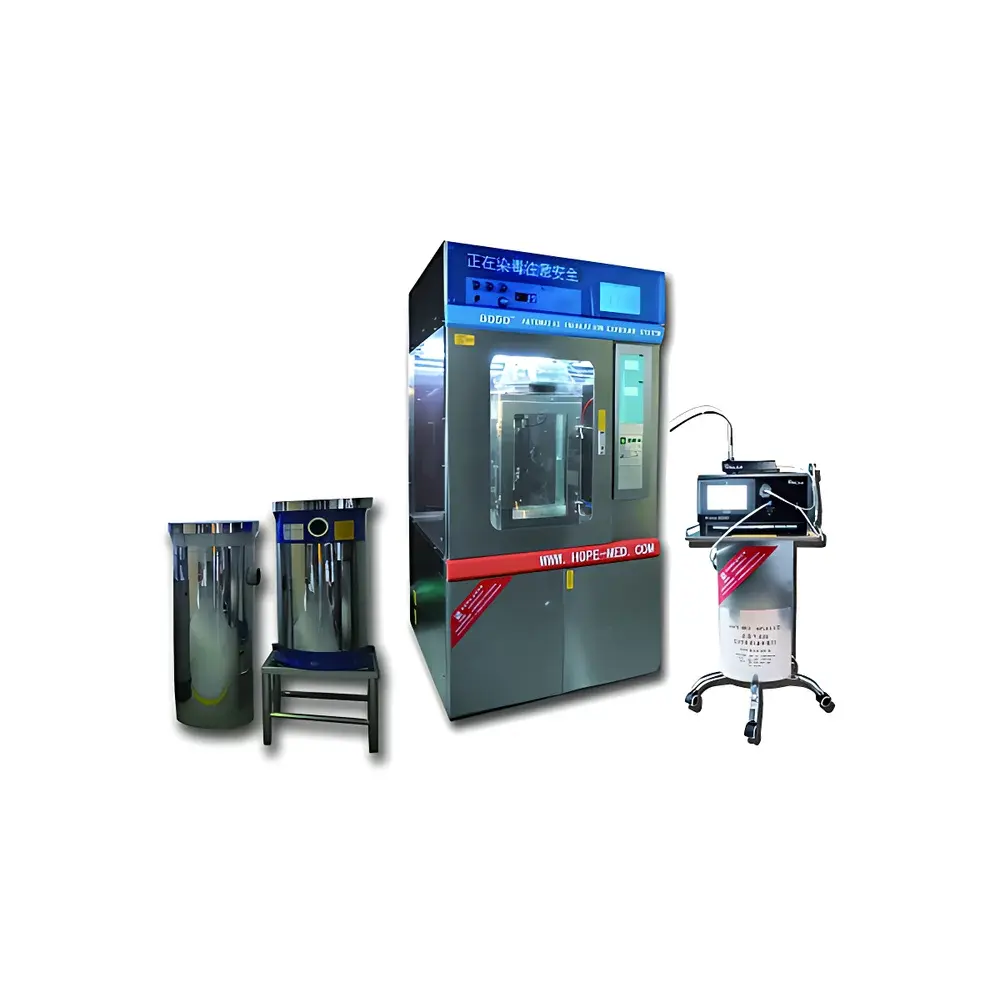
HOPE-MED HOPE-MED8050H Dynamic Inhalation Exposure Chamber System
| Brand | HOPE-MED |
|---|---|
| Model | HOPE-MED8050H |
| Origin | Tianjin, China |
| Chamber Volume | Standardized for rodent whole-body or nose-only exposure (configurable) |
| Aerosol Generation | Dual-mode (dry powder & liquid aerosol) |
| Environmental Control Range | Temp: 15–35 °C (±0.5 °C), RH: 30–70% (±3%), O₂: 18–21% (±0.2%), Pressure: ±50 Pa differential control |
| Flow Rate Accuracy | ±2% of setpoint |
| Data Logging Interval | 1–60 s user-selectable |
| Compliance | Designed to support OECD 412, OECD 413, ASTM E1931, ISO 10993-12, and GLP-aligned study execution |
Overview
The HOPE-MED HOPE-MED8050H Dynamic Inhalation Exposure Chamber System is an engineered platform for controlled, reproducible, and physiologically relevant inhalation toxicology studies in rodents. It operates on the principle of dynamic airflow-driven aerosol delivery—maintaining continuous, laminar gas exchange within the exposure chamber while precisely regulating aerosol concentration, particle size distribution, and environmental parameters (temperature, relative humidity, oxygen partial pressure, and differential pressure). Unlike static or semi-static systems, the HOPE-MED8050H ensures stable atmospheric conditions and consistent dosimetry throughout exposure duration, minimizing inter-animal variability and supporting regulatory-grade data generation for nonclinical safety assessment.
Key Features
- Dual-Mode Aerosol Generation: Integrates two patented, independently controllable aerosol sources: (1) a pressure-switching dry powder nebulizer with open-chamber design for high-efficiency, low-residue delivery of micronized pharmaceutical powders or industrial dusts; and (2) an ultrasonic two-phase flow gravity pre-screening array for generating respirable liquid aerosols with mass median aerodynamic diameter (MMAD) < 3 µm and geometric standard deviation (GSD) < 2.0—optimized for alveolar deposition.
- Thermally Regulated Liquid Sample Handling: Built-in heated magnetic stirrer module maintains sample temperature between 25–40 °C (user-settable) during nebulization, preventing crystallization, phase separation, or viscosity-induced clogging in suspension-based formulations.
- Real-Time Environmental Monitoring: Onboard sensor suite continuously measures and logs chamber temperature (PT100), relative humidity (capacitive hygrometer), absolute/relative pressure (piezoresistive transducer), O₂ concentration (zirconia electrochemical cell), and volumetric inlet/outlet airflow (thermal mass flow meters)—all traceable to NIST-calibrated references.
- Fail-Safe Operational Integrity: Redundant hardware interlocks monitor critical fault conditions—including thermal excursion (>±1.5 °C from setpoint), hypoxia (±100 Pa), and power supply anomaly—triggering audible/visual alerts and automatic exposure termination with timestamped event logging.
Sample Compatibility & Compliance
The HOPE-MED8050H accommodates both whole-body and nose-only exposure configurations for mice and rats (up to 300 g). It supports aerosols derived from sterile-filtered aqueous suspensions, organic solvent-based solutions, dry powders (e.g., TiO₂, carbon black, lactose blends), and volatile compounds (with optional condensation trap integration). The system architecture and software audit trail meet core requirements for Good Laboratory Practice (GLP) compliance per OECD Principles, including electronic signature capability, user access control (role-based permissions), and immutable raw data storage. Hardware design aligns with ISO 10993-12 for biocompatibility of wetted components and ASTM E1931 for inhalation exposure apparatus validation protocols.
Software & Data Management
Control and acquisition are managed via the HOPE-MED Exposure Control Suite—a Windows-based application compliant with FDA 21 CFR Part 11 (electronic records/signatures enabled). The interface provides real-time visualization of all monitored parameters as time-series plots, configurable alarm thresholds, and synchronized video annotation (when integrated with external camera systems). All raw sensor outputs, actuator states, and protocol metadata are saved in HDF5 format with embedded calibration certificates and version-stamped configuration files. Export options include CSV, PDF reports (with customizable templates), and direct SQL database push for LIMS integration. Audit trails record every parameter change, user login/logout, and system event with SHA-256 hashing for integrity verification.
Applications
This system is routinely deployed in preclinical respiratory toxicology (OECD 412/413), pulmonary drug delivery development (DPI/MDI formulation screening), nanomaterial safety assessment (ISO/TS 12901-2), occupational health hazard evaluation (NIOSH/OSHA-relevant aerosol metrics), and mechanistic studies of airway inflammation or fibrosis. Its precise environmental control enables modeling of altitude-exposure scenarios (via O₂ modulation) and co-exposure paradigms (e.g., ozone + particulate matter). Method transfer validation packages—including aerosol characterization (SMPS, APS), chamber homogeneity mapping, and mass balance recovery—are available upon request.
FAQ
What aerosol size distributions can the HOPE-MED8050H reliably generate?
The liquid aerosol mode achieves MMAD 1–3 µm with GSD < 2.0; dry powder mode delivers MMAD 2–5 µm depending on feedstock morphology and fluidization energy.
Is the system compatible with GLP-regulated contract research organizations (CROs)?
Yes—the software includes 21 CFR Part 11 modules, electronic signature workflows, and full audit trail generation required for FDA/EMA submission readiness.
Can the chamber be validated for spatial uniformity and temporal stability?
Yes—HOPE-MED provides a comprehensive IQ/OQ/PQ protocol package, including ISO 8573-1 compressed air quality testing, aerosol homogeneity mapping per ASTM D7260, and 24-hour drift validation under load.
What maintenance intervals are recommended for the aerosol generators?
Dry powder nebulizer cleaning is required after each study; ultrasonic transducers undergo quarterly performance verification using traceable PSL standards and acoustic output calibration.
Does the system support remote monitoring during long-duration exposures?
Yes—secure TLS-encrypted web interface allows authenticated access to live data streams, alarm status, and historical logs from offsite locations without compromising network security posture.
Related Products



