
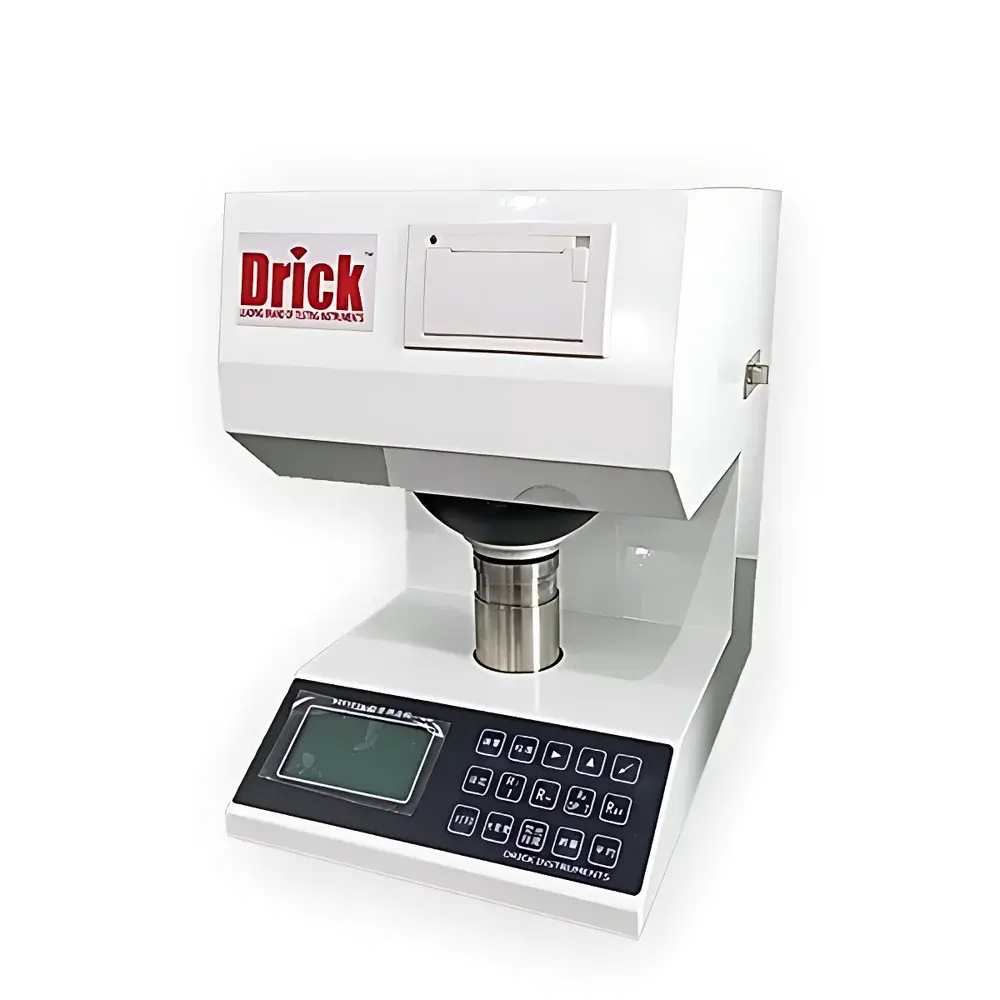
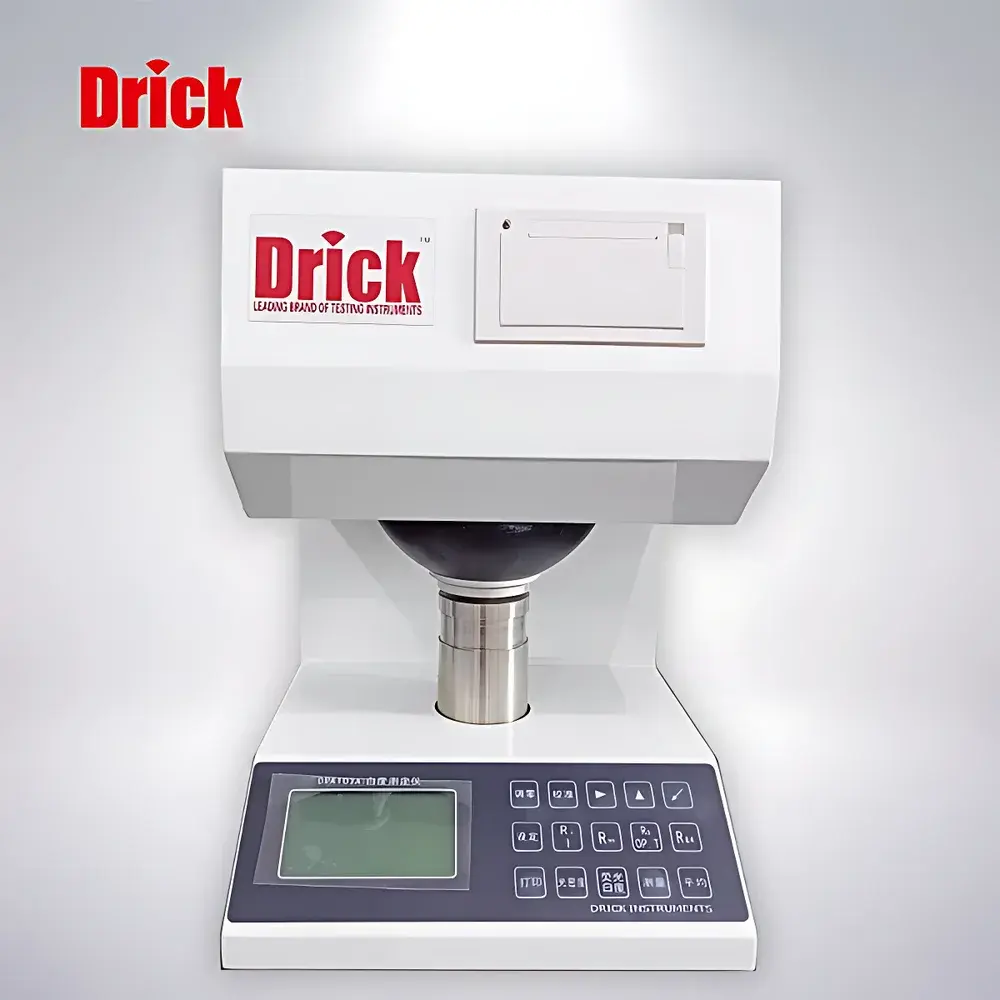
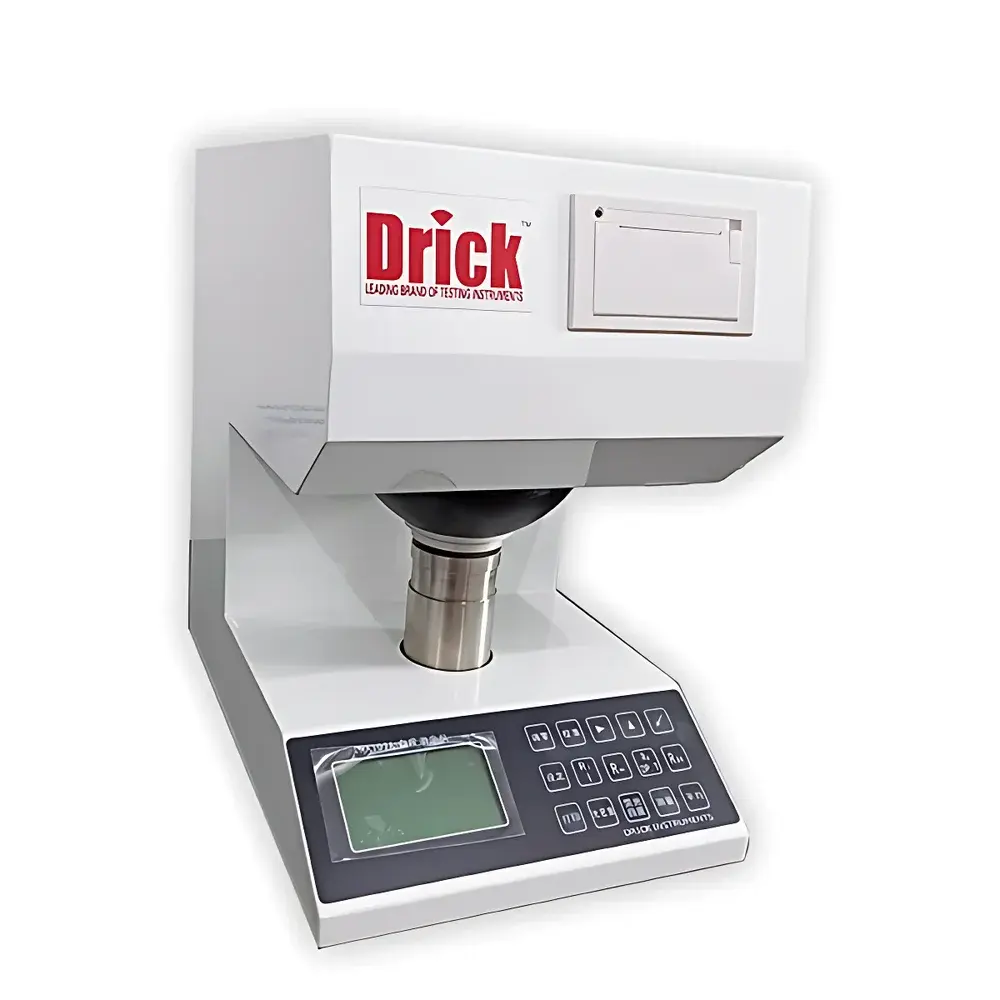
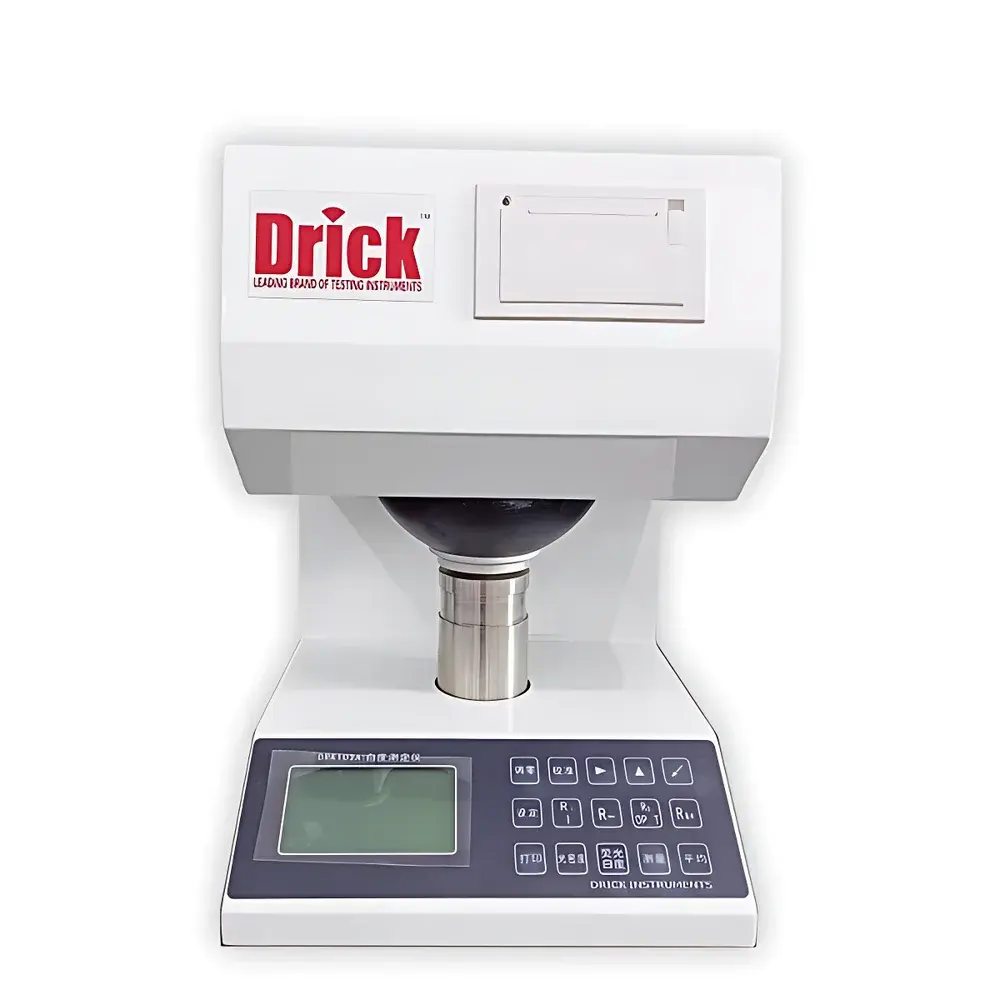
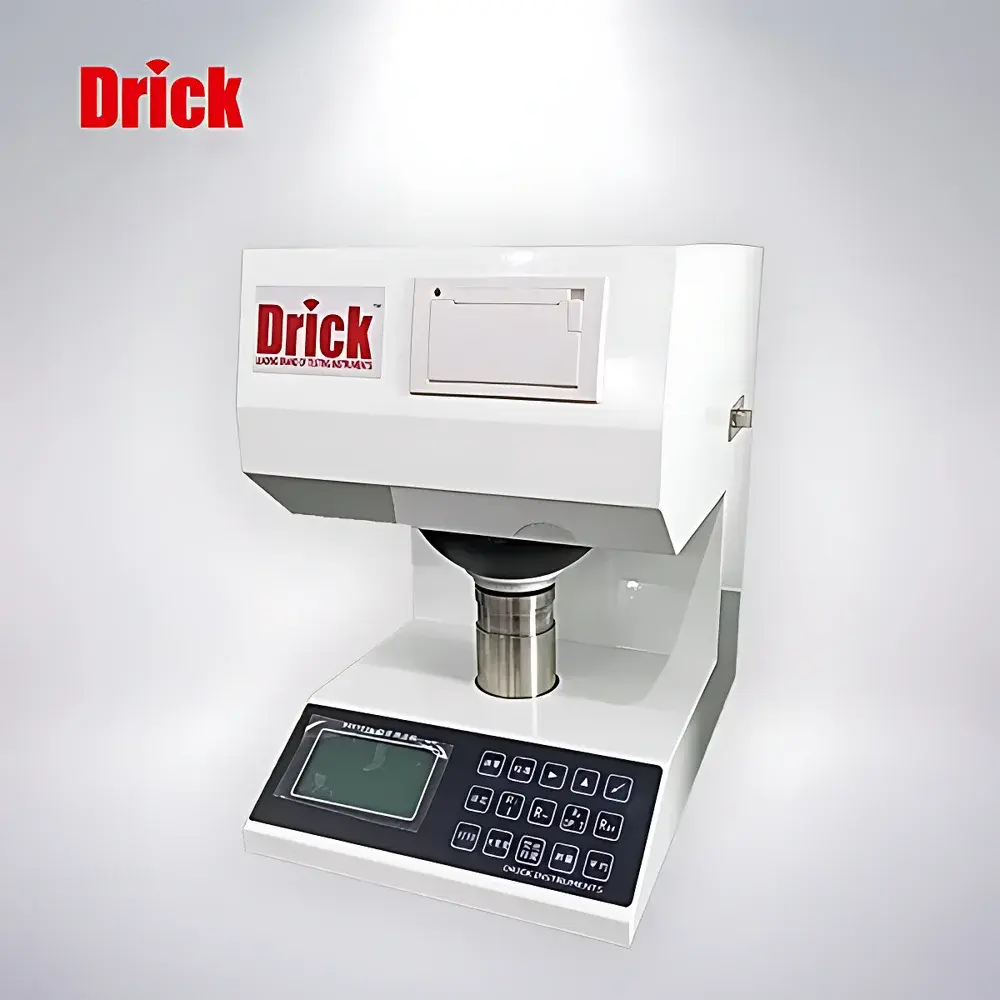
Drick DRK103 Whiteness and Color Meter
| Brand | Drick |
|---|---|
| Origin | Shandong, China |
| Manufacturer Type | Direct Manufacturer |
| Country of Origin | China |
| Model | DRK 103 |
| Illuminant | Simulated D65 |
| Geometry | Diffuse/0° (d/0) |
| Sphere Diameter | 150 mm |
| Aperture | 25 mm |
| Repeatability | δ(Y₁₀) < 0.1, δ(X₁₀,Y₁₀) < 0.001 |
| Accuracy | ΔY₁₀ < 1.0, ΔX₁₀/ΔY₁₀ < 0.01 |
| Sample Size | ≥Φ30 mm, ≤40 mm thick |
| CIE Systems | CIE 1964 Supplementary Observer (10°), CIE 1976 L*a*b* color space, CIE XYZ tristimulus values |
| Measurable Indices | Whiteness (ISO R₄₅₇, Ganz W₁₀, TW₁₀), Yellowness Index (YI), Opacity (OP), Transparency, Scattering Coefficient (S), Absorption Coefficient (A), Ink Absorption Value, ΔE*ab, ΔL*, ΔC*ab, ΔH*ab, h*ab, λd, Pe, Hunter L,a,b |
| Data Storage | Up to 10 reference samples |
| Interface | Built-in thermal printer, digital display |
| Power | 170–250 V, 50 Hz, 0.3 A |
| Operating Environment | 10–30 °C, RH ≤85% |
| Dimensions | 300 × 380 × 400 mm |
| Weight | 15 kg |
Overview
The Drick DRK103 Whiteness and Color Meter is a precision optical measurement instrument engineered for quantitative evaluation of whiteness, yellowness, color coordinates, and related photometric indices in solid and powdered materials. It operates on the principle of diffuse/0° (d/0) illumination geometry—compliant with ISO 2470, GB/T 7974, and ASTM E313—where a hemispherical integrating sphere (150 mm diameter) uniformly diffuses incident light from a simulated D65 illuminant onto the sample surface, and a single-angle (0°) spectrophotometric detector captures the reflected spectral energy. The system computes tristimulus values (X₁₀, Y₁₀, Z₁₀) using the CIE 1964 10° standard observer function, then derives chromaticity parameters—including CIE L*a*b*, CIELCh, whiteness (ISO R₄₅₇, Ganz W₁₀), yellowness index (ASTM E313/YI), opacity, scattering/absorption coefficients, and ink absorption—according to internationally recognized physical models. Designed for routine quality control in regulated industrial environments, the DRK103 delivers traceable, reproducible results without requiring spectral scanning or external calibration transfer standards.
Key Features
- Integrated d/0 optical architecture with 150 mm integrating sphere and 25 mm measurement port ensures high geometric conformity to ISO and national standard test conditions.
- Simulated D65 illuminant meets CIE-defined daylight spectral power distribution, enabling accurate assessment of fluorescent whitening agent (FWA) response in paper, textiles, and detergents.
- Comprehensive parameter output: ISO brightness (R₄₅₇), Ganz whiteness (W₁₀) and tint (TW₁₀), CIE L*a*b*, ΔE*ab (with full component breakdown: ΔL*, ΔC*ab, ΔH*ab), hue angle (h*ab), dominant wavelength (λd), excitation purity (Pe), Hunter L,a,b, yellowness index (YI), opacity (OP), transparency, scattering coefficient (S), absorption coefficient (A), and ink absorption value.
- Onboard statistical processing: automatic averaging of up to 10 sequential measurements per sample; memory retention of zero point, calibration data, standard reference values, and up to 10 user-defined physical or digital reference samples—even after power loss.
- Thermal printer interface enables immediate hardcopy reporting of all measured values, including date/time stamp, sample ID, reference ID, and deviation metrics—supporting GLP-compliant documentation workflows.
- Robust mechanical design: cast aluminum housing, vibration-damped optical path, and sealed detector assembly ensure long-term stability under factory or lab conditions (10–30 °C, RH ≤85%).
Sample Compatibility & Compliance
The DRK103 accepts flat, rigid, or powdered samples with minimum diameter ≥30 mm and thickness ≤40 mm. Optional powder press fixtures (available as accessory) enable standardized compaction of granular or fibrous materials—critical for repeatable opacity and scattering measurements in starch, salt, ceramic powders, and pulp. Instrument compliance spans over 30 national and international standards, including: ISO 2470 (paper brightness), ISO 2471 (opacity), GB/T 7973–7975 (paper and board reflectance, whiteness, color), GB/T 5950 (non-metallic minerals), GB/T 8424 (textile color), GB/T 13531.2 (cosmetic colorimetry), GB/T 11942 (colored building materials), ASTM E313 (yellowness index), and ISO 11475 (paper color under D65). Its fixed-geometry d/0 configuration satisfies audit requirements for routine QC labs operating under ISO/IEC 17025 or GMP-aligned internal procedures.
Software & Data Management
While the DRK103 operates as a standalone benchtop instrument with embedded firmware, its printed output format is structured for direct integration into laboratory information management systems (LIMS) or Excel-based QA databases. All reports include unambiguous parameter labels (e.g., “Y₁₀ = 89.23”, “ΔE*ab = 0.47”, “W₁₀ = 92.5”) and conform to SI unit conventions. Memory retention logic preserves calibration history and reference traceability—essential for FDA 21 CFR Part 11–aligned environments where electronic records must demonstrate integrity and non-repudiation. Though no proprietary PC software is bundled, ASCII-formatted printouts support automated OCR parsing and batch import into validated analytical platforms.
Applications
- Quality assurance of paper, board, and pulp: ISO brightness (R₄₅₇), fluorescence compensation, and CIE whiteness grading per ISO 11475 and TAPPI T452.
- Textile and dye manufacturing: color difference evaluation (ΔE*ab) against master standards, yellowness index tracking for polyester and nylon substrates, and whiteness consistency in bleached cotton.
- Ceramics and construction materials: whiteness quantification of tiles, glazes, and mineral fillers per GB/T 5950 and ISO 105-J03.
- Food-grade salts and starches: compliance testing per GB/T 13025 (salt) and GB/T 1840 (starch), where whiteness directly correlates with purification efficacy.
- Chemical and detergent production: FWA activity assessment in laundry additives using dual-standard (fluorescent/non-fluorescent) calibration per GB/T 9338.
- Plastics and coatings: yellowing resistance monitoring per GB/T 2409 and ISO 4892–2, alongside opacity and scattering analysis for pigment dispersion validation.
FAQ
What standards does the DRK103 comply with for paper brightness measurement?
It conforms to ISO 2470, GB/T 7974, and TAPPI T452 for ISO brightness (R₄₅₇) determination using d/0 geometry and D65 simulation.
Can the instrument measure fluorescent samples accurately?
Yes—the D65-simulated source includes near-UV components (360–400 nm) required to excite common optical brighteners, and the system applies built-in correction algorithms per ISO 11475 Annex B.
Is calibration traceable to national metrology institutes?
The instrument is supplied with NIST-traceable certified white and black standards; users perform daily verification using these artifacts in accordance with ISO/IEC 17025 clause 6.5.
Does it support batch reporting for production line use?
Each thermal printout includes sample ID, operator code, timestamp, and all computed indices—enabling manual or OCR-assisted batch logging without third-party software.
What maintenance is required beyond lamp replacement?
Annual verification of sphere coating integrity and aperture alignment is recommended; lamp replacement (included: 4×) follows manufacturer’s 2,000-hour service interval guidance.






