
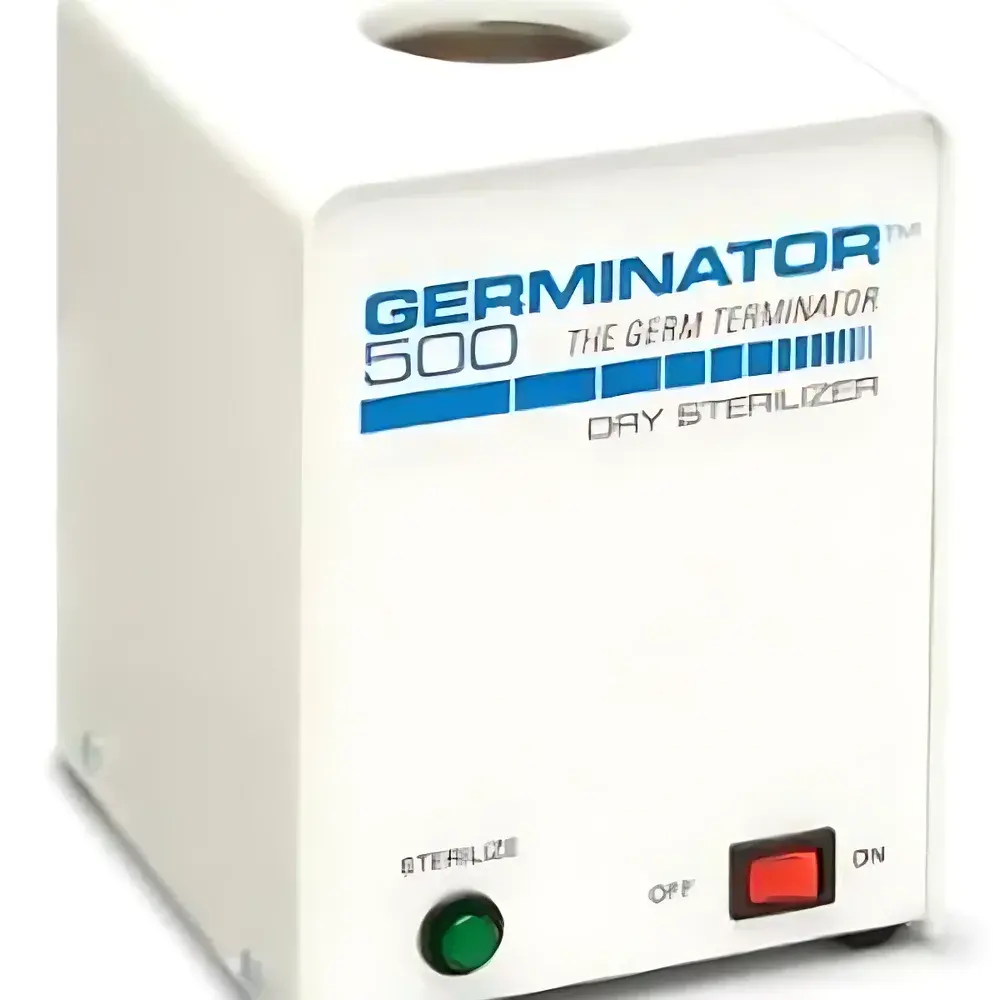
EMS Germinator 500 Dry Heat Sterilizer
| Brand | EMS |
|---|---|
| Origin | United Kingdom |
| Model | Germinator 500 |
| Chamber Internal Dimensions | 2.0 in (51 mm) diameter × 4.0 in (102 mm) depth (ID) |
| Preheat Time | 20 min |
| Operating Temperature | up to 260 °C |
| Cycle Time | 15 s |
| External Dimensions (H×W×D) | 5.25 in × 6.75 in × 5.25 in |
| Weight | 4.5 lb (2.04 kg) |
| Power Supply | 220 V AC, UL certified |
| Sterilizing Medium | Lead-free glass beads, 1.5 mm diameter |
| Compliance | UL 61010-1 |
Overview
The EMS Germinator 500 Dry Heat Sterilizer is a compact, benchtop thermal sterilization system engineered for rapid, reliable decontamination of heat-stable laboratory and clinical instruments. It operates on the principle of dry heat conduction—utilizing uniformly heated, inert lead-free glass beads (1.5 mm diameter) to transfer thermal energy directly to instrument surfaces. Unlike steam-based autoclaves, this system eliminates moisture-related corrosion, making it ideal for sterilizing sharp metallic tools—including scalpel blades, forceps, needle holders, and biopsy punches—without compromising edge integrity or surface finish. The unit achieves a validated microbial kill rate (≥6-log reduction of Geobacillus stearothermophilus spores) at 260 °C within 15 seconds of immersion, meeting established microbiological efficacy benchmarks for dry heat sterilization per ISO 17665-1 and ASTM E530. Its fully enclosed chamber design minimizes convective heat loss and ensures consistent thermal distribution across the entire bead bed.
Key Features
- Ultra-rapid sterilization cycle: 15-second exposure time at 260 °C, enabling high-throughput processing in busy labs or procedure rooms
- Compact footprint (6.75 in W × 5.25 in D × 5.25 in H) and lightweight construction (4.5 lb), suitable for space-constrained environments including laminar flow hoods and mobile surgical carts
- UL 61010-1 certified electrical safety compliance with 220 V AC input; integrated thermal cut-off and overtemperature protection circuits
- Stainless steel chamber housing and corrosion-resistant internal components ensure long-term durability under repeated thermal cycling
- Preheat stabilization in ≤20 minutes; digital temperature indicator provides real-time feedback during warm-up and operation
- Lead-free, chemically inert glass beads (1.5 mm nominal diameter) eliminate toxic leaching risks and support repeatable thermal conductivity performance over >5,000 cycles
Sample Compatibility & Compliance
The Germinator 500 accommodates instruments with maximum dimensions of 2.0 inches in diameter and 4.0 inches in length—sufficient for most standard surgical handpieces, dental burs, ophthalmic hooks, and microbiology inoculating loops. It is not intended for sterilizing porous materials, plastics, rubber, or liquids. Validation documentation supports alignment with ISO 14937 (sterilization of health care products) and complements GLP/GMP workflows where rapid, non-steam alternatives are required. While not FDA-cleared as a medical device, its operational parameters conform to accepted dry heat sterilization practices referenced in USP and AAMI ST58 for critical item reprocessing. Routine verification using biological indicators (e.g., Bacillus atrophaeus spore strips) is recommended per institutional infection control protocols.
Software & Data Management
The Germinator 500 is a manually operated, analog-controlled device with no embedded microprocessor or data logging capability. Temperature regulation is achieved via calibrated bimetallic thermostats and resistive heating elements, ensuring mechanical reliability and minimal maintenance requirements. For laboratories requiring audit-ready records, external validation tools—including calibrated thermocouple probes (e.g., Type K, ±0.5 °C accuracy) and time-stamped thermal profiling systems—can be integrated during routine qualification (IQ/OQ/PQ). The absence of firmware or network interfaces simplifies 21 CFR Part 11 compliance in regulated environments, as no electronic records or user authentication mechanisms require validation.
Applications
- Routine sterilization of reusable metal surgical and dental instruments between procedures
- Decontamination of microbiology loop wires and spreaders in teaching and research laboratories
- Emergency sterilization when autoclave availability is limited or maintenance is scheduled
- Pre-sterilization conditioning of glassware prior to aseptic filling operations
- Supporting ISO/IEC 17025-accredited testing labs requiring traceable, repeatable dry heat treatment steps
FAQ
What types of instruments are compatible with the Germinator 500?
Metal instruments that are heat-stable and non-porous—such as stainless steel scalpels, forceps, needle holders, and inoculation loops—are appropriate. Plastic, coated, or temperature-sensitive items must not be used.
Is the Germinator 500 suitable for sterilizing endoscopes or fiber-optic devices?
No. Endoscopes and optoelectronic instruments require low-temperature methods (e.g., ethylene oxide or hydrogen peroxide plasma) and are incompatible with dry heat at 260 °C.
How often should the glass beads be replaced?
Under normal use (≤50 cycles/day), the lead-free glass beads maintain consistent thermal properties for ≥2 years or 5,000 cycles. Visual inspection for discoloration, cracking, or clumping is recommended quarterly.
Does the unit include validation documentation?
The Germinator 500 ships with a Declaration of Conformity (UL 61010-1) and technical specifications sheet. Full IQ/OQ/PQ documentation templates and third-party validation support are available upon request from authorized EMS distributors.
Can the Germinator 500 be used in ISO Class 5 cleanrooms?
Yes—its sealed chamber design, absence of steam or aerosol generation, and low particulate emission profile make it suitable for integration into controlled environments when installed on stable, vibration-dampened surfaces.
Related Products



