
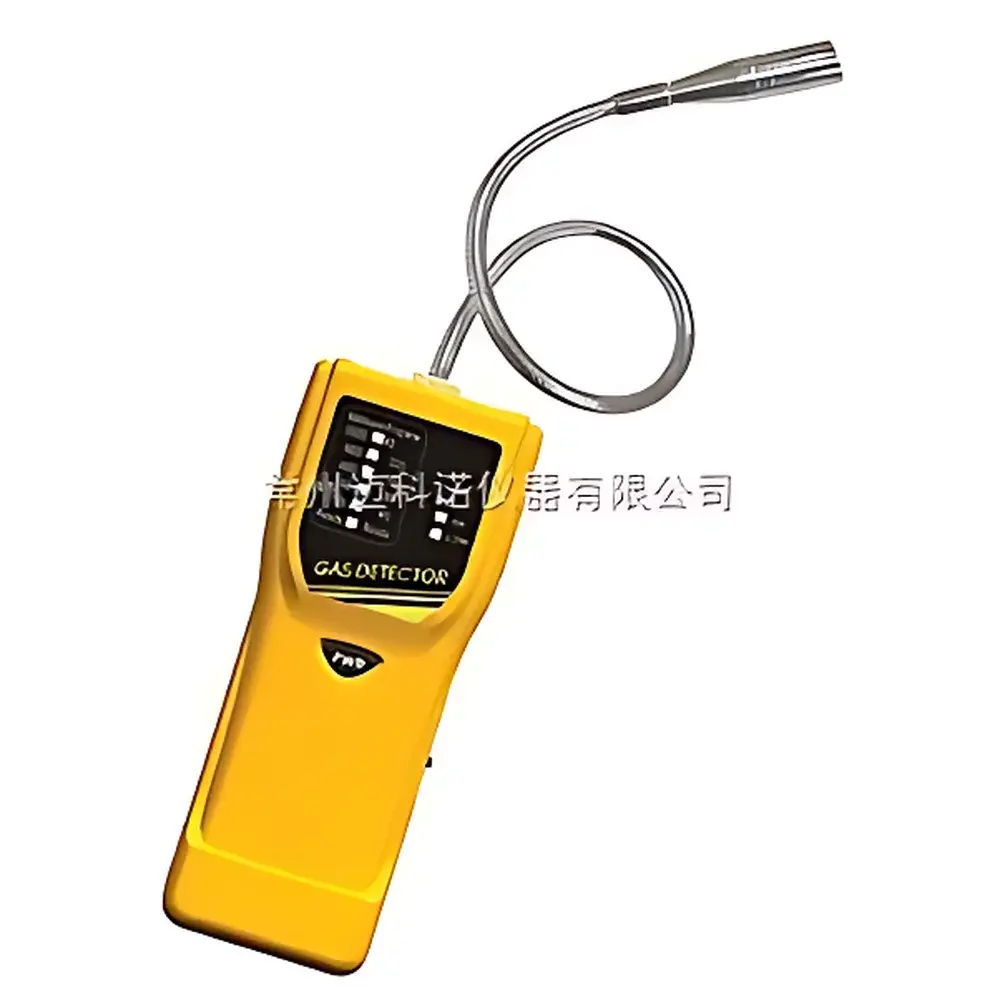
AZ7201 Portable Combustible Gas Detector
| Origin | Zhejiang, China |
|---|---|
| Manufacturer Type | Authorized Distributor |
| Origin Category | Domestic (China) |
| Model | AZ7201 |
| Pricing | Available Upon Request |
| Detection Gases | Methane (CH₄), Propane (C₃H₈) |
| Measurement Range | CH₄: 120–1920 ppm |
| C₃H₈ | 40–640 ppm |
| LED Indication Stages | 5-step segmented display (CH₄: 40/80/160/320/640 ppm |
| C₃H₈ | 120/240/480/960/1920 ppm) |
| Sensitivity Threshold | CH₄ ≥120 ppm |
| Response Time (T90) | <2 s |
| Warm-up Time | <60 s |
| Dimensions | 175 × 70 × 38 mm (L×W×T) |
| Power Supply | 4 × AAA alkaline batteries |
| Operating Environment | –5 to +45 °C |
| Audio/Visual Alerts | Buzzer alarm, multi-level LED bar graph, low-battery indicator, headphone jack, mute function |
Overview
The AZ7201 Portable Combustible Gas Detector is a compact, battery-powered instrument engineered for rapid, on-site detection and visual concentration estimation of methane (CH₄) and propane (C₃H₈) in ambient air. It employs catalytic bead (pellistor) sensor technology—a widely accepted principle for combustible gas detection per ISO 28011 and IEC 60079-29-1—where gas oxidation on a heated sensing element induces a measurable resistance change proportional to concentration. Unlike photoionization or infrared-based systems, the AZ7201 prioritizes field responsiveness and intuitive interpretation over quantitative trace analysis, making it suitable for preliminary hazard screening in utility maintenance, HVAC inspection, laboratory safety audits, and confined-space entry pre-checks. Its design adheres to fundamental functional safety expectations for portable gas detectors used in non-classified (Zone 2/Division 2) environments, with no intrinsic safety certification (e.g., ATEX, UL 1482, or IECEx) implied by default.
Key Features
- Five-stage LED bar graph providing immediate, color-coded visual feedback aligned with predefined concentration thresholds for both methane and propane—enabling rapid situational assessment without numerical interpretation.
- Dual-gas capability with dedicated calibration and response scaling for CH₄ and C₃H₈, ensuring appropriate sensitivity weighting per gas’s lower explosive limit (LEL) contribution (CH₄ LEL = 5.0% v/v; C₃H₈ LEL = 2.1% v/v).
- Sub-2-second T90 response time supports dynamic leak tracing and real-time exposure monitoring during mobile surveys.
- Integrated audio alarm with user-activated mute function and 3.5 mm headphone jack for discreet operation in noise-sensitive or high-ambient-noise settings.
- Low-voltage detection circuitry with clear LCD or LED indicator ensures reliable operation across battery discharge cycles; typical runtime exceeds 12 hours under intermittent use.
- Rugged ABS housing and IP54-rated ingress protection provide resistance against dust and water splashes encountered in industrial or outdoor field conditions.
Sample Compatibility & Compliance
The AZ7201 is intended for ambient air sampling only and is not designed for direct insertion into process streams, ducts, or pressurized enclosures. It detects combustible hydrocarbon vapors in the vapor phase at atmospheric pressure and temperatures between –5 °C and +45 °C. Relative humidity tolerance up to 99% RH (non-condensing) minimizes false triggering due to moisture interference—a common concern with pellistor sensors. While the device meets basic performance benchmarks outlined in EN 45544-1 for portable gas detectors, it does not carry formal conformity markings for explosion protection (e.g., ATEX, UKCA, or IECEx), nor does it comply with OSHA 1910.120 or EPA Method 21 requirements for regulatory leak detection reporting. Users must verify local jurisdictional requirements prior to deployment in regulated facilities.
Software & Data Management
The AZ7201 operates as a standalone analog-digital hybrid instrument with no onboard data logging, Bluetooth/Wi-Fi connectivity, or PC interface. All measurements are conveyed via real-time LED staging and audible alerts only. No firmware updates, configuration software, or audit trail functionality is provided. As such, it aligns with GLP/GMP principles only in terms of operational consistency—not electronic record integrity—and does not satisfy FDA 21 CFR Part 11 requirements for electronic signatures or data retention. For traceable documentation, users must manually record readings alongside time/date stamps and environmental conditions using external logbooks or validated paper-based procedures.
Applications
- Routine leak checks around natural gas distribution infrastructure—including meter boxes, regulator stations, and service lines.
- Safety verification prior to hot work in mechanical rooms, boiler areas, or residential basements where propane-fueled appliances are installed.
- Educational demonstrations of combustible gas behavior and detector response characteristics in chemistry or occupational safety laboratories.
- Pre-entry screening for confined spaces such as manholes, storage tanks, or utility vaults where residual fuel vapors may accumulate.
- Field validation of fixed gas detection system alarms during commissioning or troubleshooting activities.
FAQ
Does the AZ7201 require periodic calibration? Why?
Yes. Catalytic bead sensors drift over time due to poisoning, aging, and environmental exposure. Calibration with certified CH₄ or C₃H₈ span gas (typically at 50% LEL) is recommended before each day’s use or after any event that may compromise sensor integrity (e.g., exposure to silicones, leaded fuels, or high-concentration gas).
Can the AZ7201 detect hydrogen or carbon monoxide?
No. Its pellistor sensor is optimized for saturated hydrocarbons (CH₄, C₃H₈) and exhibits minimal cross-sensitivity to H₂ or CO. Dedicated electrochemical sensors are required for those gases.
Is the device suitable for use in explosive atmospheres?
No. The AZ7201 lacks intrinsic safety certification and must not be operated in classified hazardous locations (e.g., Zone 0, Zone 1, or Division 1 areas) unless verified and approved by a qualified safety engineer under site-specific risk assessment protocols.
What is the expected service life of the sensor?
Under normal operating conditions and proper maintenance, the catalytic bead sensor typically remains functional for 12–24 months. Performance degradation is indicated by sluggish response, failure to reach full-scale LED illumination, or inconsistent zero stability.
How should the unit be stored when not in use?
Store in a clean, dry environment at room temperature, with batteries removed to prevent leakage-related corrosion. Avoid prolonged exposure to solvents, high humidity, or extreme temperatures.
Related Products







