
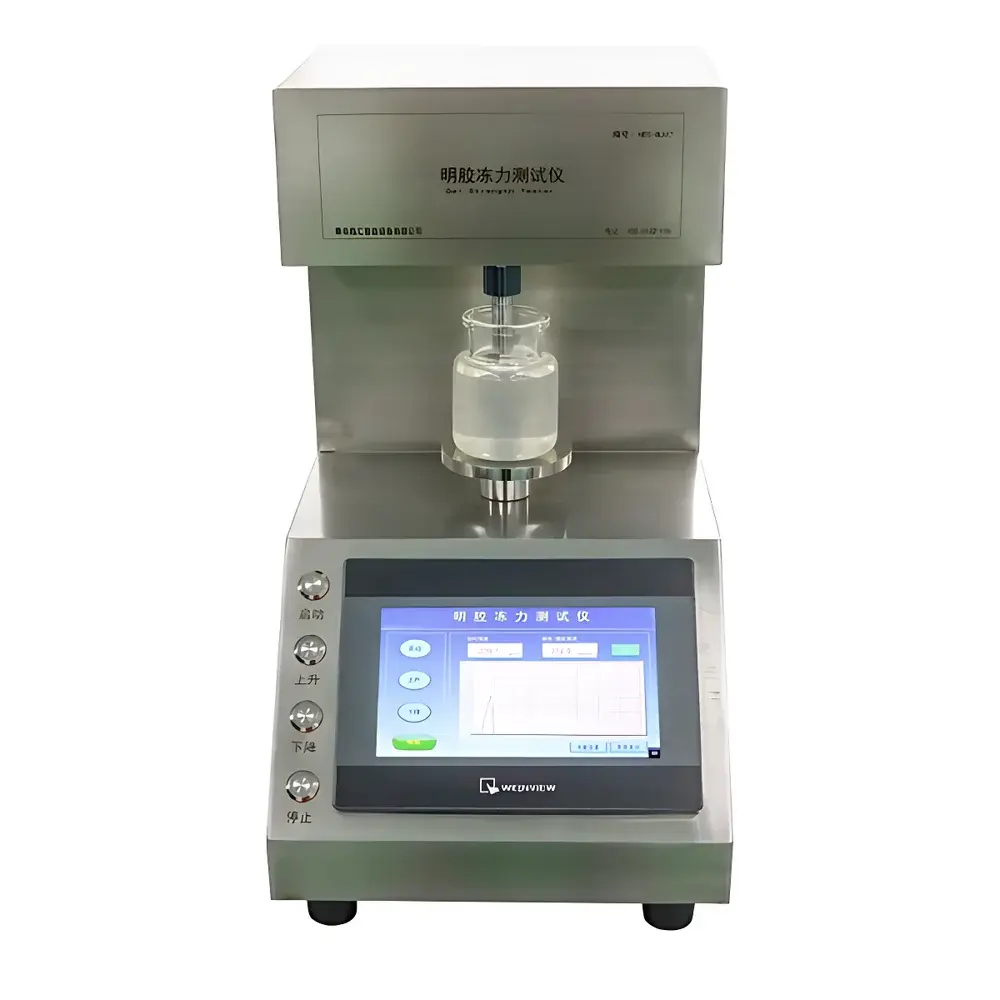
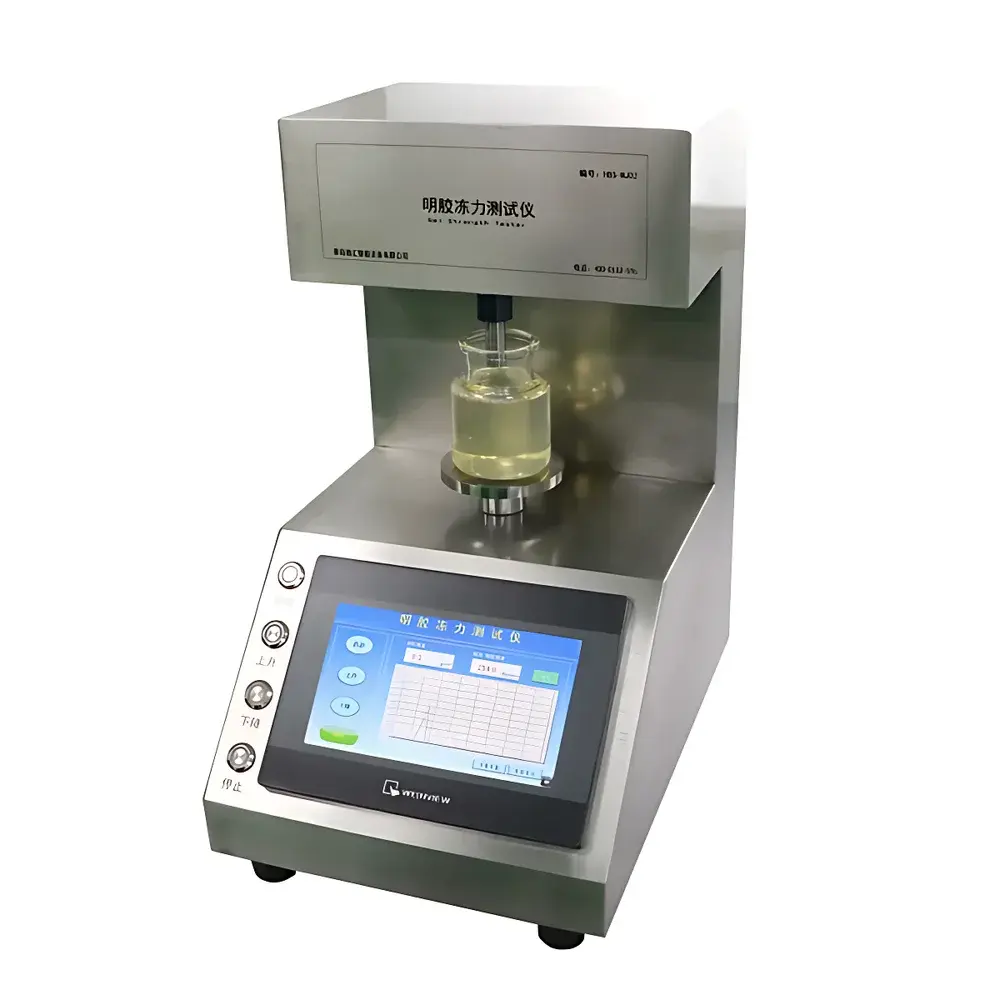
Hopebio HBS-NJ02 Gel Strength Tester
| Brand | Hopebio |
|---|---|
| Model | HBS-NJ02 |
| Measurement Principle | Controlled-depth compression with stainless-steel plunger (12.7 mm Ø) |
| Force Range | 0–3000 g/cm² (gel) / 0–3000 g (Bloom) |
| Resolution | 0.1 g |
| Plunger Diameter | 12.7 ± 0.1 mm (AISI 304 stainless steel) |
| Penetration Depth (gelatin) | 4 mm (adjustable, 1–50 mm range) |
| Stroke Travel | 0–40 mm |
| Pre-test Speed / Test Speed / Retract Speed | Adjustable |
| Data Storage | On-device (36 tests), USB export (FAT32 ≤32 GB, 60-day history) |
| Display | 7-inch capacitive touchscreen |
| Power | 220 V AC, 1 A |
| Operating Temp | 10–40 °C |
| Relative Humidity | <90% RH |
| Dimensions | 350 × 250 × 435 mm |
| Weight | 10 kg |
Overview
The Hopebio HBS-NJ02 Gel Strength Tester is an engineered instrument for quantitative mechanical characterization of thermo-reversible and physical gels in food, pharmaceutical, and industrial polymer applications. It operates on the principle of controlled-force compression using a standardized cylindrical plunger (12.7 mm diameter) to measure resistance to deformation—either as Bloom gel strength (g) for animal-derived gelatin per ISO 9665 and USP/ChP methods, or as compressive rupture force (g/cm²) for hydrocolloids such as carrageenan, agar, konjac glucomannan, and synthetic superabsorbent polymers. The device complies with multiple regulatory and standardization frameworks including ISO 9665 (adhesives—animal glues), GB 6783–2013 (gelatin bloom strength), GB 28304–2012 (curdlan gel strength), and Chinese Pharmacopoeia 2020 Edition (capsule-grade gelatin specifications). Its architecture integrates a high-stability load cell, programmable motion control, and real-time force–displacement curve acquisition—enabling reproducible, operator-independent evaluation of gel network integrity under defined thermal and geometric conditions.
Key Features
- High-resolution force measurement system with ±0.1 g accuracy and 0–3000 g/cm² dynamic range, calibrated traceably to national metrological standards.
- Standardized AISI 304 stainless-steel plunger (12.7 ± 0.1 mm Ø), compliant with ISO 9665 and GB 6783–2013 dimensional requirements for Bloom testing.
- Fully adjustable motion parameters: pre-contact descent speed, test penetration speed (for gelatin or gel modes), retract speed, and stroke distance (1–50 mm).
- Two operational modes: Gelatin Mode (fixed 4 mm penetration depth, reporting Bloom g) and Gel Mode (peak rupture force at break point, reporting g/cm²).
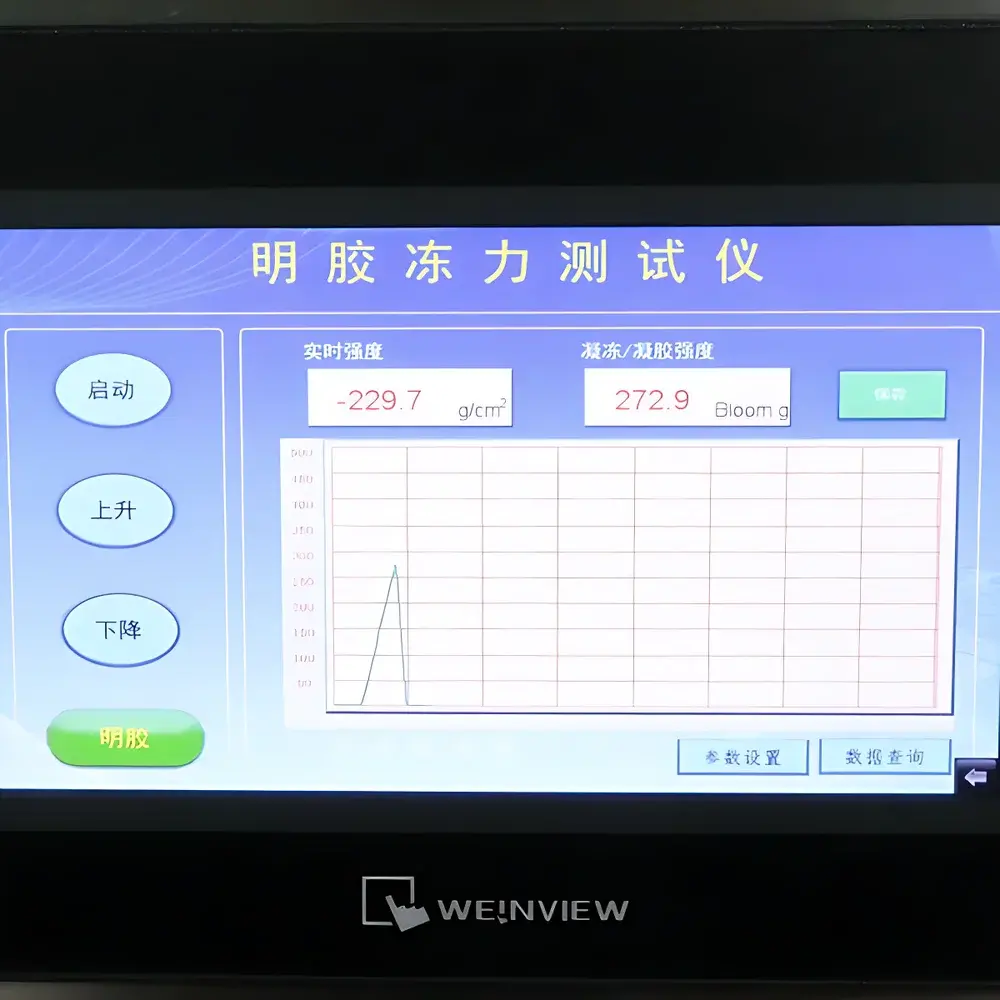
- Real-time force–displacement curve visualization on a 7-inch capacitive touchscreen; automatic peak detection with 2-second post-maximum data capture window.
- Onboard data storage for up to 36 test records; USB 2.0 interface supporting FAT32-formatted drives (≤32 GB) for secure export of 60-day historical datasets with timestamps.
- Robust mechanical design optimized for low-vibration environments—critical for maintaining measurement repeatability in QC laboratories handling soft viscoelastic matrices.
Sample Compatibility & Compliance
The HBS-NJ02 supports a broad spectrum of thermally set and cold-set gels relevant to food science, nutraceutical formulation, and excipient qualification. Validated sample types include bovine/piscine gelatin, agarose gels, κ-/ι-carrageenan systems, pectin networks, konjac glucomannan, alginate hydrogels, dairy-based protein gels (e.g., casein, whey), butter and margarine emulsions, surimi analogs (e.g., fish balls), and oilfield polymer thickeners. All measurements are performed under strictly controlled ambient conditions: samples must be equilibrated at 10–25 °C for ≥90 minutes prior to testing to ensure consistent cross-link density and thermal history. The instrument meets GLP-aligned documentation requirements—test logs include date/time stamp, operator ID (manual entry), sample ID, mode selection, and full curve metadata—facilitating audit readiness for ISO/IEC 17025-accredited labs and FDA 21 CFR Part 11–aligned workflows when paired with validated electronic record procedures.
Software & Data Management
The embedded firmware provides intuitive touchscreen navigation without external PC dependency. Parameter configuration—including measurement speed profiles, depth limits, and Y-axis scaling—is accessible via hierarchical menus with password-protected administrator settings. Each test generates three primary outputs: instantaneous force (g), maximum force (g or Bloom g), and a time-synchronized force–displacement plot (CSV exportable). USB data dumps contain structured .csv files with column headers: “Test_ID”, “Date_Time”, “Mode”, “Max_Force_g”, “Penetration_mm”, “Curve_Sample_Rate_Hz”, and “Operator_Note”. No proprietary binary formats are used—ensuring compatibility with LIMS platforms, statistical process control (SPC) software (e.g., Minitab, JMP), and automated QA reporting pipelines. Firmware updates are delivered via signed USB packages, preserving cryptographic integrity and version traceability.
Applications
- Quality control of commercial gelatin batches against pharmacopeial monographs (ChP 2020, USP , EP 2.7.1) and contractual Bloom specifications (e.g., 150–250 Bloom for hard capsules).
- Routine assessment of hydrocolloid functionality in plant-based dairy alternatives, fruit jellies, and low-sugar confectionery systems.
- Stability monitoring of heat-treated or freeze-thawed gels during shelf-life studies.
- Raw material screening for edible film formulations incorporating chitosan, sodium alginate, or methylcellulose.
- Process validation support for thermal setting steps in meat analog production and surimi processing lines.
- Regulatory submission dossiers requiring documented gel strength consistency across manufacturing sites (aligned with ICH Q5E comparability guidelines).
FAQ
What is the difference between Bloom g and g/cm² units on this instrument?
Bloom g is a dimensionless empirical unit defined by ISO 9665 and USP for gelatin: it reports the force (in grams) required to depress a 12.7-mm-diameter plunger 4 mm into a standardized 6.67% w/v gelatin solution held at 10 °C. g/cm² is a pressure-derived metric used for non-gelatin gels (e.g., carrageenan, agar), calculated as peak force divided by plunger contact area (126.68 mm²).
Can the HBS-NJ02 be used for compliance with FDA 21 CFR Part 11?
The device itself does not include electronic signature or audit trail features out-of-the-box. However, its CSV-based data export architecture enables integration into validated Part 11–compliant LIMS or ELN systems when deployed with appropriate procedural controls (e.g., user access tiers, change logs, electronic signatures applied at the system level).
Is calibration traceable to national standards?
Yes—factory calibration uses NIST-traceable deadweight standards. Users may perform intermediate verification using certified reference weights (±0.05 g tolerance); calibration certificates are issued with each unit and include uncertainty budgets per ISO/IEC 17025 requirements.
What environmental conditions are required for accurate testing?
Ambient temperature must be maintained between 10–40 °C with relative humidity <90% RH. Sample conditioning is critical: gelatin samples require 16–24 h refrigeration at 10 °C; hydrocolloid gels must equilibrate at 10–25 °C for ≥90 min prior to measurement to minimize thermal drift artifacts.
Does the instrument support GLP-compliant reporting?
It supports GLP-aligned documentation through timestamped test records, manual operator identification, and structured CSV exports. Full GLP compliance requires supplementary lab SOPs covering equipment qualification (IQ/OQ/PQ), preventive maintenance logs, and analyst training records—none of which are embedded but are fully compatible with the instrument’s output architecture.




