
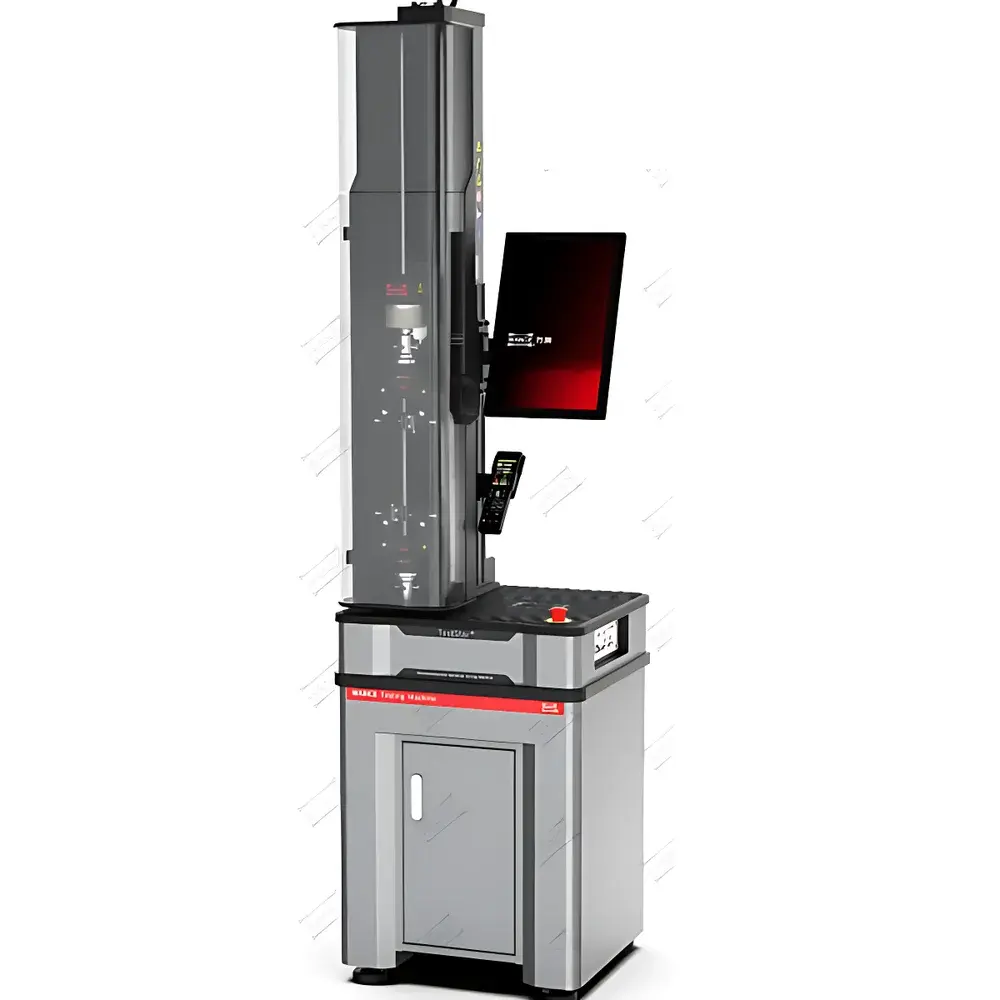
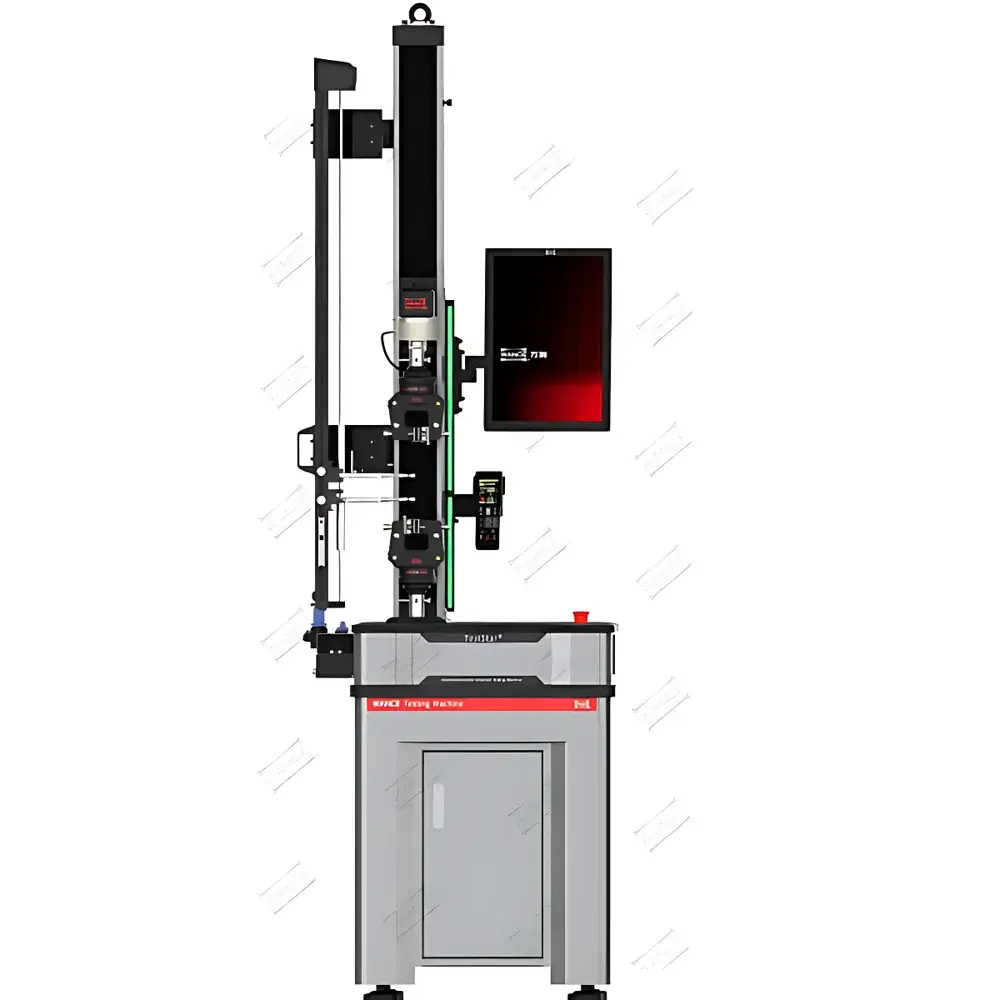
WANCE ETM-A Desktop Single-Column Electronic Universal Testing Machine
| Brand | WANCE |
|---|---|
| Model | ETM-A |
| Type | Electronic Universal Testing Machine |
| Load Capacity | 0.01 kN to 5 kN |
| Load Accuracy Class | 0.5 |
| Frame Type | Desktop, Single-Column |
| Maximum Test Speed | 2400 mm/min |
| Minimum Test Speed | 0.00005 mm/min |
| Crosshead Travel | 960 mm |
| Crosshead Position Resolution | 0.0133 µm |
| Axial Stiffness (with spoke-type load cell) | 10 kN/mm |
| Vertical Test Space | 1150 mm |
| Horizontal Test Space | 100 mm |
| Dimensions (H×W×D) | 1580 × 580 × 520 mm |
| Weight | 108 kg |
| Power Supply | AC 220 V ±10%, 50 Hz, 600 W |
| Compliance | GB/T 16491-2022, GB/T 2611-2022, JJG 139-2014, JJG 475-2008, GB/T 1040.1–2025, GB/T 1040.2–2022, GB/T 1041–2008, GB/T 9341–2008, GB/T 2568–1995, GB/T 2790–1995, GB/T 2791–1995, GB/T 2792–2014, GB/T 528–2009, GB/T 529–2008 |
Overview
The WANCE ETM-A is a precision-engineered desktop single-column electronic universal testing machine designed for high-reproducibility mechanical characterization of low-to-moderate force materials. It operates on the principle of servo-controlled electromechanical actuation, where a high-resolution ball-screw-driven crosshead applies controlled tensile, compressive, flexural, shear, peel, or tear loads to specimens while synchronously acquiring force and displacement data via calibrated load cells and optical encoders. Its modular architecture supports standardized test configurations across ISO, ASTM, and GB-compliant methodologies—making it suitable for R&D laboratories, quality control departments, and contract testing facilities requiring traceable, auditable mechanical property data under GLP/GMP-aligned workflows.
Key Features
- Single-column compact frame optimized for benchtop integration without compromising structural rigidity; axial stiffness of 10 kN/mm (measured with spoke-type load cell) ensures minimal frame deflection during high-speed or high-force testing.
- Wide dynamic load range: 0.01 kN to 5 kN (10 N to 5,000 N), enabling seamless transition from delicate biological tissues and thin films to robust metallic wires and reinforced polymers.
- Ultra-fine motion control: minimum test speed of 0.00005 mm/min supports creep, stress-relaxation, and slow-strain-rate investigations per ISO 899-1 and ASTM D2990.
- Crosshead position resolution of 0.0133 µm enables sub-micron displacement tracking critical for modulus determination in compliant materials such as hydrogels or elastomeric adhesives.
- Maximum test speed of 2400 mm/min accommodates high-rate impact simulation protocols (e.g., ASTM D3763) when paired with optional high-speed data acquisition modules.
- Full compliance with Chinese national metrological verification regulations (JJG 139-2014, JJG 475-2008) and performance standards (GB/T 16491-2022), ensuring calibration traceability to CNAS-accredited reference laboratories.
Sample Compatibility & Compliance
The ETM-A accommodates diverse specimen geometries—from 10 mm-diameter polymer discs to 0.1 mm-thick PET films and 50 mm-long solder joints—via interchangeable grips (pneumatic, wedge, vise, peel, and custom fixtures). Its 1150 mm vertical and 100 mm horizontal test envelopes allow standard-compliant specimen mounting per GB/T 1040.1–2025 (plastics), GB/T 528–2009 (vulcanized rubber), and GB/T 2792–2014 (pressure-sensitive tapes). All mechanical tests are fully aligned with international regulatory expectations: force accuracy certified to Class 0.5 per GB/T 16491-2022 corresponds to ≤±0.5% full-scale error, meeting the minimum requirement for FDA-submitted mechanical validation packages under 21 CFR Part 11–compliant software environments.
Software & Data Management
Bundled WANCE TestMaster software provides ISO/IEC 17025-aligned test sequence automation, real-time curve overlay, and automated report generation with embedded metadata (operator ID, timestamp, environmental conditions, calibration certificate IDs). Audit trails record all parameter modifications, data exports, and user logins—supporting FDA 21 CFR Part 11 electronic signature requirements when deployed with role-based access controls and password-protected administrator mode. Raw force-displacement datasets export in ASCII (.txt) and universal .csv formats compatible with MATLAB, Python (NumPy/Pandas), and third-party statistical analysis platforms. Calibration coefficients are digitally signed and stored within instrument firmware to prevent unauthorized tampering.
Applications
- Mechanical screening of thermoplastic elastomers (TPEs) per ISO 37 and ASTM D412 for elongation-at-break and tensile strength.
- Peel adhesion quantification of medical device laminates (e.g., pouch seals) per ASTM F88 and GB/T 2792–2014.
- Compression testing of pharmaceutical tablets (hardness, friability) per USP and ChP 2020 Edition.
- Tensile evaluation of biodegradable sutures and hydrogel wound dressings under hydrated conditions.
- Flexural modulus determination of printed circuit board substrates (FR-4) per IPC-TM-650 2.4.1.
- Shear strength assessment of micro-solder joints in consumer electronics assemblies.
FAQ
What is the maximum allowable specimen height for compression testing?
The vertical test space is 1150 mm, but practical compression height is limited by crosshead travel (960 mm) and fixture stack height; typical maximum specimen height is 850 mm with standard platens.
Does the system support closed-loop strain control?
Yes—when equipped with optional non-contact video extensometry or clip-on axial extensometers, the controller supports true closed-loop strain rate control per ASTM E8/E8M.
Is calibration documentation provided with shipment?
Each unit ships with a factory calibration certificate traceable to NIM (National Institute of Metrology, China), including as-found/as-left data for load and displacement channels.
Can the ETM-A be integrated into an existing LIMS environment?
Yes—TestMaster supports ODBC-compliant database connectivity and HL7 message export for direct ingestion into laboratory information management systems.
What safety certifications does the instrument hold?
Complies with GB/T 2611-2022 (general safety requirements for testing machines) and meets CE marking criteria under Machinery Directive 2006/42/EC when configured with emergency stop hardware and light curtain interlocks.
Related Products



