
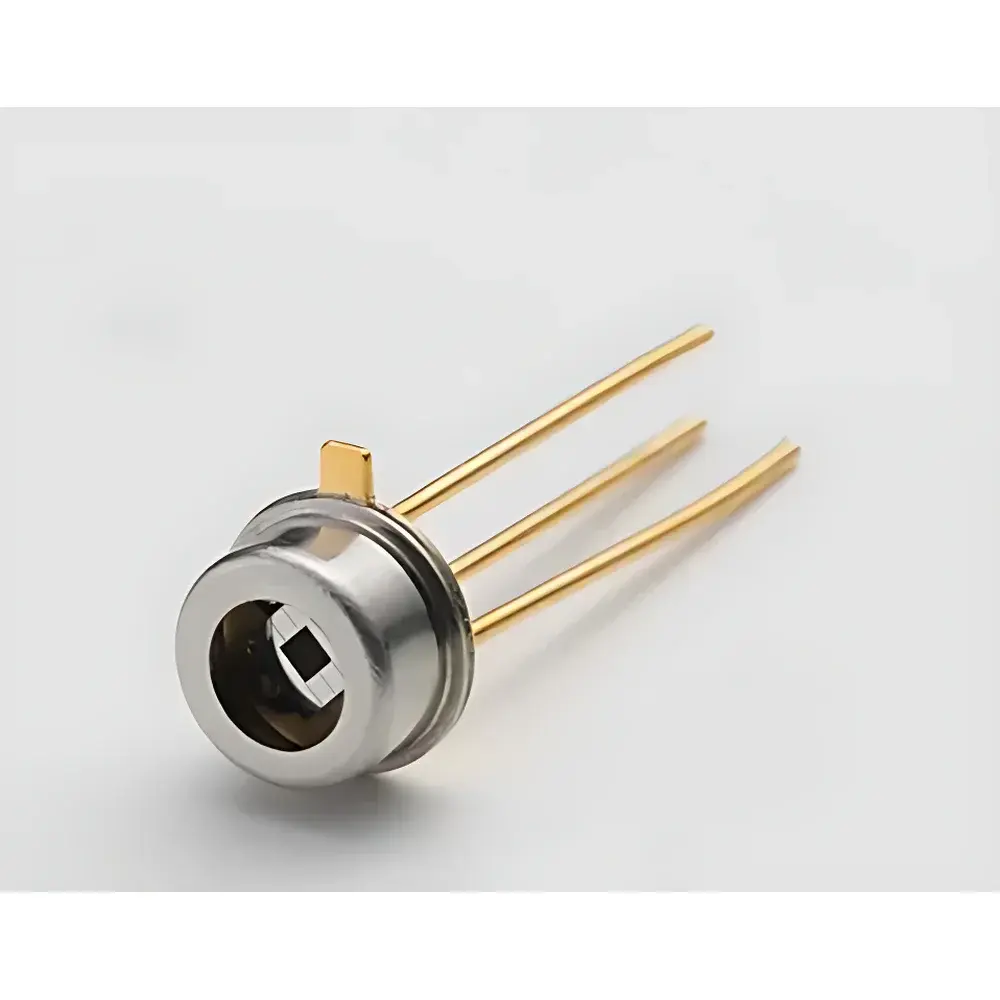
Axetris EMIRS50_AT06T_BT170 Infrared Emitter with Protective Cap
| Brand | Axetris |
|---|---|
| Origin | Switzerland |
| Model | EMIRS50_AT06T_BT170 |
| Housing | TO-46 metal can with protective cap |
| Emission Spectrum | 2–14 µm (blackbody-like) |
| Modulation Capability | Electrical (chopper-free) |
| Window Options | Sapphire or Barium Fluoride (BaF₂) |
| Typical Radiant Power | ~15 mW @ 5 V |
| Thermal Time Constant | < 10 ms |
| Operating Voltage Range | 3.3–6 V DC |
| Lifetime | > 50,000 hours (at rated conditions) |
| MEMS Structure | Silicon-based microheater with dielectric emissive coating |
Overview
The Axetris EMIRS50_AT06T_BT170 is a high-performance, surface-micromachined infrared emitter engineered for precision gas sensing applications requiring stable, broadband thermal radiation in the mid-infrared range (2–14 µm). Unlike conventional filament-based sources, this device leverages a MEMS-fabricated silicon substrate integrated with a thin-film resistive heater and optimized dielectric emissive layer—delivering true blackbody-like spectral behavior with exceptional emissivity (>0.95 across 3–12 µm). Its solid-state architecture eliminates mechanical choppers, enabling direct electrical modulation at frequencies up to several hundred hertz—critical for phase-sensitive detection schemes such as photoacoustic spectroscopy (PAS) and non-dispersive infrared (NDIR) measurement. The compact TO-46 hermetic package—available with optional protective cap and reflective cavity—ensures mechanical robustness and optical control, while compatible sapphire or BaF₂ windows maintain high transmission in key absorption bands of target analytes including CO₂, CO, CH₄, NH₃, NOₓ, SF₆, refrigerants, anesthetic agents, and volatile organic compounds.
Key Features
- Blackbody-equivalent emission spectrum (2–14 µm) with high spectral emissivity and low spectral deviation
- Fast thermal response (<10 ms time constant), supporting high-frequency modulation without external chopping
- Low power consumption (typically <120 mW at operating point), suitable for battery-powered and portable analyzers
- Long operational lifetime (>50,000 hours under continuous DC bias at nominal voltage)
- Hermetically sealed TO-46 metal-can package with integrated protective cap option for contamination resistance
- Optional internal reflector geometry to enhance forward-directed radiant intensity and optical coupling efficiency
- Window compatibility with sapphire (broadband UV–MIR transmission) or barium fluoride (extended IR transmission beyond 12 µm)
- MEMS-based design ensures batch consistency, mechanical stability, and immunity to vibration-induced drift
Sample Compatibility & Compliance
The EMIRS50_AT06T_BT170 is designed for integration into optical gas cells used in regulated analytical instrumentation. Its stable radiometric output supports compliance with international performance standards for gas analyzers, including ISO 8573-5 (compressed air purity), ASTM D6245 (CO₂ in indoor air), and EN 14624 (portable CO detectors). When deployed in medical-grade capnographs or anesthetic gas monitors, the source’s repeatability and low drift characteristics align with IEC 60601-2-56 requirements for physiological monitoring equipment. For industrial safety applications—including fixed or portable combustible gas detectors—the device meets intrinsic safety prerequisites when operated within specified voltage and current limits per IEC 60079-0 and ATEX Directive 2014/34/EU. No hazardous substances are used in fabrication; RoHS 2011/65/EU and REACH (EC 1907/2006) conformity is certified.
Software & Data Management
While the EMIRS50_AT06T_BT170 is a passive emitter requiring no embedded firmware, its analog drive interface enables seamless integration with digital signal processing platforms compliant with FDA 21 CFR Part 11 and EU Annex 11 guidelines. When paired with Axetris’ recommended driver circuits (e.g., constant-current or PWM-controlled bias), system-level calibration data—including spectral responsivity curves, temperature coefficient of resistance (TCR), and aging compensation coefficients—can be stored in instrument EEPROM with audit-trail-enabled write logging. OEMs implementing GLP/GMP workflows may embed traceable calibration identifiers into host firmware, linking each unit’s unique thermal signature to factory metrology records maintained per ISO/IEC 17025-accredited procedures.
Applications
- Medical Diagnostics: End-tidal CO₂ monitoring (capnography), anesthetic agent quantification (sevoflurane, isoflurane), respiratory rate analysis, and breath alcohol screening
- Automotive & Transportation: Onboard diagnostics (OBD-II) for exhaust gas composition, ignition interlock systems (IID), and cabin air quality sensors
- HVAC & Building Automation: Demand-controlled ventilation (DCV) via CO₂ feedback, refrigerant leak detection (R-134a, R-410A, R-32), and humidity-coupled air handling units
- Industrial Safety: Fixed and portable toxic/combustible gas detectors for petrochemical, semiconductor, and wastewater facilities
- Environmental Monitoring: Ambient air quality stations measuring NOₓ, SO₂, ozone precursors, and greenhouse gases (CH₄, N₂O)
- Research Instrumentation: Benchtop FTIR spectrometers with ATR accessories, PAS cell development, and multispectral gas imaging prototypes
FAQ
What is the typical operating voltage and current requirement?
The EMIRS50_AT06T_BT170 operates optimally between 3.3 V and 6 V DC, drawing 20–35 mA depending on setpoint temperature and window configuration.
Can this emitter be driven with pulsed or AC signals?
Yes—its low thermal mass allows reliable operation under square-wave or sinusoidal bias up to 500 Hz; however, duty cycle and peak voltage must remain within absolute maximum ratings to avoid accelerated aging.
Is there a calibrated spectral radiance dataset available?
Axetris provides NIST-traceable spectral irradiance data (measured at 5 V, 25 °C ambient) upon request for OEM integration and algorithm validation.
How does the protective cap affect optical throughput?
The cap reduces total radiant flux by ≤8% compared to the open-window variant but improves particulate resistance and long-term window cleanliness—critical for field-deployed analyzers.
Are custom window materials supported beyond sapphire and BaF₂?
Limited customization is possible for high-volume programs; ZnSe and CaF₂ options may be evaluated subject to MOQ and qualification testing.



