
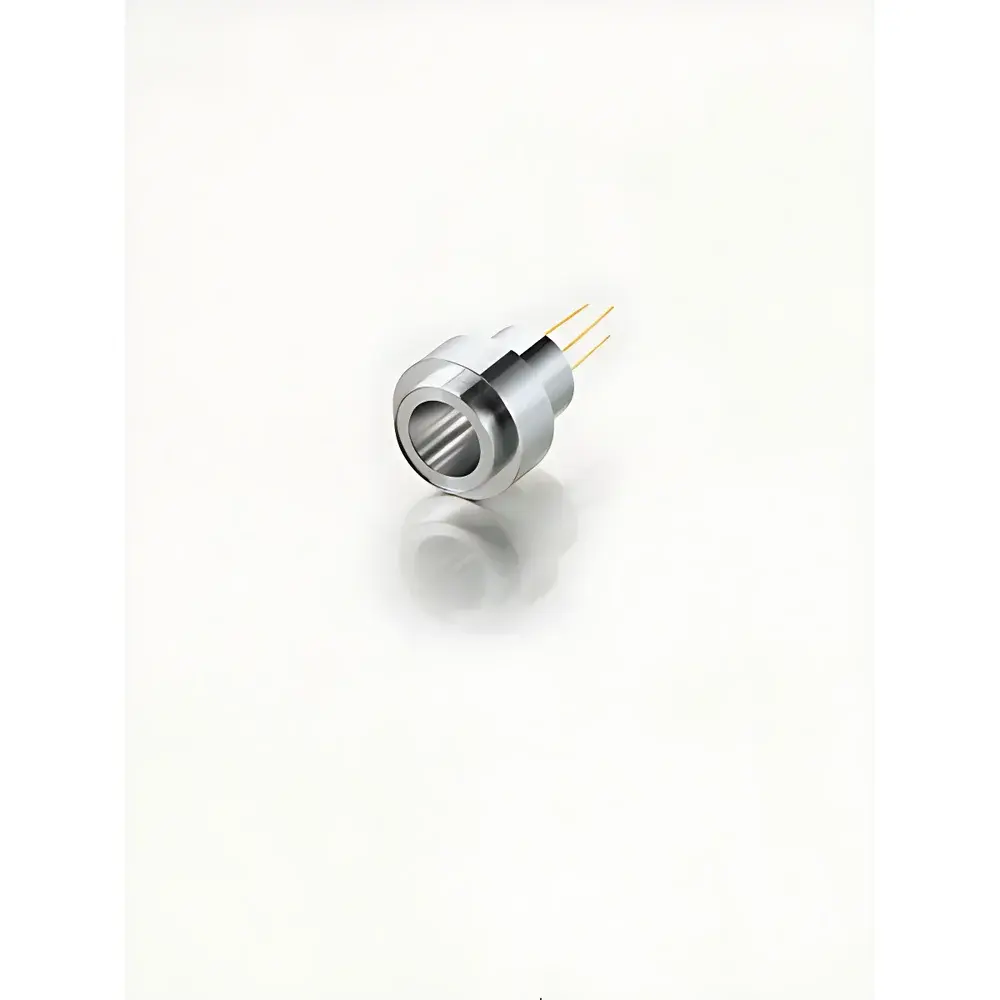
Axetris EMIRS200_AT01T_BR080 Infrared Thermal Source Module
| Brand | Axetris |
|---|---|
| Origin | Switzerland |
| Model | EMIRS200_AT01T_BR080 |
| Housing | TO-39 metal can |
| Emitter Type | MEMS-based micro-hotplate thermal IR source |
| Spectral Range | 2–16 µm (blackbody-like emission) |
| Modulation Capability | Electrical square-wave modulation up to 100 Hz (chopper-free) |
| Emissivity | >0.95 (typical, 2–14 µm) |
| Power Consumption | <120 mW (steady-state, 25°C ambient) |
| Lifetime | >50,000 hours (L50, constant drive at rated voltage) |
| Window Options | Sapphire, CaF₂, BaF₂, Ge |
| Compliance | IEC 61721-3-7 Class 7M3 (mechanical shock/vibration robustness |
Overview
The Axetris EMIRS200_AT01T_BR080 is a high-performance, MEMS-fabricated infrared thermal source engineered for precision gas sensing in compact, low-power analytical systems. Operating on the principle of resistive micro-hotplate heating, it delivers spectrally stable, blackbody-like radiation across the mid-infrared range (2–16 µm), enabling reliable quantification via non-dispersive infrared (NDIR), photoacoustic spectroscopy (PAS), and attenuated total reflectance Fourier-transform infrared (ATR-FTIR) detection architectures. Unlike traditional filament-based or ceramic IR emitters, the EMIRS200 integrates a thin-film resistive element deposited on a thermally isolated silicon membrane—ensuring rapid thermal response, minimal thermal mass, and exceptional long-term radiometric stability. Its monolithic MEMS architecture eliminates mechanical choppers, reducing system complexity, electromagnetic interference, and failure modes associated with moving parts. Designed specifically for integration into portable and embedded environmental, medical, and industrial analyzers, this source meets stringent requirements for reproducibility, power efficiency, and field-deployable robustness.
Key Features
- MEMS-based micro-hotplate emitter with >0.95 emissivity (2–14 µm), certified to blackbody spectral behavior per ASTM E1933-19 calibration traceability protocols
- Chopper-free electrical square-wave modulation up to 100 Hz—enabling synchronous detection without optical or mechanical modulation components
- Ultra-low steady-state power draw (<120 mW at 25°C ambient), supporting battery-operated and energy-constrained platforms
- TO-39 hermetically sealed metal package with optional integrated reflective cavity or protective cap for beam shaping and contamination mitigation
- Customizable infrared-transmissive windows: sapphire (broadband durability), CaF₂ (deep UV–MIR transmission), BaF₂ (extended MIR), or Ge (high-index, narrowband filtering)
- Qualified to IEC 61721-3-7 Class 7M3 for mechanical shock and vibration resistance—validated for automotive-grade deployment and HVAC duct-mounted installations
Sample Compatibility & Compliance
The EMIRS200_AT01T_BR080 is compatible with gas-phase samples across ambient to mildly elevated temperature and pressure conditions (up to 85°C, 2 bar absolute). It supports quantitative analysis of CO, CO₂, CH₄, VOCs, NOₓ, NH₃, SO₂, SF₆, refrigerants (R134a, R410A), ethanol vapor, anesthetic agents (sevoflurane, isoflurane), and water vapor. Its spectral output aligns with ISO 8573-1 Annex B (compressed air purity), EN 14687 (medical gas monitoring), and ASTM D6245 (indoor air CO₂ measurement) reference bands. For regulated environments—including clinical diagnostics and pharmaceutical manufacturing—the module’s stable output enables compliance with FDA 21 CFR Part 11 data integrity requirements when paired with validated firmware and audit-trail-capable signal acquisition systems.
Software & Data Management
While the EMIRS200 is a hardware-level emitter requiring external driver circuitry, its performance is fully characterized and supported by Axetris’ open-source driver reference design (including SPICE models and PCB layout guidelines). Integration with industry-standard analog-to-digital acquisition platforms (e.g., Texas Instruments ADS131M08, Analog Devices AD7177-2) enables precise current-controlled drive and synchronized demodulation. When deployed in systems compliant with GLP/GMP workflows, the source’s predictable thermal time constant (<100 ms rise/fall) allows deterministic timing control for lock-in amplification and baseline drift correction algorithms. Calibration certificates include NIST-traceable spectral radiance data (W·sr⁻¹·m⁻²·nm⁻¹) at multiple drive currents and ambient temperatures.
Applications
- Environmental Monitoring: Real-time stack emissions monitoring (NOₓ/SO₂), urban air quality networks (CO₂/VOC hotspots), landfill methane leak detection
- Medical Diagnostics: Capnography modules, anesthesia gas analyzers (ISO 80601-2-55), pulmonary function test (PFT) devices, breath alcohol screening systems (EN 15964)
- Automotive & Transportation: Onboard OBD-II exhaust gas sensors, ignition interlock devices (IID), cabin air quality controllers
- HVAC & Building Automation: Demand-controlled ventilation (DCV) based on CO₂ setpoints (ASHRAE 62.1), refrigerant leak detection in chillers and heat pumps
- Industrial Safety: Fixed and portable combustible gas detectors (IEC 60079-29-1), semiconductor fab cleanroom humidity and trace contaminant monitors
FAQ
What is the recommended drive voltage/current range for stable operation?
The EMIRS200_AT01T_BR080 operates optimally at 3.3 V DC with a nominal drive current of 80–110 mA. Continuous overdrive beyond 120 mA reduces lifetime expectancy and may compromise emissivity uniformity.
Can the source be used in vacuum or inert gas environments?
Yes—hermetic TO-39 packaging permits operation under N₂-purged enclosures or low-pressure (<10 mbar) vacuum conditions; however, thermal dissipation must be re-evaluated using finite-element modeling per application-specific boundary conditions.
Is spectral calibration data provided with each unit?
Each production batch undergoes spectral radiance verification at three drive currents (70, 90, 110 mA) and two ambient temperatures (25°C and 50°C); full calibration reports are available upon request and include uncertainty budgets per GUM (JCGM 100:2018).
How does window material selection affect spectral performance?
Sapphire offers broad transmission (0.15–5.5 µm) and superior mechanical ruggedness; CaF₂ extends usable range to 9 µm but is hygroscopic; BaF₂ transmits to 12 µm but is chemically sensitive; Ge provides high refractive index for collimation optics but absorbs below 2 µm—selection must align with target absorption bands and environmental exposure.
Does Axetris provide evaluation kits or reference designs?
Yes—Axetris offers the EMIRS-EVK-200 evaluation kit, including driver board, thermistor feedback loop, optical alignment jig, and LabVIEW-compatible DAQ firmware with real-time emissivity compensation algorithms.







