
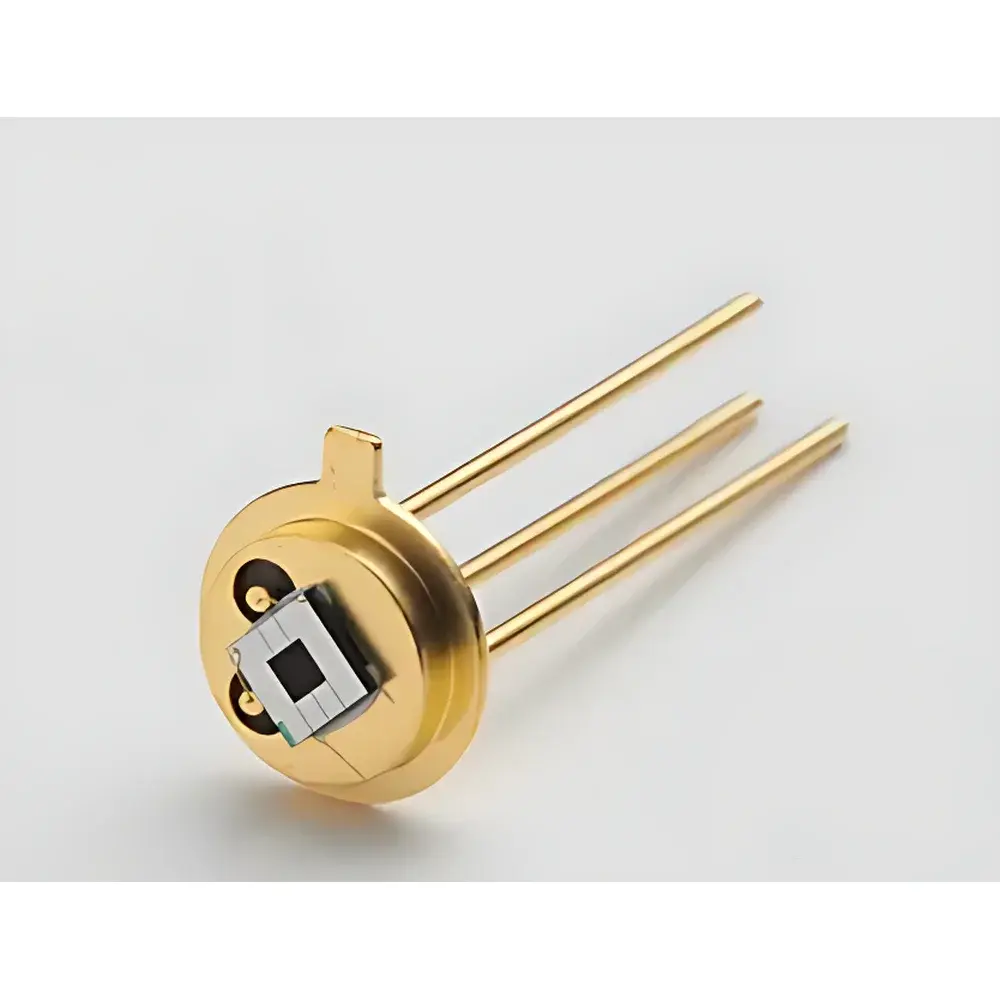
Axetris EMIRS50_AT06V Infrared Emitter (Without Protective Cap)
| Brand | Axetris |
|---|---|
| Origin | Switzerland |
| Model | EMIRS50_AT06V |
| Housing | TO-46 metal can |
| Emission Range | 2–14 µm (blackbody-like spectral profile) |
| Modulation Capability | Electrical (chopper-free, DC–>100 Hz typical) |
| Substrate | Silicon MEMS platform with thin-film resistive element |
| Window Options | Sapphire or Barium Fluoride (BaF₂) |
| Power Consumption | <150 mW (typ. at 5 V, 25 °C ambient) |
| Lifetime | >50,000 hours (L₅₀ at rated drive conditions) |
| Radiation Efficiency | >90% (vs. ideal blackbody in 3–12 µm band) |
| Stability | <0.5% drift over 1,000 h (constant-current operation) |
Overview
The Axetris EMIRS50_AT06V is a high-performance, silicon-based microelectromechanical systems (MEMS) infrared emitter engineered for precision gas sensing applications requiring stable, spectrally broad thermal radiation in the mid-infrared range (2–14 µm). Unlike traditional wire-filament or ceramic emitters, the EMIRS series leverages a monolithic MEMS architecture: a thin-film resistive heating element is deposited and patterned directly onto a thermally isolated silicon membrane, then hermetically sealed within a compact TO-46 metal-can package. This design enables true blackbody-like emissivity (>0.90 across 3–12 µm), rapid thermal response (<10 ms rise time), and exceptional long-term radiometric stability—critical for quantitative NDIR (Non-Dispersive Infrared), PAS (Photoacoustic Spectroscopy), and ATR-FTIR (Attenuated Total Reflection Fourier Transform Infrared) measurement systems. Its chopper-free electrical modulation capability eliminates mechanical moving parts, reducing system complexity, vibration sensitivity, and failure modes—making it ideal for embedded, battery-powered, and safety-critical instrumentation.
Key Features
- MEMS-integrated thermal emitter with silicon substrate and dielectric-passivated resistive layer
- Blackbody-equivalent spectral emission from 2 to 14 µm, optimized for fundamental vibrational absorption bands of key gases (CO, CO₂, CH₄, NH₃, NOₓ, SF₆, VOCs, anesthetic agents, ethanol)
- Electrical amplitude modulation up to 100 Hz without external chopper wheel—enabling synchronous detection and noise rejection in low-signal environments
- Ultra-low power consumption: typically <150 mW at 5 V bias under standard operating conditions, supporting portable and energy-constrained designs
- Proven lifetime exceeding 50,000 hours (L₅₀ criterion) under continuous DC or modulated drive, validated per IEC 60747-14 reliability protocols
- Hermetic TO-46 metal-can packaging compatible with industry-standard PCB mounting and reflow soldering
- Optional optical interfaces: AR-coated sapphire window (transmission >85% from 0.15–5.5 µm) or BaF₂ window (transmission >90% from 0.2–12 µm), both vacuum-compatible and chemically inert
Sample Compatibility & Compliance
The EMIRS50_AT06V is designed for integration into certified gas analyzers used in medical devices (e.g., capnographs, anesthetic gas monitors compliant with ISO 80601-2-56), automotive onboard diagnostics (OBD-II, ignition interlock systems per SAE J2716), HVAC demand-controlled ventilation (DCV) controllers meeting ASHRAE Standard 62.1, and industrial safety instruments (IEC 60079-29-1 for combustible gas detection). Its radiation profile aligns with ISO/IEC 17025 traceable calibration practices for NDIR transducers. The device complies with RoHS Directive 2011/65/EU and REACH Regulation (EC) No. 1907/2006. Full documentation—including material declarations, aging test reports, and thermal transient characterization—is supplied to support FDA 21 CFR Part 820 design history file (DHF) and IEC 62304 software lifecycle requirements where applicable.
Software & Data Management
While the EMIRS50_AT06V is a passive emitter requiring external driver circuitry, Axetris provides comprehensive application support including SPICE models, thermal simulation templates (ANSYS Icepak-ready), and reference schematics for constant-current drivers with temperature compensation. For systems implementing digital control (e.g., via I²C or SPI DACs), the emitter’s linear resistance–temperature relationship (α ≈ +0.25 %/°C) enables closed-loop intensity stabilization using integrated thermistor feedback. All performance data—including spectral radiance curves, modulation transfer functions, and lifetime acceleration test results—are delivered in machine-readable CSV and MATLAB .mat formats, facilitating integration into automated calibration workflows compliant with ISO/IEC 17025 clause 5.10.2 (data management).
Applications
- Medical Diagnostics: End-tidal CO₂ monitoring, anesthetic vapor concentration analysis, breath ethanol screening (EN 15964:2011), and pulmonary function testing
- Automotive Safety: On-vehicle alcohol interlock systems (SAE J2716 Level 2), exhaust gas recirculation (EGR) composition monitoring, cabin air quality sensors
- HVAC & Building Automation: Demand-controlled ventilation based on CO₂ setpoints (ASHRAE 62.1–2022), refrigerant leak detection (R-134a, R-1234yf, R-744), and indoor air quality (IAQ) multi-gas platforms
- Industrial Process & Safety: Fixed and portable gas detectors for toxic (NH₃, SO₂) and flammable (CH₄, C₃H₈) species; fermentation and incubator atmosphere control; semiconductor fab cleanroom monitoring
- Environmental Monitoring: Ambient air quality stations measuring NOₓ, O₃ precursors, and greenhouse gases (CO₂, CH₄) via open-path or extractive NDIR configurations
FAQ
Does the EMIRS50_AT06V require a mechanical chopper for AC-coupled detection?
No. Its inherent thermal mass and MEMS architecture enable direct electrical modulation up to 100 Hz, eliminating the need for external chopper wheels and associated alignment, wear, and vibration issues.
What is the recommended drive configuration for optimal stability?
Constant-current drive with real-time temperature compensation (using an on-board or adjacent thermistor) is strongly recommended to maintain radiometric consistency across ambient temperature shifts.
Can the emitter be operated continuously at maximum rated power?
Yes—lifetime validation testing was conducted under continuous DC operation at nominal voltage. However, pulsed or modulated operation further extends operational longevity and reduces thermal stress on optical windows.
Is the TO-46 package compatible with automated optical alignment systems?
Yes. The TO-46’s standardized pinout, planar base, and tight dimensional tolerances (±25 µm) support pick-and-place placement and active alignment using vision-guided bonders common in high-volume sensor module assembly.
Are spectral calibration certificates available?
Yes. Axetris provides NIST-traceable spectral radiance calibration reports (per ISO/IEC 17025 accredited laboratory) upon request, covering absolute irradiance, bandwidth, and temperature-dependent peak shift behavior.




