
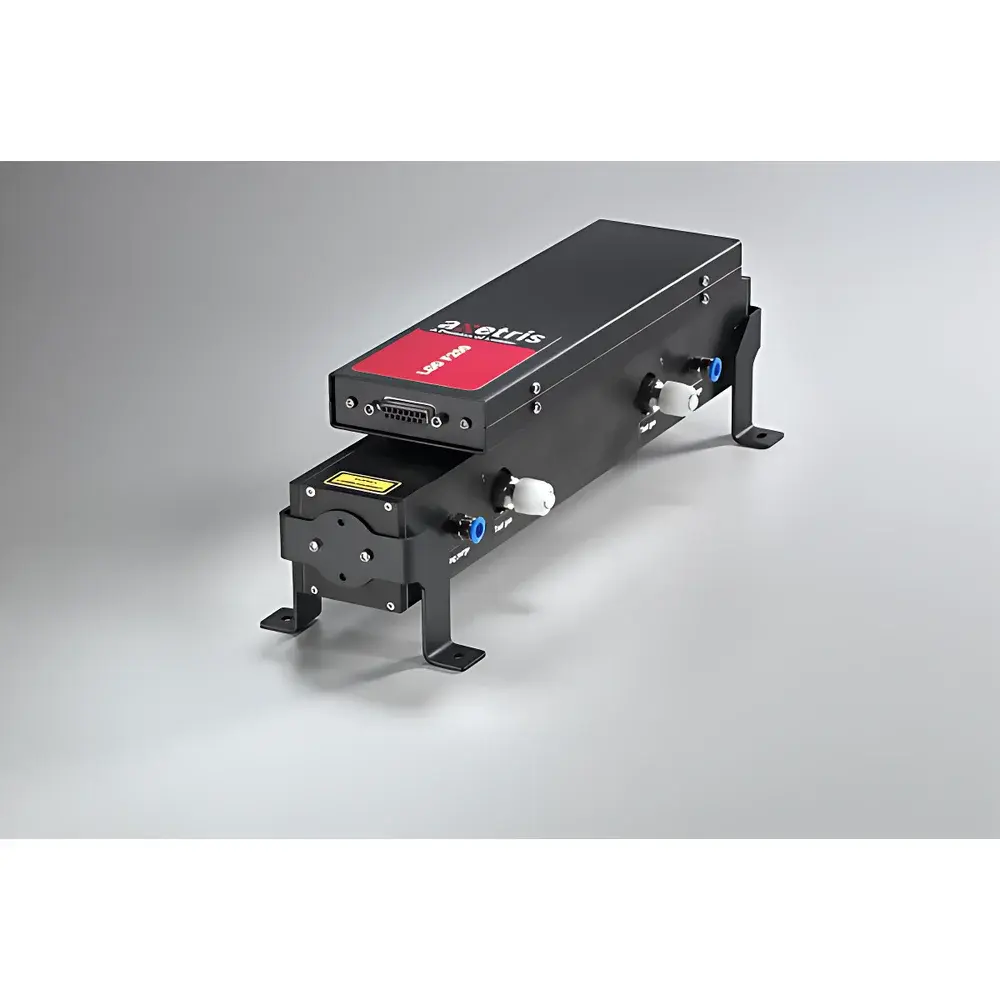
Axetris LGD Series Tunable Diode Laser Gas Detection Module
| Brand | Axetris |
|---|---|
| Origin | Switzerland |
| Model | LGD Series |
| Detection Principle | Tunable Diode Laser Absorption Spectroscopy (TDLAS) |
| Target Gases | NH₃, CH₄, H₂O, CO₂, HCl, HF, O₂ |
| Design | OEM-ready modular optical sensor |
| Operating Temperature Range (Heated Option) | Up to 190 °C |
| Measurement Type | Non-contact, in-situ, continuous |
| Cross-Interference | Negligible due to spectral selectivity |
| Calibration | Factory-calibrated |
| Compliance Context | Designed for integration into systems compliant with IEC 61508 (SIL2-capable architectures), EN 14181 (QAL3), and EPA Method 205/207 (for extractive TDLAS configurations) |
Overview
The Axetris LGD Series is a compact, high-performance tunable diode laser (TDL) gas detection module engineered for original equipment manufacturers (OEMs) requiring robust, maintenance-free, and application-specific gas sensing solutions. Built upon the physical principle of tunable diode laser absorption spectroscopy (TDLAS), the module performs quantitative, real-time measurement of trace and percent-level concentrations of target gases—including NH₃, CH₄, H₂O, CO₂, HCl, HF, and O₂—by analyzing wavelength-specific absorption features in the near-infrared (NIR) and mid-infrared (MIR) spectral regions. Unlike electrochemical or metal-oxide semiconductor sensors, TDLAS is inherently optical and non-contact: it measures gas concentration via light attenuation along an open or enclosed optical path without chemical consumption or surface fouling. This enables exceptional long-term stability, sub-second response times (τ₉₀ < 1 s typical), and immunity to cross-sensitivity from background gases—eliminating the need for reference cells, frequent recalibration, or complex compensation algorithms.
Key Features
- OEM-optimized modular architecture: Standardized mechanical footprint (e.g., 120 × 60 × 35 mm), 24 V DC power input, and digital (UART/I²C) and analog (4–20 mA, 0–10 V) output interfaces simplify integration into analyzers, process controllers, and distributed monitoring systems.
- Thermally stabilized laser and detector assembly: Ensures wavelength accuracy and signal reproducibility across ambient temperatures from −20 °C to +60 °C; optional high-temperature variant supports continuous operation at probe tip temperatures up to 190 °C for hot-stack or reactor monitoring.
- Optical path flexibility: Compatible with both extractive (sample cell-based) and in-situ (open-path or probe-mounted) configurations; path lengths configurable from 10 cm to 10 m depending on sensitivity requirements and gas concentration range.
- Embedded digital signal processing: Onboard microcontroller executes real-time harmonic detection (2f-wavelength modulation), baseline correction, and temperature/pressure compensation—delivering calibrated concentration values directly via serial interface.
- Zero-drift performance: Factory calibration traceable to NIST-certified standards; no field recalibration required under normal operating conditions—reducing lifecycle cost and operational downtime.
Sample Compatibility & Compliance
The LGD module is suitable for gaseous samples in industrial, environmental, and safety-critical applications where reliability, repeatability, and regulatory alignment are essential. It operates effectively in corrosive, humid, or particulate-laden streams when paired with appropriate sample conditioning (e.g., heated filter housings, PTFE-lined sampling lines). While the module itself is not CE-marked as a standalone instrument, it is designed to support final system compliance with key international frameworks: IEC 61508 (functional safety for SIL2 integration), EN 14181 (QAL3 verification for continuous emission monitoring systems), and U.S. EPA Performance Specifications (PS-15 for NH₃, PS-18 for CO₂ in combustion sources). For pharmaceutical or food-grade environments, the optical head may be constructed with electropolished 316L stainless steel and certified per FDA 21 CFR Part 11 when embedded in validated software-controlled platforms.
Software & Data Management
Axetris provides the LGD Evaluation Kit (including GUI software and API libraries for Windows/Linux) to accelerate prototyping and system validation. The module supports ASCII-based command protocols and Modbus RTU over RS-485 for interoperability with SCADA, DCS, and IoT edge gateways. Raw spectral data (absorbance vs. wavelength) and processed concentration outputs are timestamped and logged with metadata (temperature, pressure, laser current). When integrated into regulated environments, full audit trails—including configuration changes, firmware updates, and alarm events—can be implemented via host-system logging aligned with ALCOA+ (Attributable, Legible, Contemporaneous, Original, Accurate, Complete, Consistent, Enduring, Available) principles per GxP guidance.
Applications
- Process Control: Real-time NH₃ slip monitoring in selective catalytic reduction (SCR) systems; CH₄ and CO₂ feedback in anaerobic digesters; O₂ trim control in combustion optimization.
- Emission Monitoring: Continuous stack monitoring for HCl and HF in waste incineration; CH₄ quantification at landfill biogas flares per ISO 14064-1.
- Environmental Surveillance: Ambient NH₃ mapping near livestock facilities; CO₂ and CH₄ flux analysis in eddy covariance towers; H₂O vapor profiling in climate-controlled agricultural chambers.
- Safety & Leak Detection: Rapid-response HF/HCl leak detection in semiconductor fabs; refrigerant (e.g., R-134a surrogate CH₄) monitoring in HVAC maintenance zones.
FAQ
Is the LGD module certified for hazardous area use (e.g., ATEX or IECEx)?
No—the LGD module is not intrinsically safe or explosion-proof certified. It must be installed in Zone 2/Class I Div 2 areas or housed within certified enclosures when deployed in potentially explosive atmospheres.
Can multiple gases be measured simultaneously with one module?
Each LGD module is configured for a single target gas during manufacturing, based on laser wavelength selection and optical filtering. Multi-gas capability requires parallel modules or sequential scanning variants (e.g., LGD-2F series with multi-line lasers).
What is the typical detection limit for NH₃ in extractive mode?
With a 1-meter path length and standard configuration, the limit of detection (LOD) is ≤ 0.5 ppm·m (1σ, 1 s averaging); LOD improves linearly with path length and averaging time.
Does the module require periodic optical alignment or cleaning?
No—hermetically sealed optical bench design ensures permanent alignment; anti-reflective coated windows resist condensation and particulate deposition; routine maintenance is limited to external window inspection per site-specific SOPs.
How is temperature and pressure compensation handled?
Internal Pt100 sensor and absolute pressure transducer feed real-time data to the onboard processor, which applies HITRAN-based line broadening and intensity correction models per measured gas species.
Related Products







