
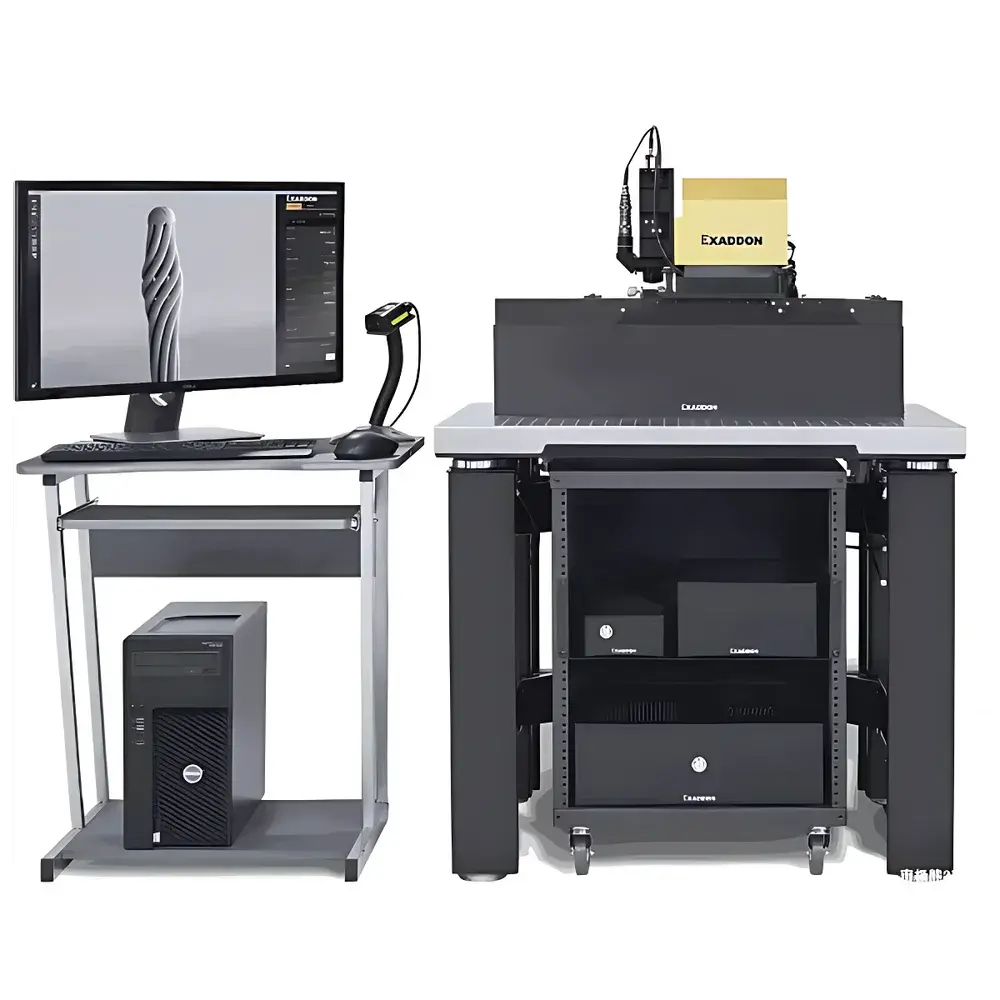
Exaddon CERES Electrochemical Micro- and Nano-Scale 3D Metal Printer
| Brand | Exaddon |
|---|---|
| Origin | Switzerland |
| Model | CERES |
| Printing Resolution | Up to 1 µm (typical) |
| Printable Materials | Copper, Gold, Silver, Platinum, Nickel, and other electrodepositable metals |
| Operating Environment | Ambient laboratory conditions (no vacuum or inert gas required) |
| Technology Principle | Localized electrochemical deposition (LECD) with microfluidic ion delivery and nanoscale electrode positioning |
Overview
The Exaddon CERES system is a benchtop electrochemical micro- and nano-scale 3D metal printer engineered for precision additive micro-manufacturing (µAM). Unlike conventional laser- or powder-based metal 3D printing technologies, CERES operates on the principle of localized electrochemical deposition (LECD): a microfluidic capillary delivers metal-ion-containing electrolyte directly onto a conductive substrate, while a nanoscale working electrode precisely controls reduction kinetics at the interface. This enables true voxel-level control—down to sub-micrometer lateral and vertical resolution—without thermal stress, phase transformation, or support structure requirements. The system is designed for research laboratories and advanced prototyping facilities where functional metallic microstructures—such as freestanding coils, interconnects, microelectrodes, and metamaterial unit cells—must be fabricated with high fidelity, material purity, and structural integrity.
Key Features
- Sub-micrometer resolution: Achieves consistent feature sizes from 1 µm to >1000 µm in both 2D and 3D configurations, validated via SEM metrology and profilometry.
- Multi-material capability: Supports electrodepositable metals including Cu, Au, Ag, Pt, Ni, and their alloys—each deposited in near-pure form (>99.5% wt) without post-processing sintering or annealing.
- Ambient operation: Functions under standard lab conditions (20–25 °C, 40–60% RH); no vacuum chamber, inert gas purge, or high-power lasers required—reducing infrastructure overhead and safety constraints.
- Integrated motion control: High-stiffness XYZ nanopositioning stage (closed-loop piezoelectric actuators) with <50 nm repeatability and real-time tip-substrate distance regulation.
- Modular microfluidics: Disposable or reusable capillaries with integrated reference and counter electrodes; compatible with custom electrolytes and colloidal nanoparticle suspensions.
- Open API architecture: Enables integration with external automation platforms (e.g., LabVIEW, Python-controlled stages, or synchrotron beamline environments).
Sample Compatibility & Compliance
CERES accommodates a broad range of conductive substrates—including Si/SiO₂ wafers, ITO/glass, flexible PI films, and pre-patterned PCBs—without requiring surface metallization or adhesion layers. Substrates up to 100 mm in diameter can be mounted using standard kinematic chucks. All hardware and firmware comply with CE marking directives (EMC 2014/30/EU, LVD 2014/35/EU), and the system meets ISO 14001 environmental management standards for lab instrumentation. For regulated environments, audit-ready logging (timestamped process parameters, electrode potential, current, flow rate) supports GLP and GMP-aligned workflows, and raw data export formats (HDF5, CSV, TIFF stacks) are compatible with FDA 21 CFR Part 11-compliant document management systems when deployed with appropriate institutional validation protocols.
Software & Data Management
The CERES Control Suite provides a unified graphical interface for design import (STL, G-code, SVG), path planning, real-time electrochemical monitoring (potentiostatic/galvanostatic modes), and in situ feedback adjustment. All print jobs generate traceable metadata logs—including applied potential waveform, deposition charge, capillary position history, and environmental sensor readings (temperature, humidity). Data is stored locally in vendor-neutral HDF5 containers, enabling direct ingestion into MATLAB, Python (via h5py), or commercial CAE tools for post-fabrication simulation. Version-controlled project files support reproducibility across multi-user labs, and optional cloud synchronization (with on-premise deployment mode) facilitates cross-site collaboration while maintaining data sovereignty.
Applications
- Microelectronics: Fabrication of 3D interconnects, embedded antennas, and reconfigurable RF components on IC packages or flexible substrates.
- Electrochemical sensors: Direct-write of porous Au or Pt microelectrode arrays with tunable surface area and diffusion geometry.
- Micro-optics & plasmonics: Freeform gold nanoantennas, split-ring resonators, and gradient-index metasurfaces with sub-wavelength feature control.
- MEMS & microactuators: Stress-engineered bimetallic cantilevers and self-assembling microcoils for soft robotics interfaces.
- Biomedical devices: Biocompatible Pt-Ir neural probes, microneedle arrays, and scaffold-free vascular graft segments.
- Fundamental electrochemistry: In situ studies of nucleation overpotential, grain growth kinetics, and mass transport limitations at confined microelectrode interfaces.
FAQ
What electrochemical techniques does CERES support?
CERES operates in potentiostatic, galvanostatic, and pulsed electrodeposition modes—with programmable waveform generation (square, triangular, ramp) and real-time current/potential feedback for adaptive control.
Can CERES print non-metallic or composite structures?
While primarily optimized for pure metals, CERES has demonstrated co-deposition of metal–nanoparticle composites (e.g., Au–Fe₃O₄) using stabilized colloidal electrolytes; polymer or ceramic printing is not supported.
Is training and application support available outside Switzerland?
Yes—Exaddon-certified application engineers provide remote and on-site training, method development assistance, and failure analysis services globally through authorized partners, including Yixin Tech (China regional representative).
How is calibration maintained over time?
The system includes automated daily self-calibration routines for stage positioning, capillary alignment, and electrochemical baseline drift correction—traceable to NIST-traceable reference electrodes.
What file formats are accepted for print job definition?
Native support for STL, G-code (ISO 6983), SVG, and DXF; parametric designs generated in Python (via CadQuery) or MATLAB can be exported directly to CERES-compatible path scripts.



