
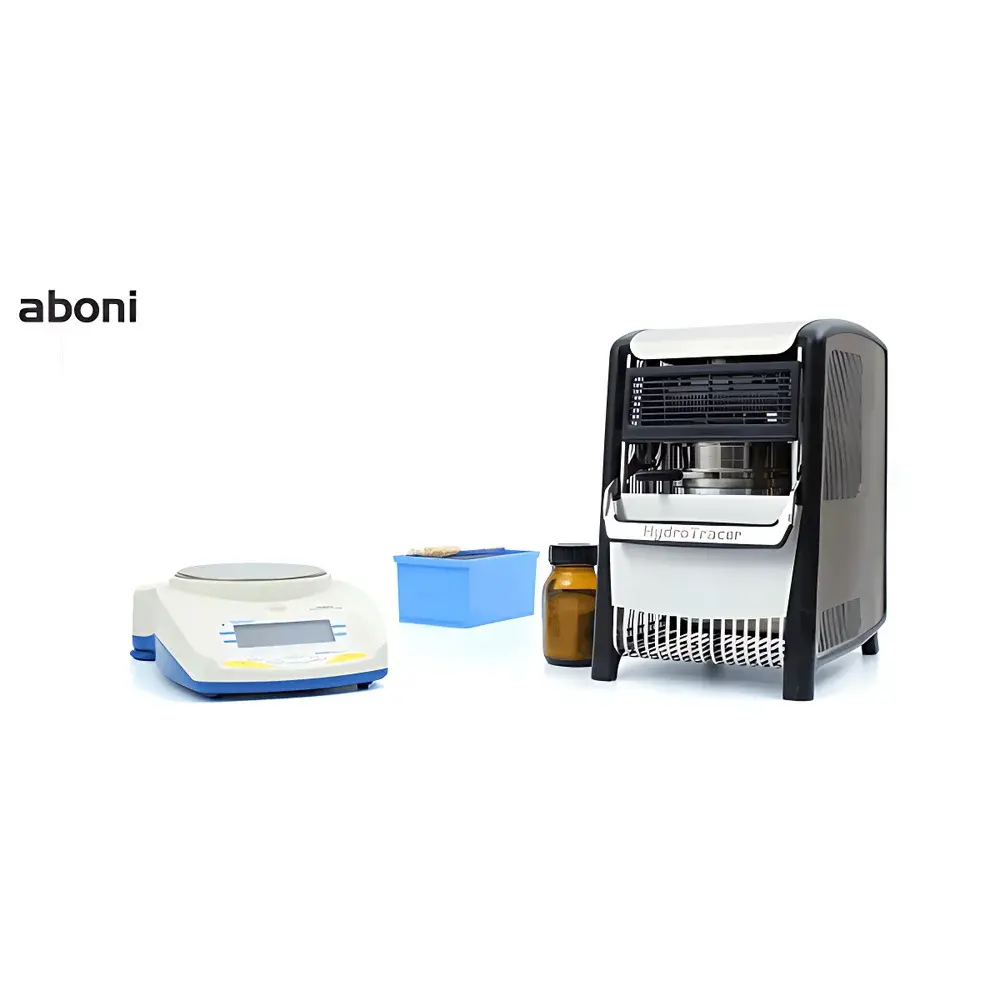
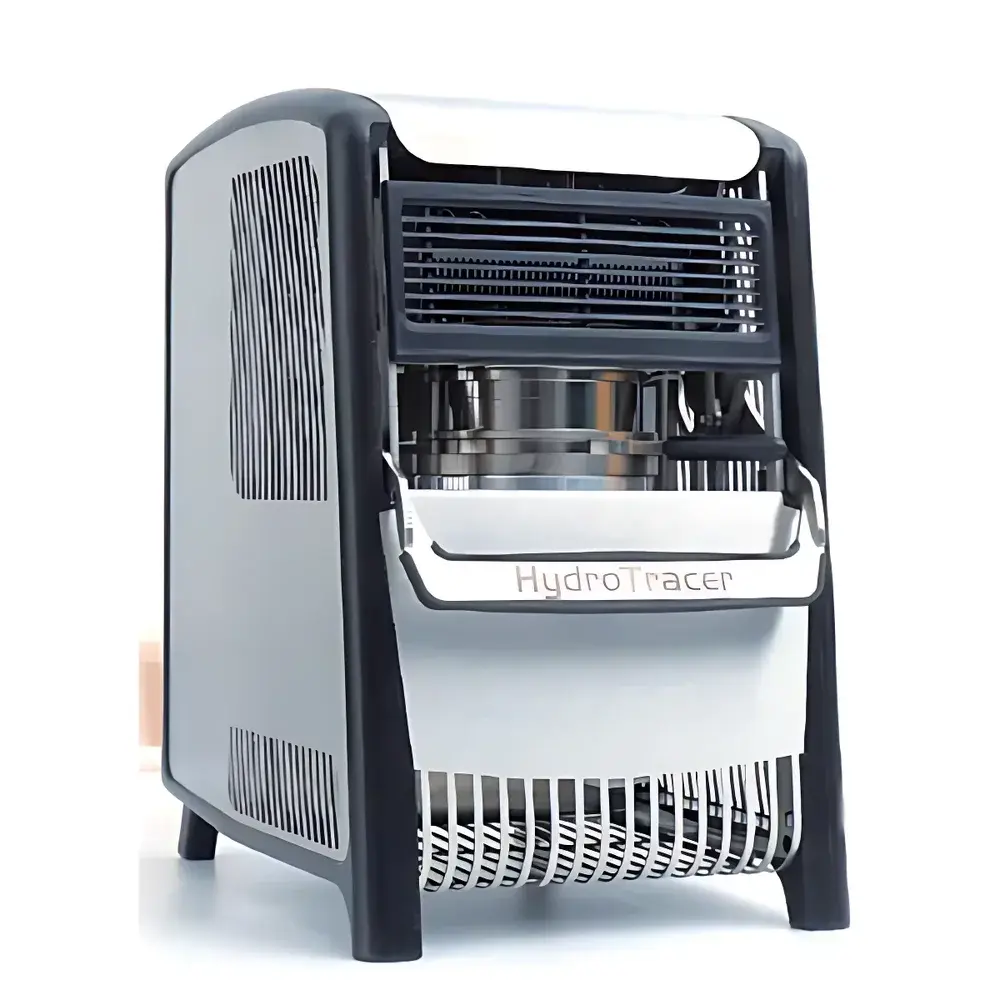
HydroTracer HT3 Plastic Pellet Moisture Analyzer by aboni
| Brand | aboni |
|---|---|
| Origin | Germany |
| Model | HT3 |
| Measurement Principle | Calcium Hydride Reaction (Direct Absolute Moisture Quantification) |
| Resolution | 0.01 mg / 1 ppm / 0.0001 % H₂O |
| Sample Type Compatibility | Plastic pellets, granules, powders, and molded polymer components |
| Interface | USB-connected to Windows PC |
| Output | Auto-generated PDF report with timestamp, sample ID, moisture content, and operator metadata |
| Calibration | Calibration-free across polymer types |
| Vacuum Requirement | None |
Overview
The HydroTracer HT3 Plastic Pellet Moisture Analyzer is an industrial-grade, direct-quantification moisture measurement system engineered for precision and reproducibility in thermoplastic and elastomeric material processing environments. Unlike gravimetric loss-on-drying (LOD), capacitance, or near-infrared (NIR) methods—which infer moisture indirectly through physical property changes—the HT3 employs the calcium hydride (CaH₂) chemical reaction principle: water reacts stoichiometrically with CaH₂ to produce hydrogen gas, the volume of which is measured volumetrically under controlled temperature and pressure conditions. This absolute, non-destructive, and matrix-independent method delivers true mass-based moisture concentration (mg H₂O/g sample) without reliance on empirical calibration curves or material-specific correction factors. Designed specifically for the rubber and plastic industry, the HT3 meets the stringent requirements of ISO 15512 (plastics—determination of water content), ASTM D6980 (standard test method for moisture in plastics by calcium hydride technique), and supports GLP-compliant documentation workflows.
Key Features
- Direct absolute moisture quantification via calcium hydride reaction—no calibration required across polymer families including PET, PA6/66, PC, PBT, ABS, TPU, and silicone elastomers
- High-resolution detection limit of 0.01 mg absolute water mass, equivalent to 1 ppm or 0.0001 wt% H₂O in standard 10 g samples
- No vacuum chamber or inert gas purge needed—enables rapid analysis (<8 min per test) in ambient laboratory or production-floor settings
- Low reagent consumption: ≤0.2 g CaH₂ per measurement, minimizing operational cost and hazardous waste generation
- USB-hosted control architecture—fully integrated with Windows-based HydroTracer Control Software for guided workflow execution
- Robust mechanical design with IP54-rated enclosure, optimized for use in injection molding, extrusion, and compounding facilities
Sample Compatibility & Compliance
The HT3 accommodates a broad spectrum of solid polymeric materials without modification: virgin and recycled plastic pellets (2–8 mm diameter), ground flakes, fine powders (e.g., PTFE, nylon fines), and small molded parts (≤50 g, max dimension 40 mm). Its sealed reaction vessel prevents atmospheric moisture ingress during analysis, ensuring integrity for hygroscopic polymers such as polyamides and polyacrylates. The system complies with ISO/IEC 17025 traceability requirements when used with certified reference standards (e.g., NIST SRM 2890). It supports audit-ready data handling per FDA 21 CFR Part 11 (electronic records/signatures) when configured with user access controls, audit trail logging, and electronic signature capability in software version 3.2+. All measurements adhere to the fundamental metrological principles outlined in VDI/VDE 2646 Part 2 for moisture analyzers.
Software & Data Management
HydroTracer Control Software (v3.2+, Windows 10/11) provides a validated, wizard-driven interface that enforces procedural consistency—from sample weighing and vial sealing to gas volume integration and result calculation. Each measurement session automatically captures instrument serial number, environmental temperature/humidity (via optional external sensor input), operator ID, sample identifier, and raw hydrogen gas volume data. Final results are compiled into a tamper-evident PDF report compliant with ISO 17025 clause 7.8.2, including uncertainty estimation per GUM (JCGM 100:2008). Data export options include CSV (for LIMS integration), XML (for ERP systems), and encrypted SQLite database backups. Audit trails record all user actions—including parameter edits, report deletions, or software updates—with timestamps and digital signatures.
Applications
- Pre-drying verification of hygroscopic resins prior to injection molding or extrusion
- Quality control release testing for PET bottle preforms and engineering plastic components
- Moisture mapping across batch lots to support statistical process control (SPC)
- Root cause analysis of surface defects (splay, silver streaks) linked to residual moisture
- Validation of desiccant dryer performance and dew point monitoring correlation
- Research and development of moisture-sensitive polymer blends and biodegradable compounds (e.g., PLA, PHA)
FAQ
Does the HT3 require periodic recalibration for different polymer types?
No. The calcium hydride reaction is chemically specific to water and independent of polymer matrix effects—eliminating the need for material-specific calibration.
Can the HT3 measure moisture in filled or reinforced plastics (e.g., glass-fiber PA6)?
Yes. Fillers, pigments, and reinforcements do not interfere with the H₂ gas evolution reaction, provided the sample is homogeneously ground to ensure representative sub-sampling.
Is method validation support available for pharmaceutical or automotive Tier-1 supplier audits?
Yes. aboni provides IQ/OQ documentation templates, method transfer protocols, and third-party validation assistance aligned with ICH Q2(R2) and AIAG CQI-9 guidelines.
What maintenance intervals are recommended for routine operation?
Annual verification of gas-tightness, pressure transducer linearity, and temperature sensor accuracy is advised; no routine optical or electronic recalibration is required.
How does the HT3 compare to Karl Fischer titration for plastic moisture analysis?
While Karl Fischer offers comparable accuracy, it requires solvent dissolution, skilled operation, and generates halogenated waste. The HT3 provides faster, safer, and more robust analysis for solid thermoplastics without sample dissolution or hazardous reagents.





