
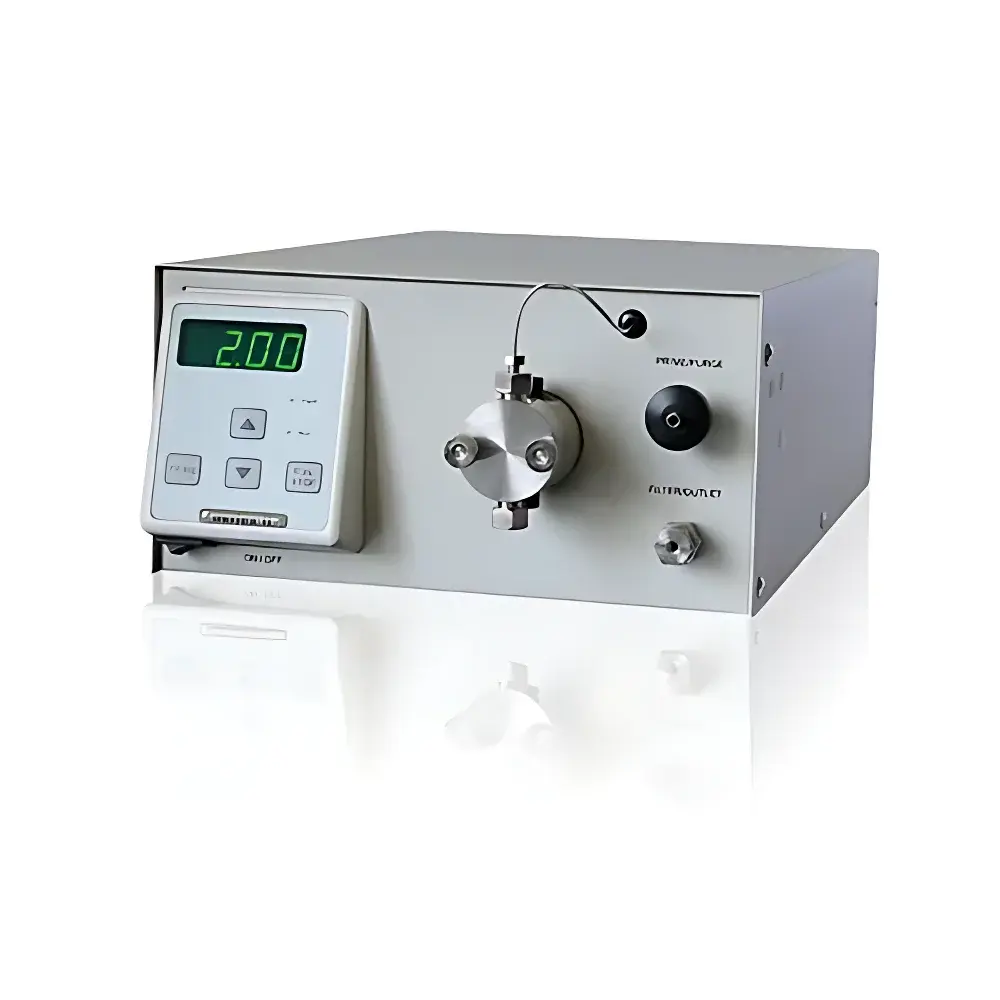
SSI Series II High-Pressure Constant Flow Pump
| Brand | SSI |
|---|---|
| Model | Series II |
| Flow Rate | 0.001–5 mL/min |
| Maximum Pressure | 6000 psi (stainless steel), 5000 psi (PEEK) |
| Accuracy | ±2% |
| Flow Precision | ≤0.2% RSD |
| Pulse Damping | Integrated low-dead-volume damper |
| Auto-Cleaning | On-column solvent-assisted seal flush |
| Materials | 316 stainless steel or PEEK (biocompatible) |
| Communication | RS232 digital interface |
| Power | 115/230 V, 50/60 Hz |
| Dimensions | 140 H × 254 W × 432 D mm |
| Weight | 11 kg |
Overview
The SSI Series II High-Pressure Constant Flow Pump is an engineered solution for precision liquid delivery in analytical and semi-preparative chromatography systems. Based on a single-piston positive displacement architecture, it delivers stable, pulse-free flow across its full operating range—achieved through integrated low-dead-volume pulsation damping and rapid solvent fill technology. Unlike dual-piston or cam-driven designs, the Series II leverages digitally controlled stepper motor actuation to ensure repeatable volumetric displacement with minimal mechanical hysteresis. Its pressure capability—up to 6000 psi with 316 stainless steel fluidic path components—supports modern UHPLC and high-resolution LC applications requiring robust backpressure tolerance. The pump operates within strict ISO/IEC 17025-aligned performance envelopes: flow accuracy of ±2% and repeatability of ≤0.2% RSD under defined temperature and viscosity conditions (e.g., water at 25°C, 1 cP). Designed for continuous unattended operation in regulated environments, it meets core functional requirements for GLP-compliant method transfer and routine QC workflows.
Key Features
- Single-piston architecture with digitally synchronized stepper motor control for deterministic flow generation and reduced wear-induced drift
- Integrated low-dead-volume pulsation damper ensuring <0.1% residual ripple amplitude across 0.001–5 mL/min range
- On-column auto-cleaning mechanism: utilizes mobile phase flow to flush column-side seal interfaces during idle cycles, extending seal service life by up to 3× versus conventional manual maintenance protocols
- Tool-free seal replacement system—completed in under 5 minutes without disassembly of pump head or recalibration
- One-touch solvent exchange: automated priming, degassing, and line purging via front-panel command or RS232-triggered sequence
- Dual-material fluid path option: electropolished 316 stainless steel for general-purpose organic/aqueous solvents; PEEK for metal-sensitive applications including biomolecule analysis, chelating buffers, and trace-metal quantification
- Factory-configurable pressure limits and flow ramp profiles to prevent column overpressure during gradient initiation or method switching
Sample Compatibility & Compliance
The Series II accommodates a broad spectrum of mobile phases—including acetonitrile/water gradients, TFA-containing peptides eluents, and high-salt aqueous buffers—without corrosion or leaching when configured with appropriate wetted materials. PEEK-path variants comply with USP Class VI biocompatibility standards and are suitable for ICH Q5C stability-indicating assays. All models support ASTM D7091-22 (liquid chromatographic pump verification) and align with ISO 13843:2021 requirements for analytical instrument qualification. Pressure transducers are NIST-traceable and calibrated per ISO/IEC 17025 procedures. The pump’s firmware implements audit-trail logging (user actions, parameter changes, error events) compatible with FDA 21 CFR Part 11 compliance when deployed with validated LIMS or CDS platforms.
Software & Data Management
Control is enabled via native RS232 serial interface supporting ASCII command protocol (e.g., “FLOW=2.5”, “PRESSURE=4500”) for integration into custom LabVIEW, Python, or MATLAB automation frameworks. Optional OEM drivers provide seamless compatibility with major chromatography data systems (CDS), including Thermo Chromeleon, Waters Empower, and Agilent OpenLab. Internal non-volatile memory retains up to 10 user-defined methods with flow/pressure/time-programmable segments. All operational logs—including seal cycle count, total solvent volume dispensed, and overpressure event timestamps—are exportable as CSV for trend analysis and preventive maintenance scheduling.
Applications
- High-resolution reversed-phase and HILIC separations in pharmaceutical impurity profiling (ICH Q3B)
- Semi-preparative purification of synthetic intermediates under GMP-controlled conditions
- Ion chromatography for anion/cation analysis in environmental water testing (EPA Method 300.0)
- LC-MS coupling where pulse-free flow minimizes ion suppression artifacts
- Method development labs requiring rapid solvent screening with minimal system downtime
- Academic research in polymer characterization (SEC/GPC) using high-viscosity THF or DMF eluents
FAQ
What is the maximum allowable backpressure for PEEK-fluidic-path configurations?
The PEEK variant is rated for continuous operation up to 5000 psi; exceeding this limit may compromise seal integrity and void warranty.
Does the auto-cleaning function require external reagent bottles or pumps?
No—the system uses the primary mobile phase reservoir and integrated check valves; only weekly refresh of the rinse solvent (deionized water recommended) is required.
Can the Series II be operated standalone without a CDS or PC connection?
Yes—front-panel keypad and LCD enable full local control of flow, pressure, and purge functions independent of external software.
Is calibration traceable to national metrology institutes?
Yes—factory calibration certificates include NIST-traceable references for flow and pressure sensors, with uncertainty budgets documented per ISO/IEC 17025 Annex A.3.
How does the pump handle viscous solvents like glycerol/water mixtures?
Viscosity-dependent flow compensation is not automatic; users must apply empirically derived correction factors based on pump calibration curves provided in the technical manual (Appendix B, Section 4.2).
Related Products



