
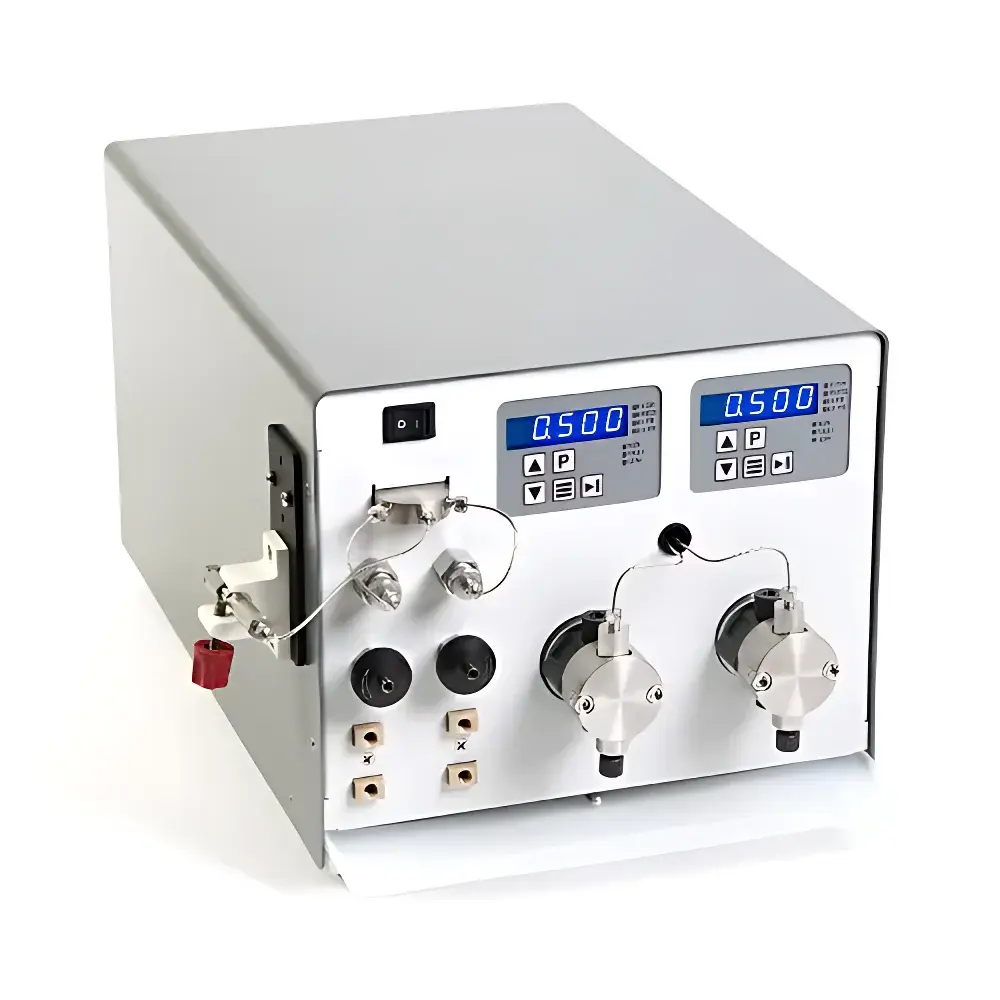
SSI BLS CLASS High-Pressure Binary Gradient Constant Flow Pump
| Brand | SSI |
|---|---|
| Origin | Imported |
| Manufacturer Type | Authorized Distributor |
| Model | SSI BLS CLASS |
| Flow Rate | 0.000–10.00 mL/min (up to 6,000 psi) |
| Maximum Pressure | 6,000 psi (5,000 psi with PEEK fluidic path) |
| Pulsation | ≤2% (at 1 mL/min, 1,000 psi, with pulse dampener) |
| Flow Accuracy | ±2% of full scale |
| Flow Precision | ≤0.2% RSD |
| Fluid Path Materials | Stainless steel, PEEK, optional titanium |
| Dimensions | 22.9 × 25.4 × 43.2 cm (H×W×D) |
| Weight | 13.6 kg |
| Power Supply | 100–240 VAC (±10%), 50–60 Hz |
| Control Interfaces | RS-232, Micro-USB, Analog (0–10 V / 4–20 mA), Run/Stop TTL |
Overview
The SSI BLS CLASS High-Pressure Binary Gradient Constant Flow Pump is a precision-engineered dual-solvent pumping system designed for demanding liquid chromatography applications requiring stable, reproducible gradient elution under high backpressure. Built upon a dual single-head positive displacement piston architecture with belt-driven cam mechanisms and electronic fast-refill capability, the system delivers ultra-low pulsation (<2% at 1 mL/min and 1,000 psi with integrated pulse dampeners) and exceptional flow stability across its operational range. Its modular fluidic path—constructed from chemically resistant stainless steel and PEEK (with optional titanium wetted components)—ensures compatibility with aggressive mobile phases including strong acids, bases, and organic solvents. The pump operates within a validated pressure envelope of up to 6,000 psi (414 bar), supporting modern UHPLC, preparative HPLC, and method development workflows where gradient fidelity, long-term repeatability, and autonomous operation are critical.
Key Features
- Dual independent piston pumps housed in a unified, service-accessible enclosure with integrated drip tray and leak detection sensor
- Belt-driven shaped-cam actuation with electronic fast refill for minimized dwell volume and enhanced gradient response time
- Configurable Prime-Purge valves per solvent channel and high-pressure, low-volume in-line mixing chamber (≤150 µL dead volume)
- Integrated pressure transducer with real-time monitoring and over-pressure shutdown logic compliant with IEC 61000-6-2/6-4 EMC standards
- Standard bulkhead-mounted outlet filters (0.2 µm) and replaceable pulse dampeners for sustained low-pulsation performance
- SSI Gradient Control Board with embedded firmware and intuitive GUI software for offline method storage and execution—no continuous PC connection required post-upload
- Support for two solvent-selection valves, programmable timed events (e.g., valve switching, purge cycles), and hardware-level leak alarm triggering
Sample Compatibility & Compliance
The BLS CLASS accommodates a broad spectrum of analytical and preparative chromatographic workflows, including reversed-phase, HILIC, ion-pairing, and chiral separations. Its fluidic materials meet USP Class VI biocompatibility requirements for PEEK and titanium options, while sapphire/ruby check valves provide wear resistance against abrasive or particulate-laden solvents. The system adheres to ISO 9001-certified manufacturing protocols and supports GLP/GMP-compliant environments through audit-trail-capable method logging (via GUI timestamps and event tagging). While not FDA 21 CFR Part 11–certified out-of-the-box, its RS-232 and analog I/O interfaces enable integration into validated control systems meeting Part 11 data integrity requirements when paired with appropriate LIMS or SCADA platforms.
Software & Data Management
The embedded SSI Gradient Control Board runs proprietary firmware enabling standalone binary gradient generation using user-defined linear, step, or multi-segment profiles. Method files (.grd) are created and validated via Windows-based GUI software, supporting parameter locking, version history, and exportable CSV logs for flow/pressure/time traces. All methods are stored in non-volatile memory with battery-backed retention (>10 years). Remote operation is supported via ASCII serial commands (e.g., “FLO 5.00” to set flow, “STA” to start), allowing integration into custom automation scripts or PLC-controlled sequences. Firmware updates are delivered via Micro-USB and include checksum verification to ensure integrity.
Applications
- Method development and optimization for HPLC/UHPLC systems requiring precise gradient reproducibility across multiple solvent blends
- Preparative-scale purification where consistent flow delivery at elevated pressures ensures column loading fidelity and fraction consistency
- Hyphenated techniques such as LC-MS and LC-ICP-MS, where low pulsation minimizes signal noise and improves detector baseline stability
- Quality control laboratories performing compendial testing per USP , EP 2.2.46, or ASTM D7097, where documented flow accuracy and pressure linearity are auditable parameters
- Research environments involving solvent-sensitive biomolecules, polymers, or nanomaterial dispersions requiring inert fluid paths and minimal shear-induced degradation
FAQ
What is the minimum programmable flow rate and its associated accuracy specification?
The system supports flow programming down to 0.000 mL/min with resolution of 0.001 mL/min. At setpoints ≥0.20 mL/min (tested with 20% IPA/water at 1,000 psi), flow accuracy is ≤±2% of full scale.
Can the BLS CLASS operate without a connected computer after method upload?
Yes—the Gradient Control Board retains uploaded methods in non-volatile memory and executes them autonomously. No continuous PC link is required during run time.
Is PTFE/PFA tubing compatible with the standard fluidic connections?
Yes. The system’s modular inlet/outlet fittings accept standard 1/16″ OD PTFE, PFA, or stainless-steel capillary tubing using Swagelok-compatible compression ferrules.
How is pressure overload protection implemented?
An integrated piezoresistive pressure transducer continuously monitors outlet pressure. If the limit (user-configurable up to 6,000 psi) is exceeded, the pump halts immediately and triggers an audible/visual alarm via front-panel LED indicators.
Does the system support analog feedback for closed-loop flow control?
No—it operates as an open-loop constant-flow device. Flow accuracy relies on calibrated piston displacement and real-time pressure compensation within the firmware; external flow meters are required for closed-loop validation.



