
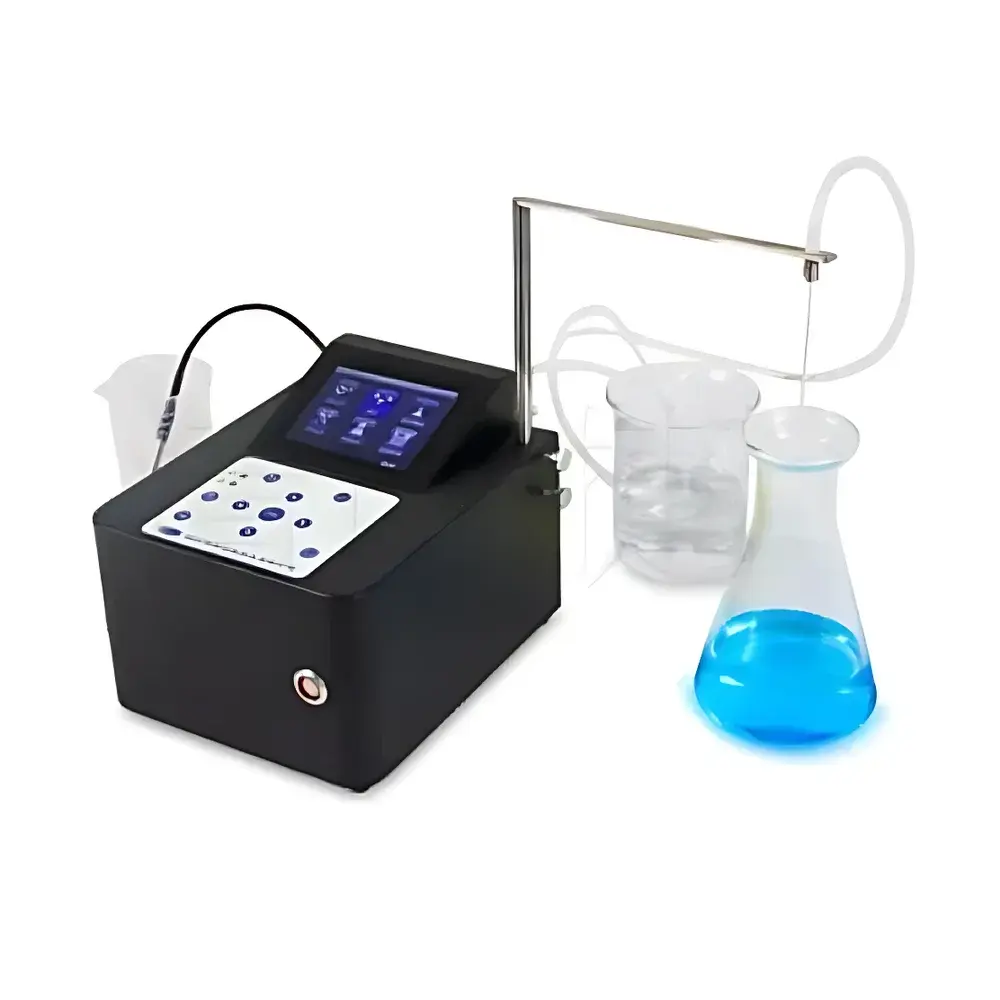
Qingshijie TC-01 Digital Titrator
| Brand | Qingshijie |
|---|---|
| Origin | Shenzhen, China |
| Model | TC-01 |
| Titration Principle | Potentiometric/Colorimetric Endpoint Detection (Auto-Endpoint Recognition) |
| Adjustable Flow Rates | Fast / Medium / Slow |
| Volume Resolution | 0.01 mL |
| Repeatability | ≤0.1% RSD |
| Dispensing Mechanism | High-Precision Peristaltic Pump |
| Tubing Material | Platinum-Cured Silicone Rubber (Acid/Base Resistant) |
| Display | LED Backlit LCD with Real-Time Volume & Result Readout |
| Data Storage Capacity | 2,000 Titration Records |
| Operating Environment | 0–50 °C, 0–90% RH (non-condensing) |
| Power Supply | AC 100–240 V, 50/60 Hz |
| Compliance | Designed for ASTM D129, ISO 9297, USP <541>, and GLP-compliant workflows |
| Software Features | Onboard Calculation Engine, Auto-Result Reporting, Endpoint Confirmation Algorithm |
Overview
The Qingshijie TC-01 Digital Titrator is an entry-level automated titration system engineered for precision, reproducibility, and operational safety in routine wet-chemistry laboratories. It implements a peristaltic pump-driven liquid delivery architecture to replace manual burette operation while preserving the fundamental chemical validity of classical volumetric analysis. Unlike endpoint-detection-only systems, the TC-01 supports both colorimetric (visual endpoint recognition via user-defined threshold) and potentiometric (optional electrode integration) titration modes — enabling compatibility with acid-base, redox, complexometric, and precipitation titrations. Its core function is to deliver standardized titrant at three discrete flow rates (fast, medium, slow), automatically detect the equivalence point based on real-time volume increment and user-configurable endpoint criteria, compute stoichiometric results in situ, and store full procedural metadata. The instrument is not a standalone analytical spectrometer or sensor platform; rather, it serves as a digitally controlled, human-factor-optimized replacement for Class A glass burettes in QC/QA, environmental testing, water quality labs, and academic teaching environments.
Key Features
- Three-step adjustable titrant delivery speed (fast/medium/slow) enables optimized response time for rapid screening or high-precision endpoint approach
- Platinum-cured silicone rubber tubing certified for long-term resistance to 0.1–1.0 M HCl, NaOH, EDTA, AgNO₃, and KMnO₄ solutions — eliminating frequent tube replacement and cross-contamination risk
- Backlit LED LCD interface displays real-time dispensed volume (0.01 mL resolution), cumulative titrant consumption, calculated analyte concentration, and pass/fail status against preset acceptance criteria
- Onboard calculation engine applies IUPAC-recommended stoichiometric algorithms for common titration types including COD (dichromate method), total hardness (EDTA complexometry), chloride (Mohr or Volhard), and total alkalinity (HCl titration to methyl orange endpoint)
- Integrated automatic rinse cycle — activated pre- and post-titration — flushes tubing and tip with deionized water using dedicated rinse port, reducing carryover and eliminating manual cleaning steps
- Robust housing rated IP20, compliant with IEC 61010-1 for laboratory electrical safety, and designed for continuous operation under ambient lab conditions (0–50 °C, ≤90% RH non-condensing)
Sample Compatibility & Compliance
The TC-01 is validated for aqueous-phase titrations across pH 2–12 and ionic strengths up to 0.5 mol/L. It accommodates standard 50 mL and 100 mL Erlenmeyer flasks and supports direct connection to optional pH, redox, or ion-selective electrodes for potentiometric mode. All firmware logic and data handling conform to ALCOA+ principles: attributable, legible, contemporaneous, original, accurate, complete, consistent, enduring, and available. Audit trails record operator ID (via optional USB keyboard input), date/time stamps, method parameters, raw volume increments, endpoint confirmation flags, and final result exports — satisfying documentation requirements for ISO/IEC 17025 accreditation and FDA 21 CFR Part 11 readiness (when paired with validated networked reporting software). The device meets essential requirements of the EU Low Voltage Directive 2014/35/EU and EMC Directive 2014/30/EU.
Software & Data Management
Data are stored locally in non-volatile memory (2,000 records maximum), each containing sample ID, method name, titrant lot number, initial/final volume, temperature (if external probe connected), endpoint deviation from theoretical, and calculated result with uncertainty estimate. Export is supported via USB 2.0 port in CSV format — compatible with LIMS platforms such as LabWare, STARLIMS, and Thermo Fisher SampleManager. No proprietary cloud service or vendor lock-in is required; raw files open directly in Excel or Python/Pandas for statistical validation. Firmware updates are performed offline via FAT32-formatted USB drive, ensuring air-gapped security in regulated environments.
Applications
- Environmental monitoring: COD determination per APHA 5220B, total hardness per EPA 130.1, chloride per ASTM D511
- Drinking water and wastewater labs: Alkalinity profiling (SM 2320B), residual chlorine titration (iodometric method)
- Pharmaceutical excipient QC: Assay of sodium carbonate, calcium gluconate, and magnesium oxide via acid–base titration
- Food & beverage: Total acidity in vinegar (USP <541>), citric acid quantification in soft drinks
- Education: Undergraduate chemistry labs requiring GLP-aligned titration training without exposure to hazardous reagents or manual technique variability
FAQ
Does the TC-01 support automatic calibration of titrant concentration?
No — it assumes pre-standardized titrant solutions. Users must validate concentration prior to use per ISO 6497 or USP <541>.
Can I connect a pH meter for potentiometric titration?
Yes — the rear-panel BNC port accepts standard pH/mV electrodes; endpoint detection switches to first-derivative dE/dV mode.
Is the tubing compatible with organic solvents like ethanol or acetone?
No — platinum-cured silicone is optimized for aqueous electrolytes only. For non-aqueous titrations (e.g., perchloric acid in glacial acetic acid), consult technical support for alternative fluid path options.
How is data integrity ensured during power interruption?
All titration records are written to flash memory before display update; partial runs are flagged as incomplete and excluded from report generation.
What maintenance intervals are recommended?
Tubing replacement every 6 months under daily use; pump head roller inspection quarterly; full functional verification annually per manufacturer’s PQ protocol.



