
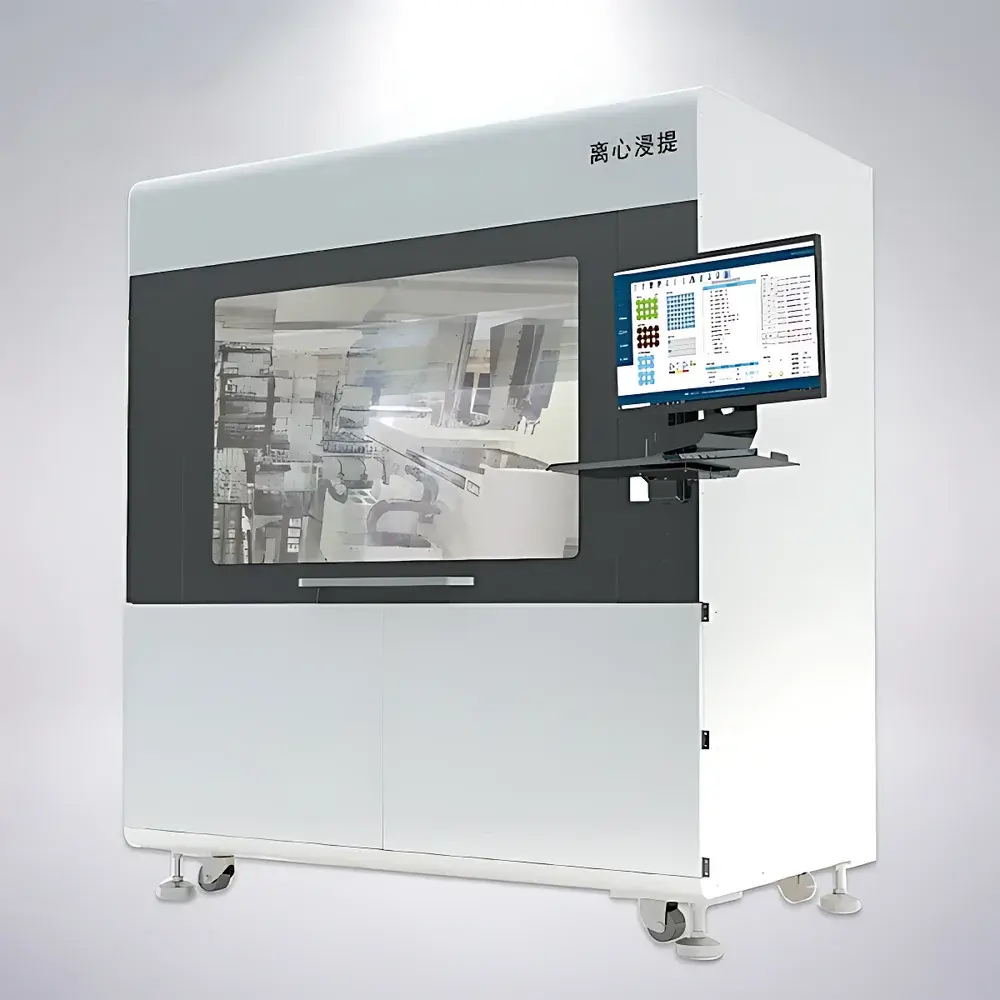
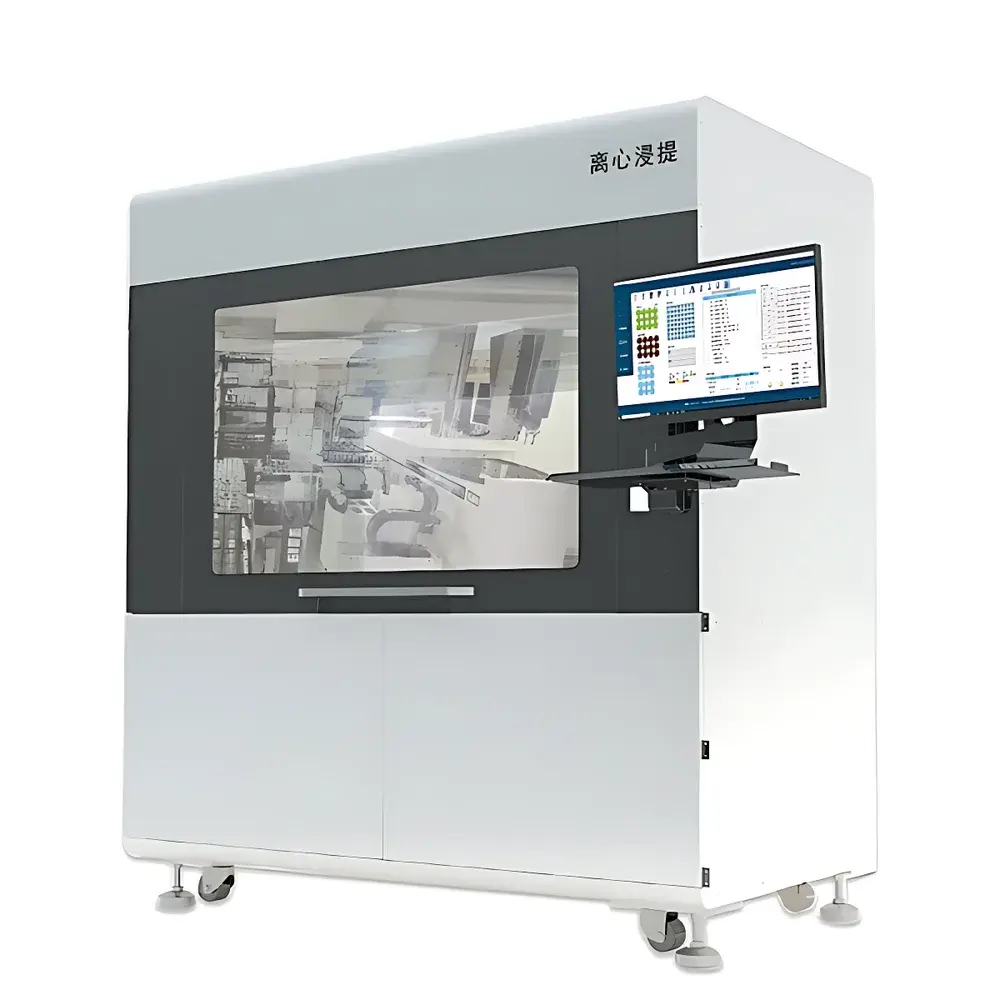
Drick DRK-02 Black-Light Laboratory Automated Centrifugal Extraction Platform
| Brand | Drick |
|---|---|
| Origin | Shandong, China |
| Manufacturer Type | OEM Manufacturer |
| Country of Origin | China |
| Model | DRK-02 Black-Light Laboratory |
| Price | USD 70,000 (FOB Qingdao) |
| Sample Capacity | 12 positions |
| Pipetting Accuracy | ≤1% CV |
| Throughput | 12 samples per 8 hours (for Cation Exchange Capacity analysis) |
| Compatible Tube Sizes | 50 mL and 100 mL centrifuge tubes |
| Maximum Centrifuge Speed | 4500 rpm |
| Dimensions (L×W×H) | 1.70 m × 0.96 m × 1.85 m |
| Regulatory Compliance | NY/T 1121.13–2006, Chinese Agricultural Standard for Soil Testing Methods |
| LIMS Integration | Yes, via ASTM E1578-compliant instrument interface protocol |
Overview
The Drick DRK-02 Black-Light Laboratory Automated Centrifugal Extraction Platform is an integrated sample preparation system engineered for high-reproducibility, unattended execution of standardized soil and environmental solid matrix extraction protocols—specifically targeting cation exchange capacity (CEC), exchangeable base cations (Ca²⁺, Mg²⁺, K⁺, Na⁺), and total base saturation quantification. It operates on a sequential robotic workflow grounded in centrifugal force-driven phase separation, precise volumetric liquid handling, and controlled mechanical agitation. Unlike semi-automated benchtop solutions, the DRK-02 implements end-to-end automation—including tube transport, lid actuation, reagent addition, vortex mixing, centrifugation, supernatant aspiration, tip exchange, homogenization, and final volume adjustment—thereby eliminating operator-induced variability in critical pre-analytical steps. Its architecture conforms to ISO/IEC 17025:2017 requirements for method validation and analytical process control, supporting traceability from raw sample to instrument-ready extract.
Key Features
- Fully automated 12-position sample processing with synchronized robotic arm motion, pneumatic lid actuation, and dual-channel positive-displacement pipetting
- Integrated refrigerated centrifuge module (max. 4500 rpm, RCF ≥ 3,200 × g) with real-time rotor imbalance detection and automatic brake calibration
- High-precision liquid handling system calibrated per ISO 8655–6; achieves ≤1% coefficient of variation across 100–1000 µL dispense ranges
- Modular tube carrier design accommodating both 50 mL and 100 mL conical-bottom polypropylene centrifuge tubes per IEC 61000-6-3 EMC standards
- Onboard vibration module delivering programmable amplitude (0.5–5 mm) and frequency (100–1200 rpm) for consistent particle suspension prior to centrifugation
- Embedded industrial PC with touch HMI, local data logging (CSV/SQLite), and audit-trail-enabled operation history (per GLP Annex 11 principles)
Sample Compatibility & Compliance
The DRK-02 platform is validated for use with air-dried, sieved (<2 mm) soil samples, sediment cores, biosolids, and agricultural compost matrices. It strictly adheres to the procedural specifications outlined in NY/T 1121.13–2006 (“Soil Testing Part 13: Determination of Cation Exchange Capacity by Ammonium Acetate Extraction Method”) and aligns with the broader framework of GB/T 32736–2016 (General Requirements for Environmental Testing Laboratories). All fluidic pathways contact only USP Class VI-certified materials (e.g., PTFE, medical-grade silicone, borosilicate glass). The system supports 21 CFR Part 11-compliant electronic signatures when deployed with validated third-party LIMS middleware (e.g., Thermo Fisher SampleManager, LabVantage).
Software & Data Management
Control firmware runs on a deterministic real-time Linux kernel (PREEMPT_RT patchset), ensuring sub-100 ms command response latency. The DRK-02 Control Suite v3.2 provides method editor functionality for custom protocol development—including conditional branching (e.g., “if turbidity > X NTU, repeat centrifugation”), multi-step dilution schemes, and dynamic volume compensation based on measured density. Raw logs include timestamped event records (e.g., “Tube #7 lid opened at 2024-06-12T08:42:17Z”, “Supernatant aspirated: 48.21 mL ± 0.12 mL”), exportable via SFTP or OPC UA to enterprise LIMS. Audit trails are cryptographically signed and immutable post-generation.
Applications
- Routine CEC and exchangeable cation profiling in agronomic soil testing laboratories accredited to CNAS-CL01:2018
- Preparation of extracts for ICP-OES/MS analysis of base saturation ratios in land application risk assessments
- Standardized leaching studies under ASTM D4373–22 (Standard Test Method for Cation Exchange Capacity of Soils)
- High-throughput screening of biochar amendment effects on soil ion retention kinetics
- Method transfer support for ISO 11260:2022 (Soil quality — Determination of cation exchange capacity — Extraction with barium chloride–triethanolamine)
FAQ
Does the DRK-02 support method validation documentation packages?
Yes. A complete IQ/OQ/PQ protocol bundle—including calibration certificates, repeatability test reports, and system suitability criteria—is supplied with each unit.
Can the platform be retrofitted with UV-Vis spectrophotometric detection?
No. The DRK-02 is a dedicated front-end extraction system; downstream analysis requires integration with external instrumentation via standardized data interfaces.
Is remote monitoring supported over corporate networks?
Yes. Secure TLS 1.3-based web dashboard access is enabled via configurable firewall rules and role-based authentication (RBAC).
What maintenance intervals are recommended for the pipetting and centrifuge modules?
Pipette calibration every 3 months; centrifuge rotor balance verification before each daily run; full preventive maintenance annually per ISO 13485:2016 guidelines.
Are consumables proprietary or industry-standard?
All tips, tubes, and reagent reservoirs comply with ANSI/SLAS microplate footprint standards; no vendor-locked consumables are required.





