
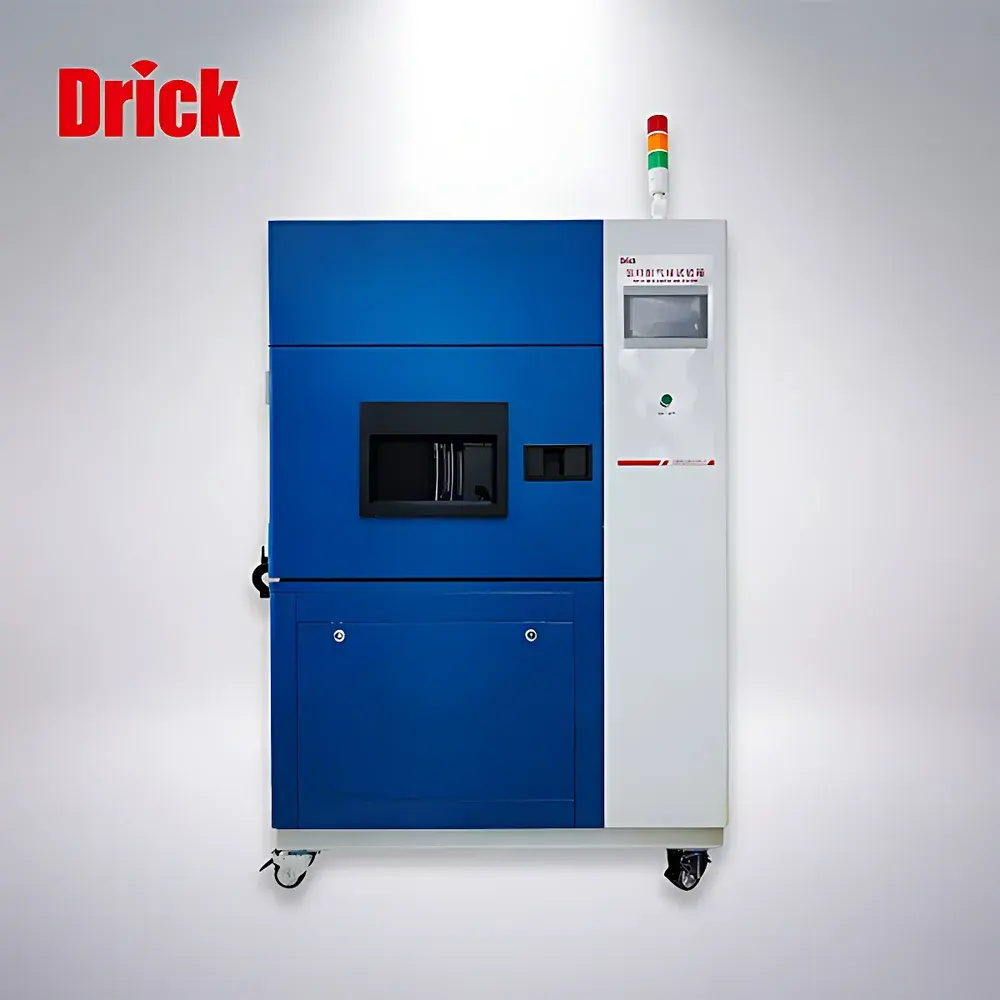
Drick DRK646 Xenon Arc Weathering Test Chamber
| Brand | Drick |
|---|---|
| Origin | Shandong, China |
| Manufacturer Type | Direct Manufacturer |
| Country of Origin | China |
| Model | DRK646 |
| Lamp Power | 1500 W (Standard), 2500 W (Optional) |
| Black Panel Temperature Range | 45–90 °C |
| Chamber Air Temperature Range (Standard) | 35–65 °C |
| Irradiance | ~40 W/m² (300–400 nm) |
| Sample Tray Dimensions (W×D×H) | 251 × 457 mm |
| External Dimensions (W×D×H) | 775 × 521 × 648 mm |
| Power Supply | AC 220 V, 50 Hz |
| Safety Protections | Leakage current protection, overcurrent protection, short-circuit protection |
| Compliance | Designed to support ASTM G155, ISO 4892-2, and GB/T 16422.2 test protocols |
Overview
The Drick DRK646 Xenon Arc Weathering Test Chamber is an engineered environmental simulation system designed for accelerated weathering evaluation of polymeric, textile, coating, glass, and composite materials under controlled exposure to full-spectrum solar radiation, thermal cycling, and moisture. It employs a high-intensity xenon arc lamp—spectrally filtered to closely replicate natural sunlight (290–800 nm)—to generate reproducible irradiance conditions that drive photochemical degradation mechanisms such as chain scission, oxidation, and chromophore breakdown. Unlike UV fluorescent or metal halide sources, the xenon arc provides continuous spectral output across UV, visible, and near-infrared bands, enabling realistic simulation of solar-induced aging phenomena including color fading, gloss loss, surface cracking, blistering, chalking, and embrittlement. The chamber integrates precise black panel temperature control, programmable light/dark cycles, and optional water spray or condensation modules to emulate diurnal humidity fluctuations—critical for assessing real-world durability in automotive, aerospace, architectural, and consumer electronics applications.
Key Features
- Robust dual-layer construction: Cold-rolled steel exterior with electrostatic powder coating; mirror-finish 304 stainless steel interior chamber for corrosion resistance and uniform reflectivity.
- Intelligent digital controller with real-time monitoring of irradiance, black panel temperature, chamber air temperature, and cycle timing—fully programmable via intuitive interface.
- High-stability xenon lamp assembly (1500 W standard; 2500 W upgrade available) with integrated radiometric sensor for automatic irradiance compensation during lamp aging or filter degradation.
- Top-mounted, downward-opening access door enables rapid specimen loading/unloading without tooling—optimized for routine QC testing and multi-sample comparative studies.
- Comprehensive safety architecture: Overtemperature cutoff, ground-fault circuit interruption (GFCI), thermal overload relay, and short-circuit protection compliant with IEC 61000-4 EMC standards.
- Modular design supports optional upgrades including water spray nozzles (ASTM D4329), humidity control (ISO 4892-2), and calibrated irradiance monitoring per NIST-traceable standards.
Sample Compatibility & Compliance
The DRK646 accommodates flat-panel specimens up to 251 mm × 457 mm on its adjustable sample tray, supporting standardized test coupons (e.g., ASTM D6675, ISO 105-B02) as well as custom-sized components. Its operational envelope—black panel temperature (45–90 °C), chamber air temperature (35–65 °C), and irradiance (~40 W/m² in 300–400 nm band)—aligns with key international weathering standards including ASTM G155 (Cycle A, B, C), ISO 4892-2 (Method A/B), and GB/T 16422.2. While not certified to UL or CE by default, the system is built to meet electrical safety requirements outlined in IEC 61010-1 for laboratory equipment. For regulated environments (e.g., automotive OEM validation or medical device packaging qualification), users may configure audit-ready data logging and user-access controls compatible with GLP/GMP documentation workflows.
Software & Data Management
The embedded microprocessor-based controller records timestamped values for irradiance, black panel temperature, chamber temperature, and elapsed cycle time at user-defined intervals (1–60 min). Data export is supported via USB flash drive in CSV format for post-processing in Excel, MATLAB, or LIMS platforms. Optional PC-based software (sold separately) enables remote monitoring, multi-chamber synchronization, alarm notification via email/SNMP, and automated report generation aligned with ISO/IEC 17025 documentation requirements. All logged parameters include traceable calibration metadata, satisfying basic FDA 21 CFR Part 11 principles for electronic records when paired with operator login authentication and change history logging.
Applications
- Accelerated photostability testing of automotive interior trims, exterior paints, and headlight lenses per SAE J2412 and GMW14124.
- Evaluation of UV stabilizers and HALS additives in polyolefins, PVC, and thermoplastic elastomers.
- Qualification of optical films, OLED encapsulation layers, and AR coatings used in display and photovoltaic modules.
- Correlation studies between xenon arc exposure and outdoor Florida/Arizona field aging for ASTM D2565 benchmarking.
- Pre-compliance screening of packaging materials (e.g., pharmaceutical blister foils, food-grade laminates) against ISO 11607-1 shelf-life claims.
FAQ
What spectral filters are included with the DRK646?
The standard configuration includes a borosilicate inner filter (Boro/Quartz) and a soda-lime outer filter, delivering a daylight spectrum approximating CIE Standard Illuminant D65. Optional Daylight-Q and Window Glass-Q filters are available for specific application matching.
Can the DRK646 operate without water spray or humidity control?
Yes—the base model functions as a dry-cycle xenon exposure chamber. Water spray and relative humidity modules are optional add-ons for wet/dry cycling per ASTM G155 Cycle A or ISO 4892-2 Method A.
Is NIST-traceable irradiance calibration provided?
Calibration certificates are available upon request. The built-in radiometer is factory-calibrated against a reference spectroradiometer; annual recalibration services are recommended for ISO/IEC 17025 compliance.
How often must the xenon lamp be replaced?
Lamp service life is typically 1,500–2,000 hours under continuous operation. The controller displays cumulative lamp hours and triggers maintenance alerts at configurable thresholds.
Does the DRK646 support multiple test standards simultaneously?
Yes—users can store and recall up to 10 preconfigured test profiles, each defining unique irradiance setpoints, temperature ramps, light/dark durations, and spray sequences per standard-specific requirements.



