
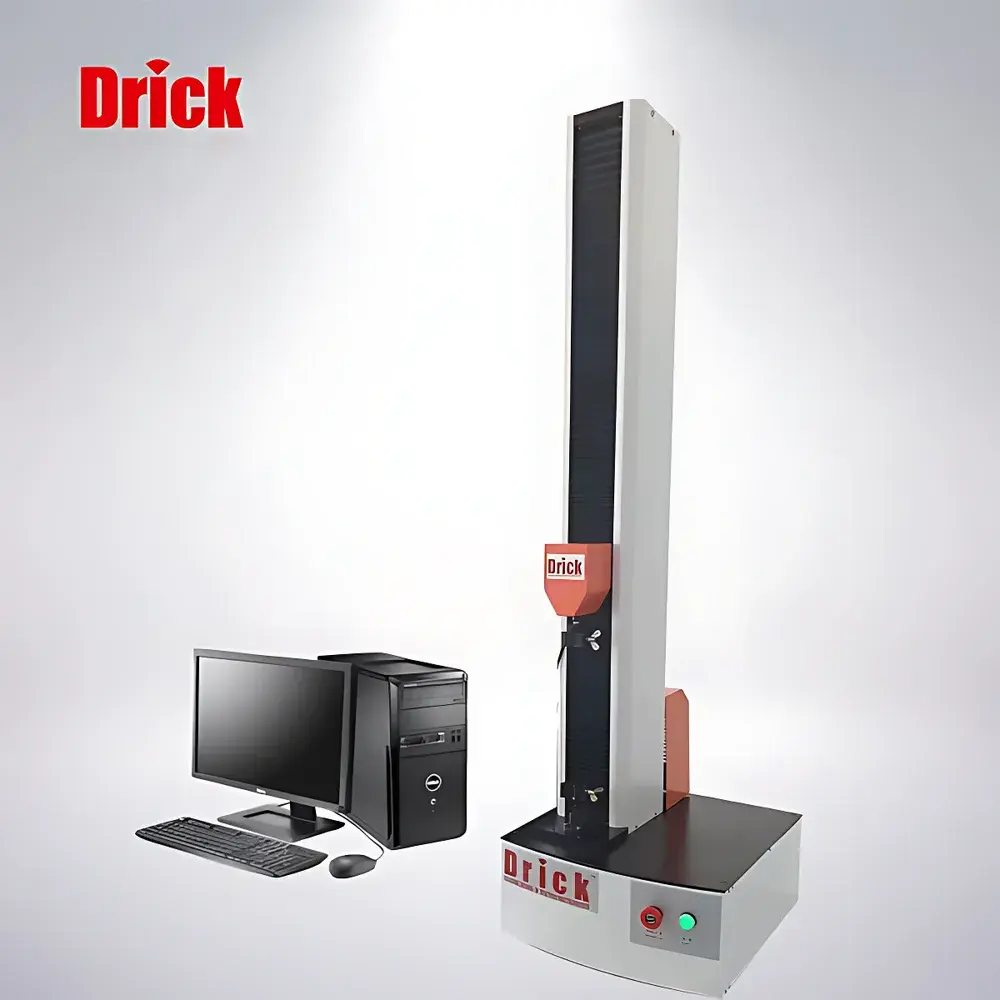
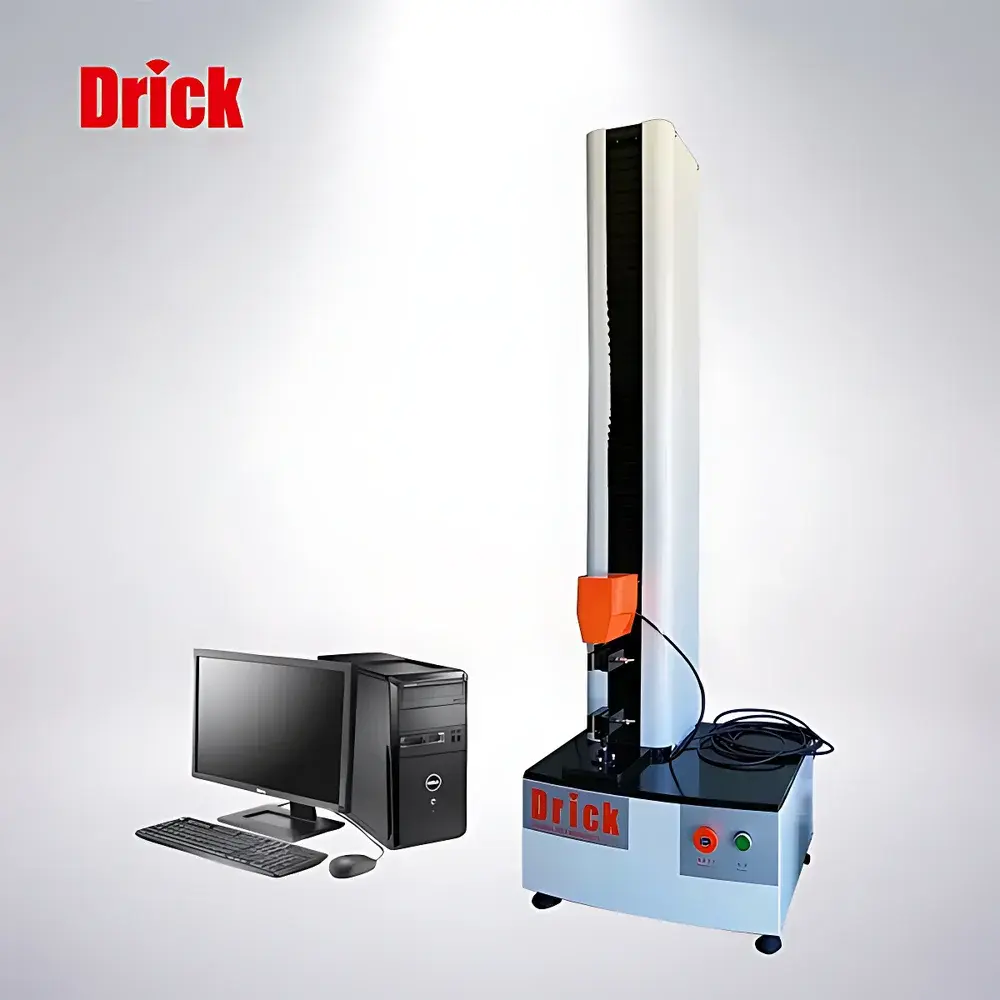
Drick DRK101PC Intelligent Tensile Tester for Paper and Paperboard – Computer-Controlled Universal Material Testing System
| Brand | Drick |
|---|---|
| Origin | Shandong, China |
| Manufacturer Type | Direct Manufacturer |
| Country of Origin | China |
| Model | DRK101PC |
| Price Range | USD 7,000 – 14,000 |
| Load Capacity Options | 100 N / 500 N / 1,000 N / 5,000 N |
| Accuracy Class | Better than 0.5 |
| Displacement Resolution | 0.001 mm |
| Speed Control | Continuously Variable (0.01–500 mm/min) |
| Specimen Width | 30 mm (standard), 50 mm (optional fixture) |
| Clamping Method | Manual Wedge-Type Grips |
| Maximum Travel | 400 mm (customizable) |
| Dimensions (L×W×H) | 500 × 300 × 1150 mm |
| Power Supply | AC 220 V, 50 Hz |
Overview
The Drick DRK101PC is a computer-controlled universal tensile testing system engineered for high-reproducibility mechanical characterization of thin, flexible sheet materials—primarily paper, paperboard, plastic films, laminates, and adhesive tapes. It operates on the fundamental principle of uniaxial tensile loading in accordance with standardized test methods including ISO 1924 (paper and board tensile properties), ISO 527-3 (plastics—tensile testing of films), ASTM D882 (tensile properties of thin plastic sheeting), and TAPPI T494 (tensile strength of paper and paperboard). The system applies controlled force via a precision ball-screw-driven crosshead actuated by a high-resolution servo motor, enabling accurate measurement of load, displacement, and time-synchronized response. Its architecture supports both static and quasi-static mechanical evaluation, delivering traceable, repeatable data required for quality control, R&D validation, and regulatory compliance in packaging, pulp & paper, and flexible packaging industries.
Key Features
- Precision mechanical drive train: High-rigidity ball-screw transmission coupled with imported servo motor ensures minimal backlash, low noise (<65 dB), and position repeatability within ±0.002 mm.
- Real-time multi-parameter acquisition: Simultaneous capture of load (N), displacement (mm), time (s), and calculated metrics—including tensile strength (kN/m), elongation at break (%), tensile energy absorption (J/m²), and tensile index (N·m/g)—with synchronized graphical display of stress–strain curves.
- Modular fixture system: Standard 30 mm pneumatic or manual wedge grips; optional 50 mm grips and specialized fixtures for 90°/180° peel, trouser tear (ISO 1974), shear adhesion (ASTM D3654), puncture (ISO 8513), heat seal strength (ASTM F88), and low-speed unwind force testing.
- Comprehensive software suite: Windows-based application compliant with GLP documentation requirements—supports audit trail logging, user-level access control, electronic signatures, and 21 CFR Part 11–ready data integrity features (configurable).
- Intelligent hardware safeguards: Automatic overload protection (120% FS), emergency stop circuit, crosshead auto-return to pre-test position, and non-volatile memory for test parameter retention across power cycles.
- Calibration traceability: Factory-calibrated using NIST-traceable load cells; supports internal verification with certified reference standards per ISO/IEC 17025 guidelines.
Sample Compatibility & Compliance
The DRK101PC accommodates specimens up to 400 mm travel length and 50 mm width, making it suitable for standard ISO/TAPPI test strips as well as custom geometries used in industrial QA workflows. It meets essential metrological and functional requirements outlined in ISO 7500-1 (static calibration of force-proving instruments), ISO 5893 (tensile testing machines), and JJG 475 (Chinese national verification regulation for universal testing machines). When configured with validated protocols and documented SOPs, the system supports compliance with ISO 9001, ISO 14001, and FDA-regulated environments where mechanical property verification forms part of batch release criteria.
Software & Data Management
The proprietary DRK-TensileSuite™ v4.x software provides full lifecycle test management—from method definition and instrument configuration to raw data export (CSV, XML, PDF), statistical reporting (mean, SD, CV%, confidence intervals), curve overlay comparison across batches or material lots, and historical trend analysis. All test files include embedded metadata: operator ID, timestamp, environmental conditions (manual entry), calibration status, and fixture configuration. Exported reports are structured for direct integration into LIMS or ERP systems. Audit logs record every user action—including parameter edits, result modifications, and report generation—with immutable timestamps.
Applications
- Paper & board mills: Routine QC of tensile strength, breaking length, and elasticity for kraft liner, corrugating medium, and coated offset papers.
- Flexible packaging labs: Peel strength validation of laminated pouches, seal integrity assessment of heat-sealed PE/PP structures, and puncture resistance of barrier films.
- Adhesives & tape manufacturers: Quantification of 180° peel adhesion (ASTM D3330), shear holding time (ASTM D3654), and tack performance via controlled debonding.
- R&D centers: Comparative mechanical profiling of bio-based films, nanocellulose composites, and recycled fiber blends under standardized strain rates.
- Contract testing laboratories: Accredited testing services aligned with ISO/IEC 17025 scope for tensile, tear, and peel methodologies.
FAQ
What standards does the DRK101PC support out-of-the-box?
Pre-configured test methods include ISO 1924-2, ISO 527-3, ASTM D882, TAPPI T494, ASTM F904 (peel), and ISO 11600 (seal strength); additional methods can be added via software configuration.
Is the system compatible with third-party LIMS or MES platforms?
Yes—via CSV/XML data export and optional OPC UA or REST API integration modules (available as add-ons).
Can the DRK101PC perform cyclic or creep testing?
Standard configuration supports monotonic tensile and peel only; creep and fatigue modules require optional hardware upgrades and advanced firmware licensing.
How often must the load cell be recalibrated?
Annual recalibration is recommended; however, daily verification using traceable check weights and periodic linearity checks per ISO 7500-1 are required for GLP/GMP adherence.
Does the system meet FDA 21 CFR Part 11 requirements?
Yes—when deployed with enabled electronic signature workflow, audit trail logging, and role-based access controls as configured in DRK-TensileSuite™ v4.x.




