
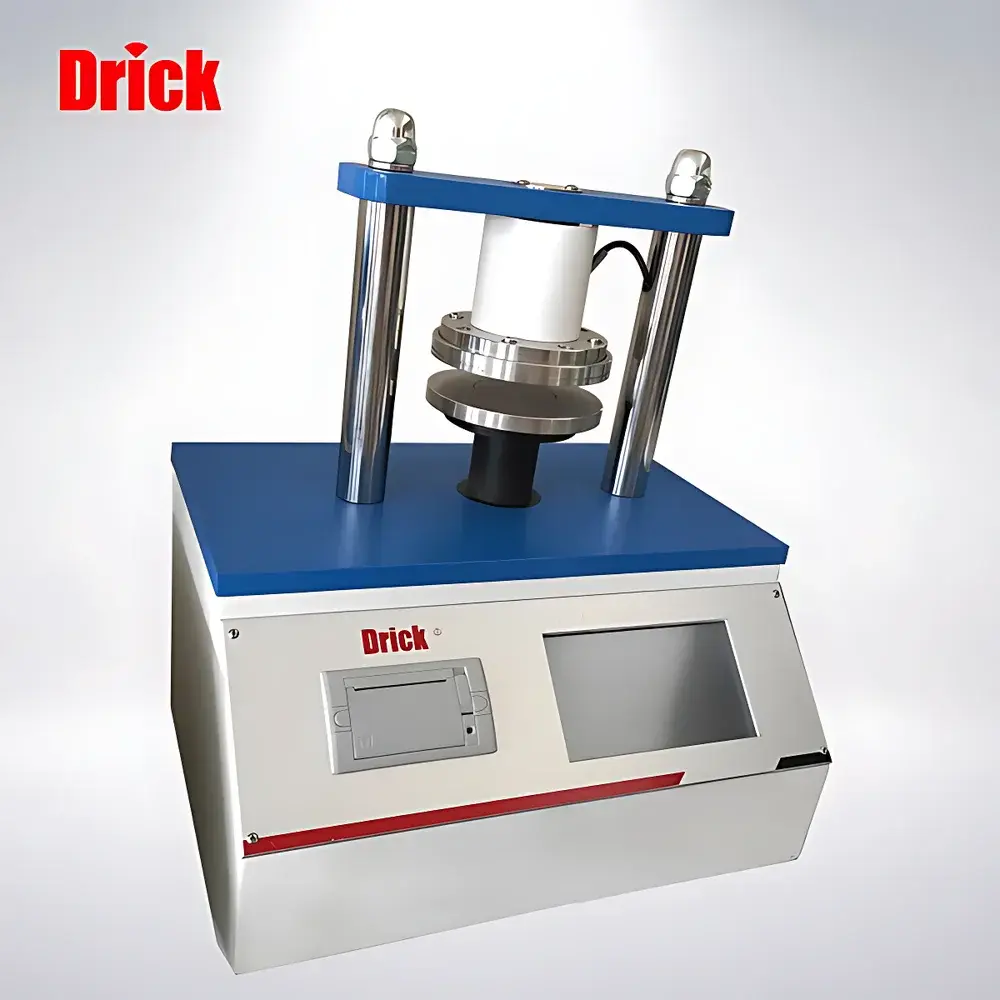
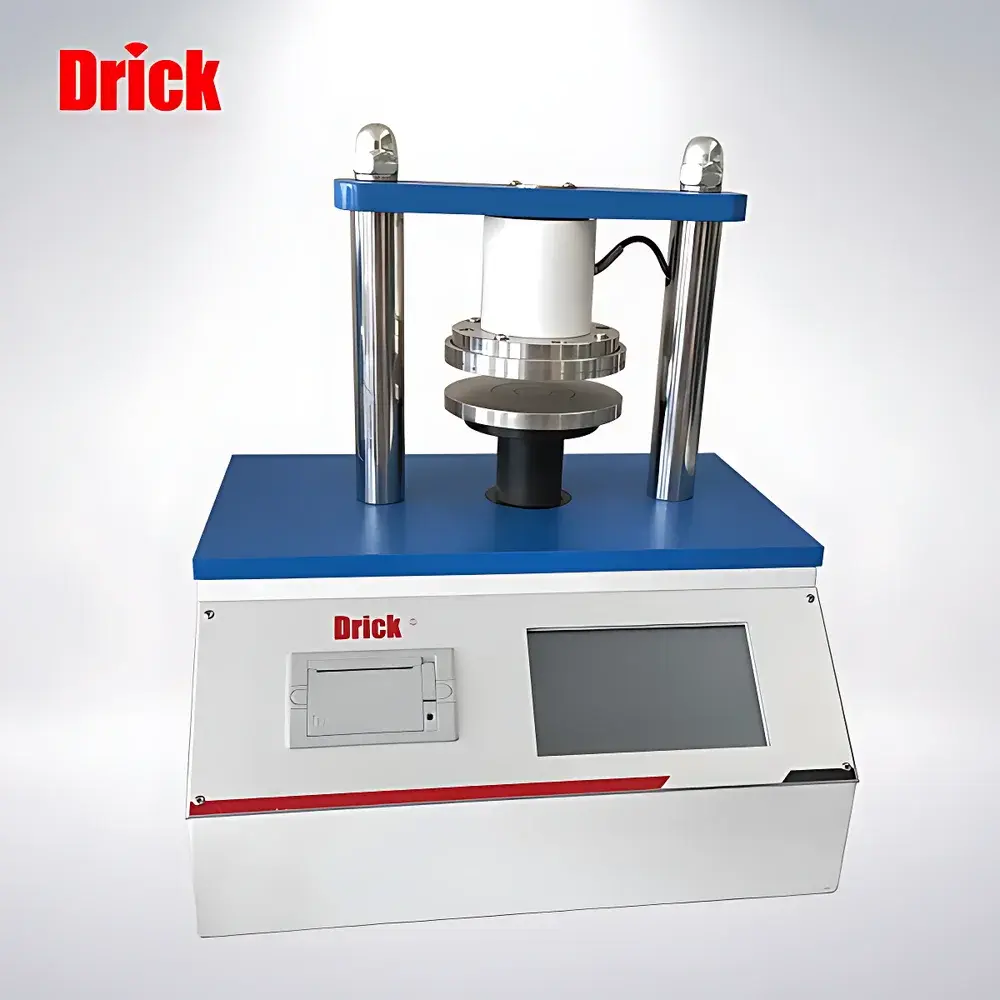
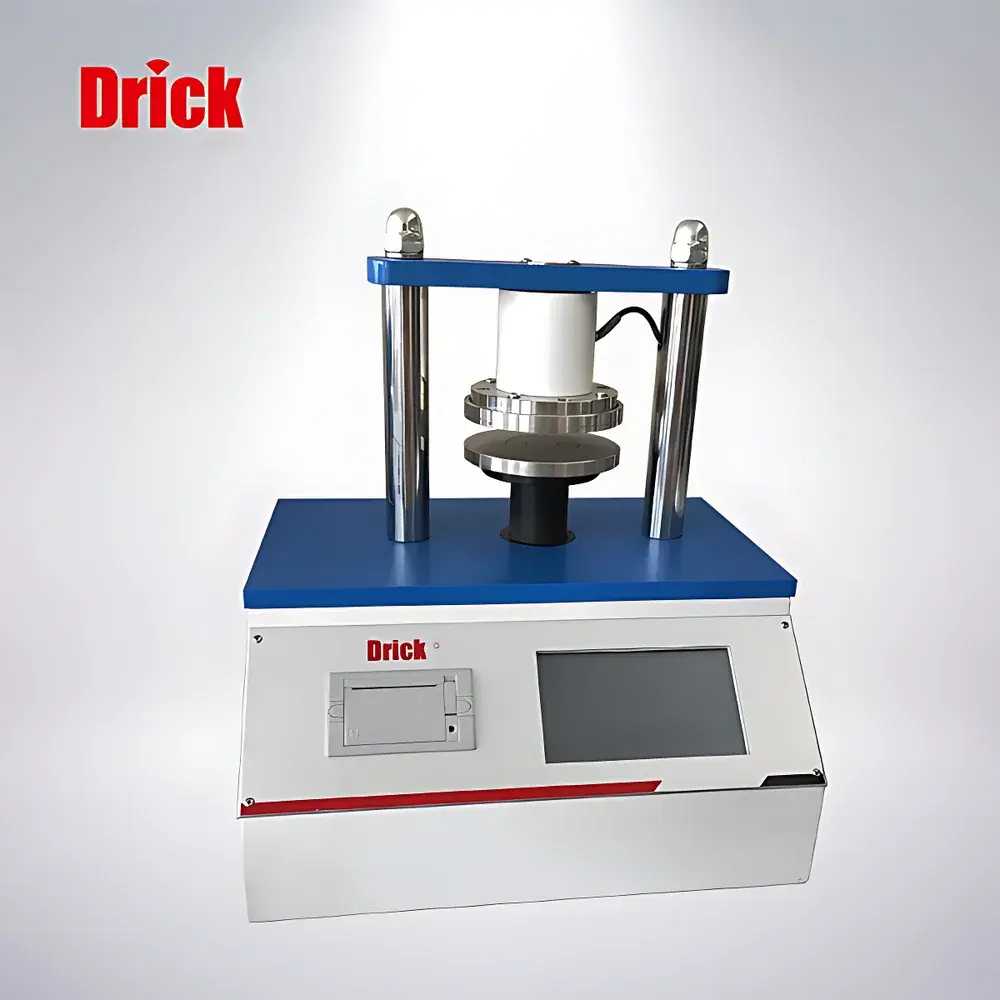
Drick DRK113 GB/T 6546 Edge Crush Test (ECT) Instrument for Corrugated Board
| Brand | Drick |
|---|---|
| Origin | Shandong, China |
| Manufacturer Type | Direct Manufacturer |
| Region Category | Domestic (China) |
| Model | DRK113 |
| Price | USD 7,000 (FOB Qingdao) |
| Power Supply | AC 220 V ±5%, 50 Hz, 2 A |
| Load Accuracy | ±1% of full scale |
| Load Repeatability | <1% |
| Resolution | 0.1 N |
| Force Range | 5–5000 N |
| Platen Parallelism | ≤0.05 mm |
| Stroke | 1–70 mm |
| Test Speed | 12.5 ± 2.5 mm/min |
| Circular Platen Diameter | 235 mm |
| Display | LCD with bilingual (Chinese/English) GUI |
| Operating Environment | 10–30 °C, RH <85% non-condensing |
Overview
The Drick DRK113 is a precision-engineered edge crush test (ECT) instrument designed and manufactured in accordance with GB/T 6546—2022, the Chinese national standard for determining the edge crush resistance of corrugated fiberboard. It operates on the fundamental principle of uniaxial compressive loading applied to a vertically oriented specimen clamped between two parallel platens, measuring peak load at failure under controlled displacement rate. This method directly correlates with the stacking strength and vertical load-bearing capacity of corrugated packaging—critical parameters for logistics integrity, shelf-life stability, and palletized transport performance. The instrument integrates a robust mechanical frame, high-stiffness load train, and microprocessor-based control system to ensure high reproducibility across repeated tests. Its design conforms to the structural and procedural requirements defined in ISO 3037 (Corrugated fibreboard — Determination of edge crush resistance), ASTM D6341 (Standard Test Method for Edge Crush Test for Corrugated Fiberboard), and TAPPI T 811 (Edge Crush Test), enabling cross-compatibility with international quality assurance protocols.
Key Features
- Compliant dual-mode testing capability: supports ECT (edge crush), RCT (ring crush), FCT (flat crush), PAT (pin adhesion), and CMT (core crush) per GB/T 6546, GB/T 2679.8, GB/T 6548, and GB/T 2679.6
- High-precision load cell with 0.1 N resolution and ±1% full-scale accuracy, calibrated traceable to national metrological standards
- Adjustable platen spacing (1–70 mm stroke) with mechanical limit protection and real-time position feedback
- Bilingual (English/Chinese) LCD interface featuring intuitive menu navigation, parameter presetting, and on-screen result display including peak load, deformation at yield, and compression modulus
- Fixed test speed of 12.5 ± 2.5 mm/min, aligned with GB/T 6546 and ISO 3037 requirements for consistent strain-rate application
- 235 mm diameter circular platen with surface flatness ≤0.05 mm, ensuring uniform stress distribution and minimizing edge effects
- Integrated thermal management and anti-vibration base design for stable operation in ambient lab conditions (10–30 °C, RH <85%)
Sample Compatibility & Compliance
The DRK113 accommodates standardized specimens conforming to GB/T 6546: 25 mm × 100 mm strips cut parallel to the flute direction for ECT; 152 mm × 12.7 mm rings for RCT; 100 mm × 100 mm squares for FCT; and cylindrical cores (diameter <60 mm) for CMT. It also accepts non-standard geometries—including paper cups, small-diameter paper tubes, folded cartons, and honeycomb panels—via optional fixture adapters. All test configurations maintain alignment with GLP documentation practices and support audit-ready reporting. The instrument’s mechanical architecture and software logic are structured to meet basic data integrity expectations under ISO/IEC 17025:2017 for testing laboratories, and its output format facilitates integration into enterprise-level QA/QC workflows compliant with ISO 9001 and IATF 16949.
Software & Data Management
While the DRK113 operates as a standalone unit with embedded firmware, it supports USB export of test records in CSV format for post-processing in Excel or statistical analysis platforms (e.g., Minitab, JMP). Each test log includes timestamp, operator ID (manually entered), specimen ID, test mode, force–displacement curve coordinates (sampled at 10 Hz), peak load, and pass/fail status relative to user-defined thresholds. Optional PC connectivity enables remote calibration verification and firmware updates. Though not natively 21 CFR Part 11 compliant, the device supports manual audit trails via printed reports (with date/time stamp and operator signature field) and can be deployed within validated environments where supplementary procedural controls govern data handling and electronic record retention.
Applications
This instrument serves as a primary evaluation tool for corrugated board manufacturers, packaging converters, and third-party testing laboratories performing routine quality control and incoming material inspection. Typical use cases include: qualification of linerboard and medium combinations prior to corrugator startup; verification of adhesive bond strength in multi-wall boards; assessment of moisture-induced degradation during accelerated aging studies; comparative analysis of recycled vs. virgin fiber blends; and validation of board specifications against customer technical agreements (e.g., ISTA 3A, Amazon Packaging Support Requirements). Its versatility extends to R&D applications such as optimizing flute geometry, evaluating starch-based adhesive formulations, and benchmarking sustainability-driven substrate alternatives (e.g., molded fiber, bamboo-reinforced composites).
FAQ
What standards does the DRK113 comply with?
It is fully aligned with GB/T 6546–2022 and supports testing methods referenced in ISO 3037, ASTM D6341, TAPPI T 811, GB/T 2679.8 (RCT), GB/T 6548 (PAT), and GB/T 2679.6 (CMT).
Can the instrument perform both ECT and RCT without hardware modification?
Yes—only specimen holder fixtures need to be swapped; the core load frame, control logic, and calibration remain unchanged.
Is external calibration required annually?
Per ISO/IEC 17025 recommendations, annual third-party calibration is advised; internal verification using certified reference load cells is supported via the service menu.
Does the DRK113 support automatic sample feeding or batch reporting?
No—it is a manually loaded, single-specimen tester; however, sequential test logging and CSV export streamline batch data aggregation.
What maintenance is required for long-term accuracy?
Monthly cleaning of platen surfaces and guide rods, biannual lubrication of motion components, and periodic verification of zero-load drift using the built-in self-check function.





