
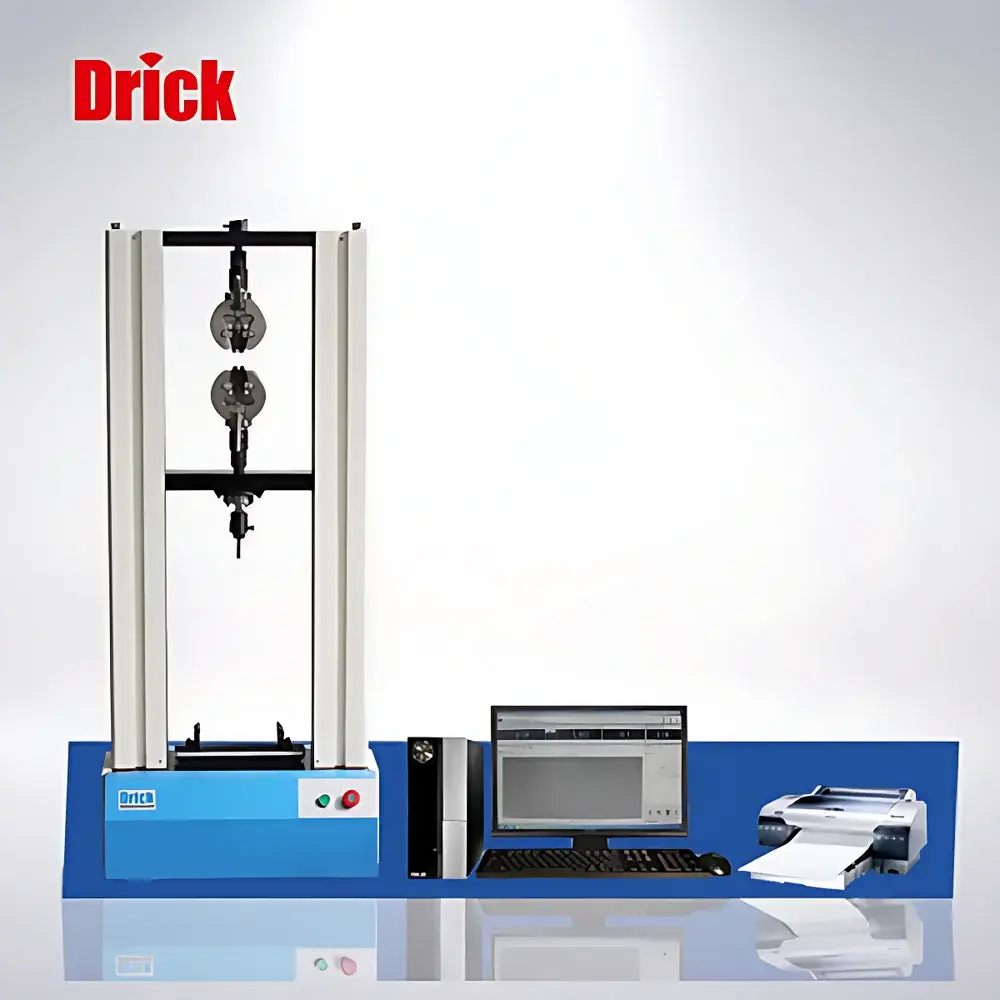
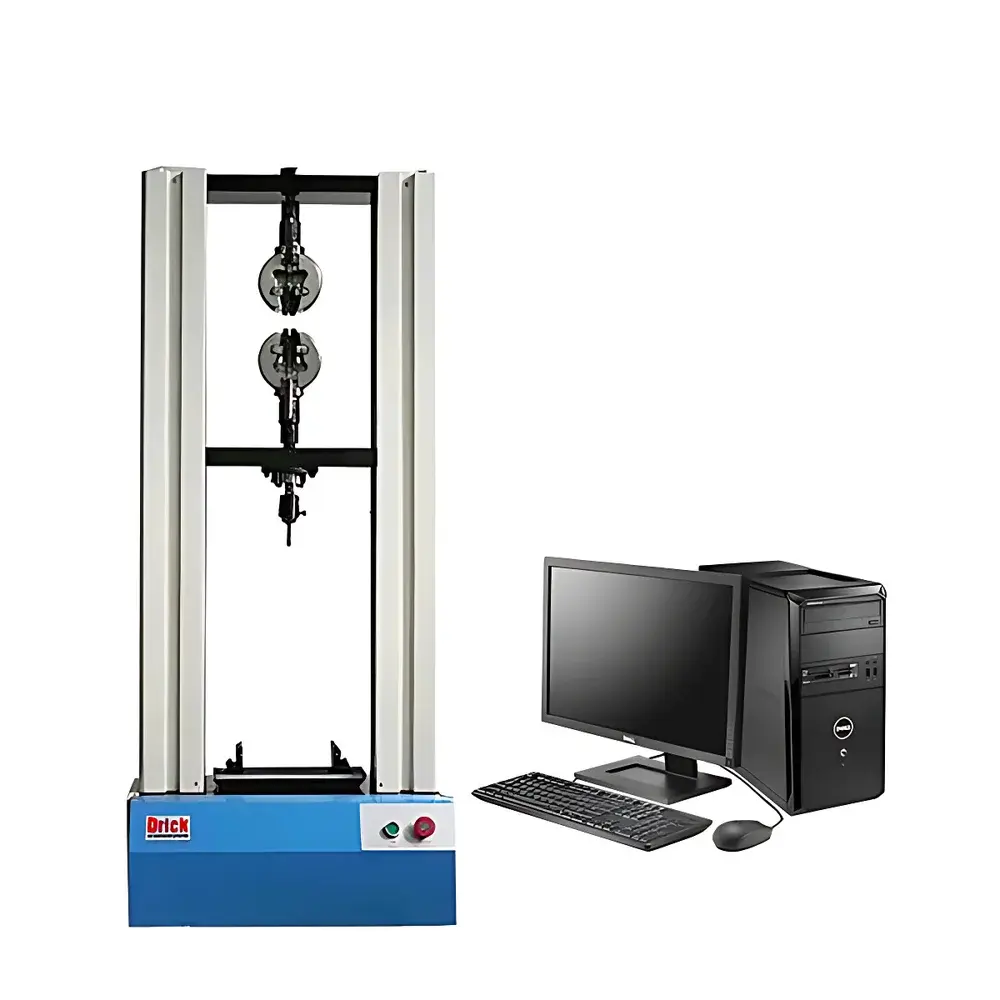
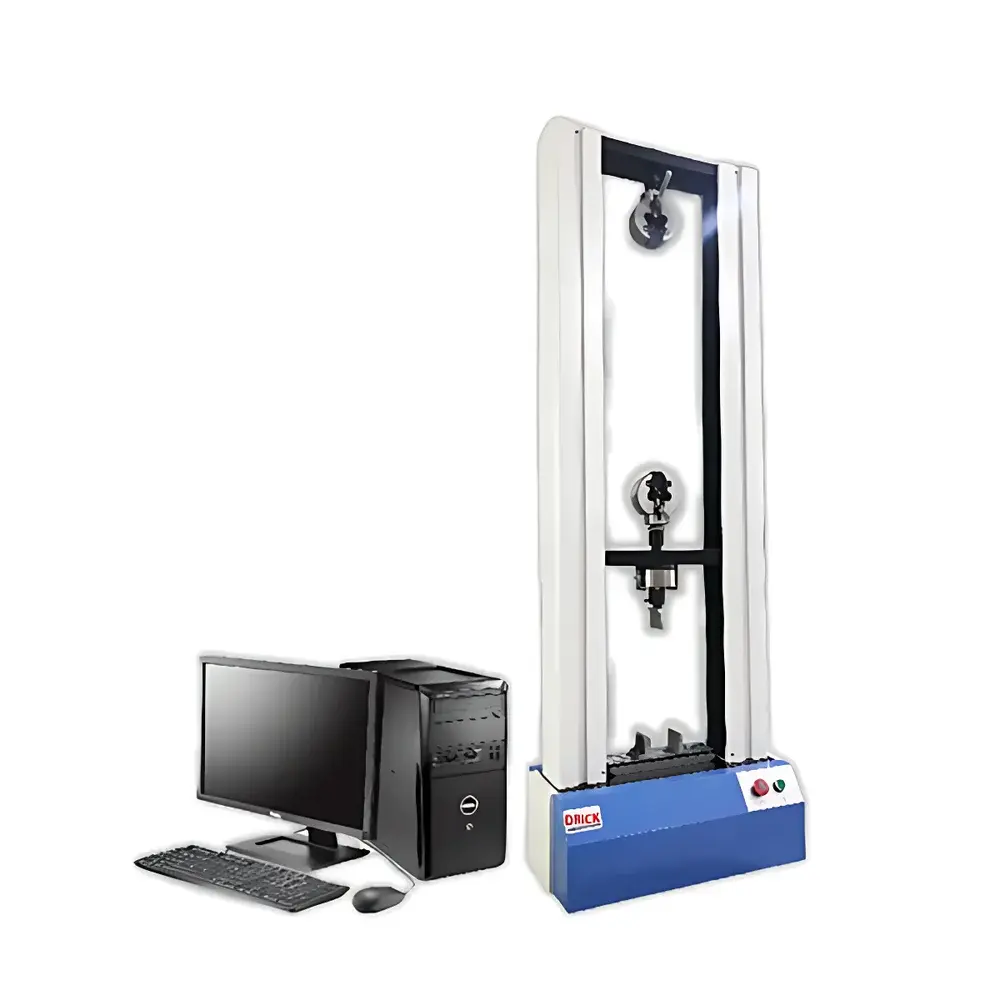
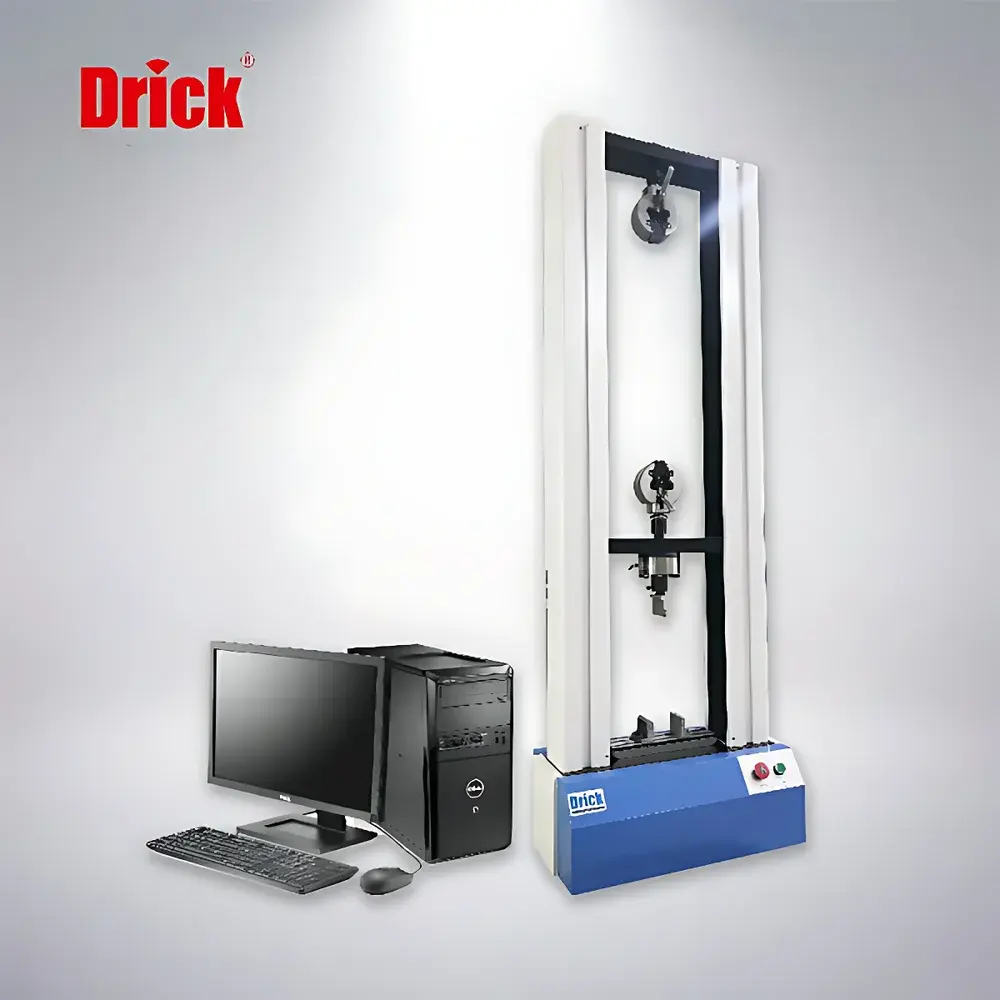
Drick DRK101DG GB 8808 Soft Plastic Peel Testing Machine
| Brand | Drick |
|---|---|
| Origin | Shandong, China |
| Manufacturer Type | Original Equipment Manufacturer (OEM) |
| Product Category | Domestic |
| Model | DRK101DG |
| Instrument Type | Electronic Tensile Testing Machine |
| Maximum Test Load Options | 100 N, 200 N, 500 N, 1 kN, 2 kN, 5 kN, 10 kN, 20 kN (user-selectable single capacity) |
| Force Accuracy | Better than Class 0.5 per ISO 7500-1 |
| Displacement Resolution | ≤ 0.001 mm |
| Effective Stroke | 400–600 mm (customizable) |
| Crosshead Speed Range | 1–500 mm/min |
| Force Resolution | 1/200,000 of full scale, single-range, constant throughout |
| Width of Test Zone | 40 mm or 50 mm (expandable on request) |
| Weight | Approx. 500 kg |
| Power Supply | 220 V AC, 50 Hz, 0.75 kW (motor power scalable with load rating) |
Overview
The Drick DRK101DG GB 8808 Soft Plastic Peel Testing Machine is a precision-engineered universal tensile and peel testing system designed to meet the stringent mechanical evaluation requirements of flexible packaging, thin-film laminates, adhesive bonds, and soft polymeric substrates. Built in accordance with China’s national standard GB 8808—“Test Method for Peel Strength of Composite Films and Laminated Materials”—this machine employs a dual-column, floor-standing electromechanical architecture based on high-rigidity structural frames, precision-ground ball screws, and industrial-grade AC servo drive systems. Its measurement principle conforms to standardized uniaxial tension and 90°/180° peel protocols defined in ISO 37, ASTM F88, ASTM F904, and GB/T 2792, delivering traceable force-displacement data under controlled displacement rate conditions. The system operates within a calibrated force range from 0.2% to 100% FS (full scale), supporting both static and dynamic mechanical characterization across compliant soft materials.
Key Features
- Modular multi-function capability: Configurable for tensile, peel (90° and 180°), tear, puncture, and elongation-at-break testing via interchangeable grips and fixtures.
- High-fidelity force transduction: Load cells available in eight selectable capacities (100 N to 20 kN), each certified to ISO 7500-1 Class 0.5 accuracy with linearity error ≤ ±0.5% of reading.
- Precision motion control: Servo-driven crosshead with speed resolution of 0.01 mm/min and programmable ramp-hold profiles across 1–500 mm/min.
- Integrated safety architecture: Dual-stage overload protection (110% FS automatic shutdown), electronic travel limit switches, emergency stop circuitry, and auto-return functionality post-test.
- Robust mechanical construction: Cold-rolled steel frame with electrostatic powder coating; base-mounted design ensures stability during high-force peel cycles up to 20 kN.
- Real-time data acquisition: 10 kHz sampling rate for synchronized force/displacement capture, enabling accurate peak load, yield point, and energy-to-failure calculations.
Sample Compatibility & Compliance
The DRK101DG accommodates specimens ranging from ultra-thin polymer films (≥12 µm) to reinforced composite laminates, including but not limited to BOPP/CPP coextrusions, PET/Alu foil laminates, pressure-sensitive adhesives (PSAs), medical pouch seals, and flexible printed electronics substrates. It supports standard specimen widths of 15 mm, 25 mm, and 50 mm per GB 8808 and ASTM D1876, with optional custom jaw widths up to 100 mm. All hardware and firmware comply with ISO/IEC 17025 documentation traceability requirements. The instrument satisfies regulatory alignment for QC laboratories operating under GLP, GMP, and ISO 9001 quality management systems. Mechanical validation includes routine verification per ASTM E4 and ISO 7500-1, with calibration certificates traceable to CNAS-accredited standards.
Software & Data Management
The DRK101DG is operated via Windows-based proprietary software compliant with FDA 21 CFR Part 11 requirements—including user access control, electronic signatures, audit trail logging, and immutable raw data storage. The interface enables real-time graphing of stress-strain, peel force vs. distance, and time-dependent creep/recovery curves. Statistical analysis modules compute mean peel strength, standard deviation, coefficient of variation (CV%), and confidence intervals across test groups. Data export supports CSV, Excel, PDF, and XML formats for integration into LIMS or ERP platforms. Software supports automated report generation per GB/T 2792, ASTM D3330, and JIS P8113 templates, including pass/fail flagging against user-defined specification limits.
Applications
- Primary use: Quantitative peel strength assessment of heat-sealed, solvent-bonded, or extrusion-laminated flexible packaging structures per GB 8808 and ASTM F88.
- Quality assurance: Routine batch testing of adhesive bond integrity in medical device pouches, pharmaceutical blister lidding, and sterile barrier systems.
- R&D support: Characterization of interfacial adhesion in multilayer bioplastics, nanocomposite films, and dissolvable packaging matrices.
- Cross-industry extension: Tensile modulus and elongation testing of nonwovens (GB/T 1040.3), tear resistance of geotextiles (GB/T 17639), and bond strength of wire insulation coatings (UL 1581).
- Regulatory submission: Generation of mechanically validated data packages for CFDA, FDA, and EU MDR compliance dossiers.
FAQ
Does the DRK101DG support both 90° and 180° peel configurations?
Yes—the system includes dedicated peel fixtures compliant with ASTM F904 (90°) and ASTM D1876 (180°), with adjustable anchoring angles and low-friction roller guides to minimize bending moment artifacts.
Can test parameters be saved as reusable methods?
Yes—up to 100 user-defined test methods can be stored locally, each containing preset speed profiles, load cell selection, auto-stop triggers, and reporting templates.
Is third-party calibration certification included with shipment?
A factory calibration certificate traceable to national metrology institutes is provided; optional CNAS-accredited calibration services are available upon request.
What is the minimum specimen thickness the machine can reliably test?
With appropriate micro-grip sets and low-force load cells (e.g., 100 N), the system achieves stable measurements on specimens as thin as 12 µm, subject to proper clamping technique and edge alignment.
How is data integrity ensured during long-duration creep tests?
The embedded controller maintains continuous 10 kHz sampling without buffer overflow, while software enforces write-locked binary archiving and SHA-256 hash verification for all raw datasets.



