
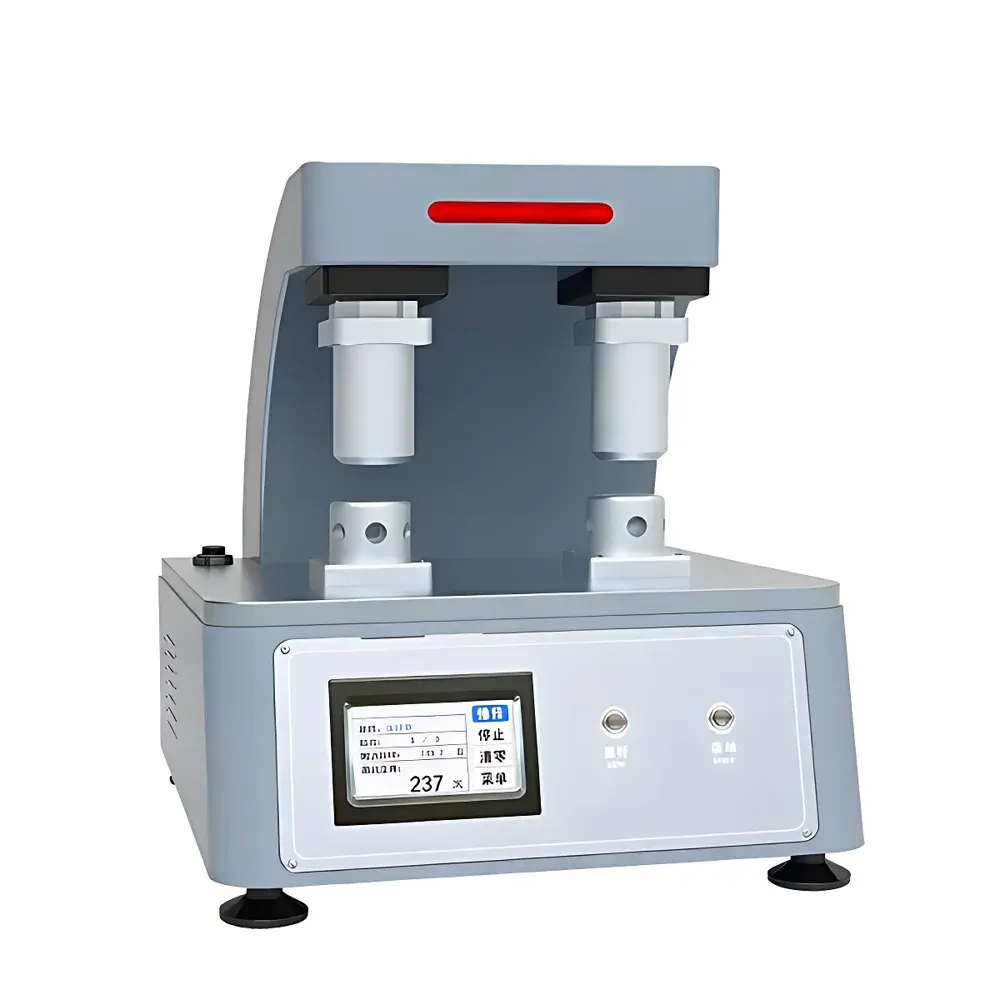
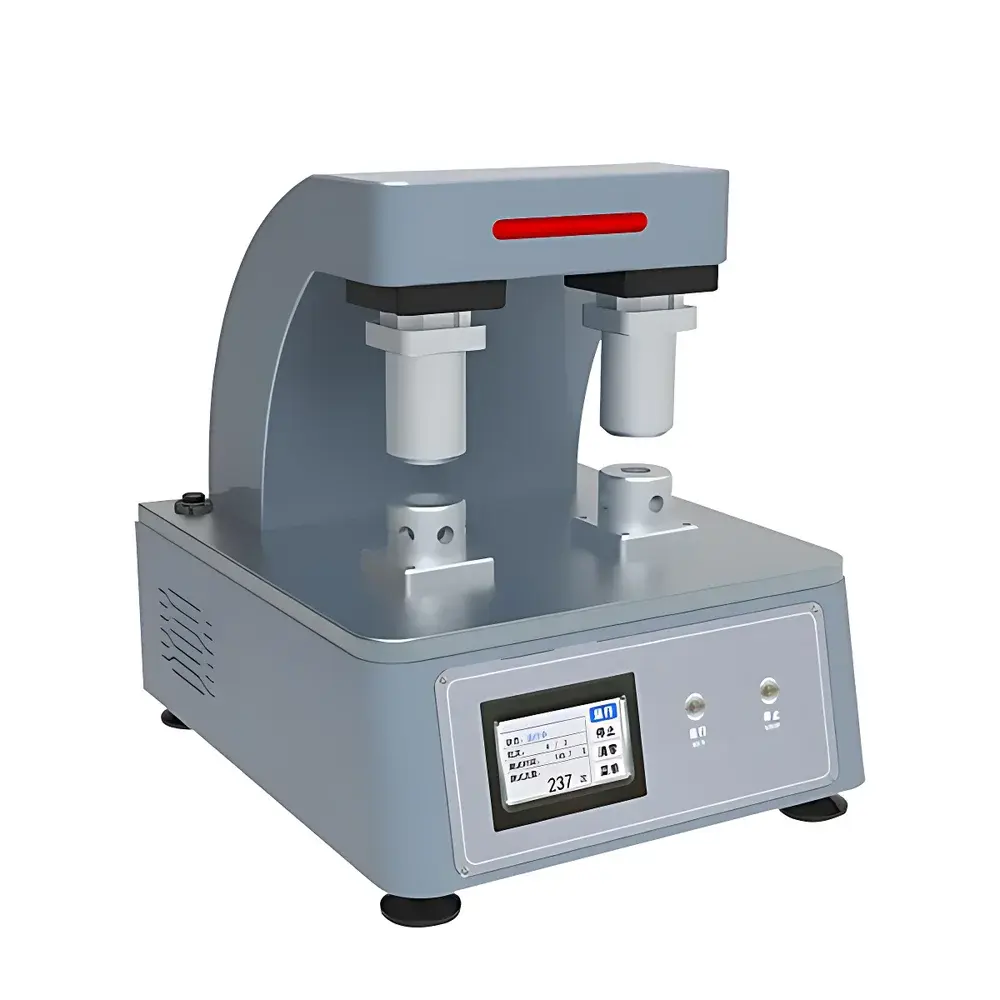
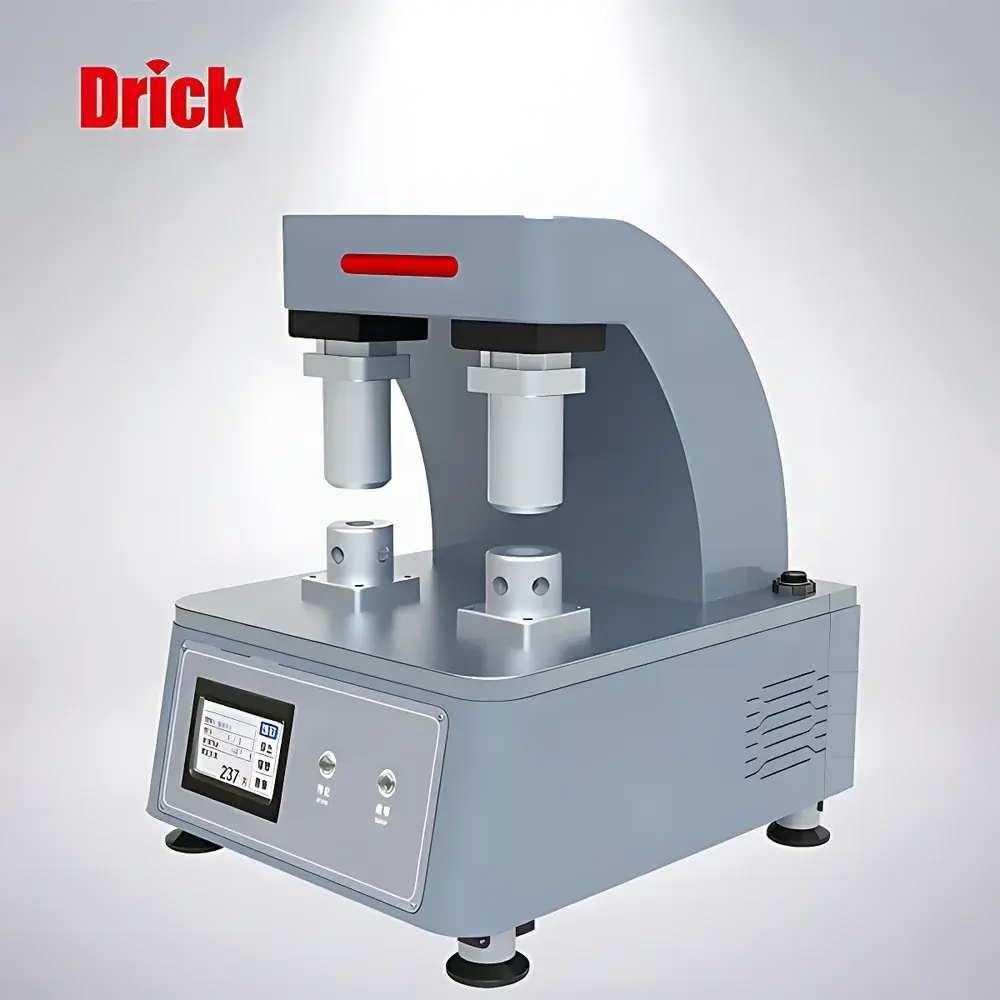
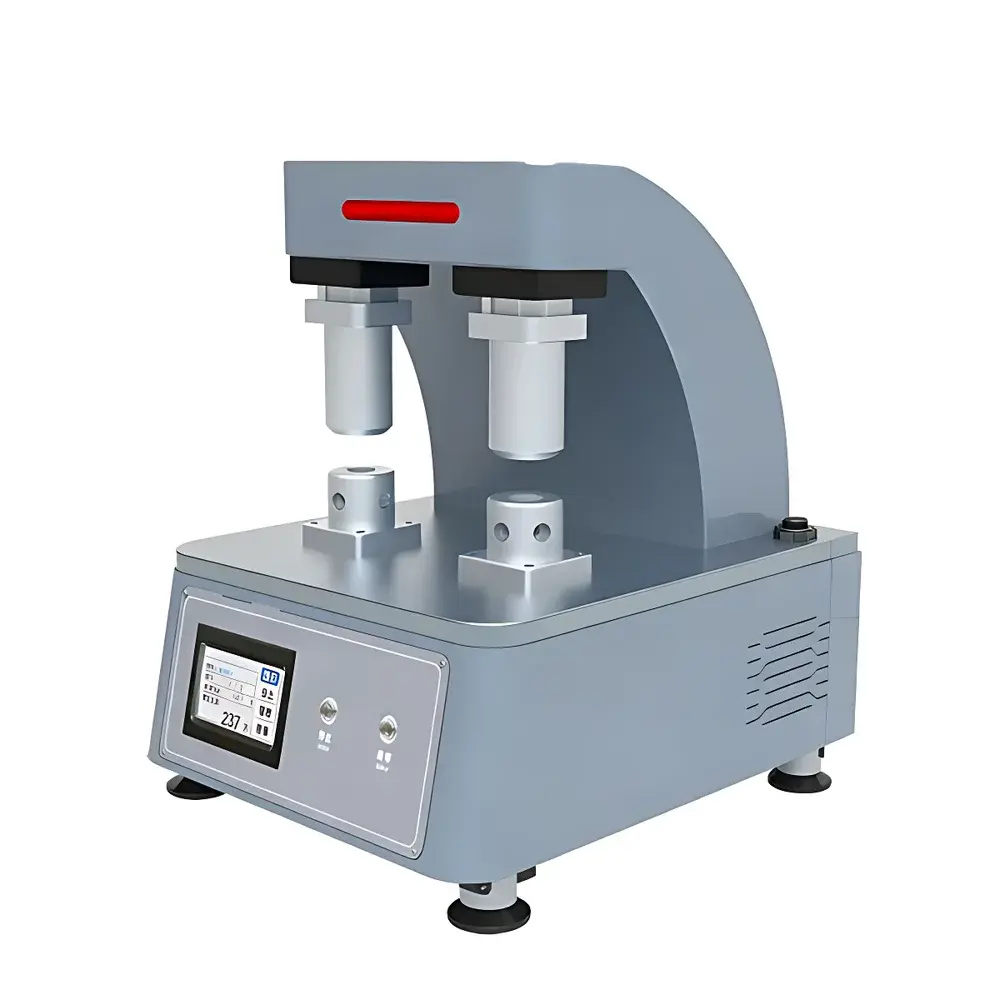
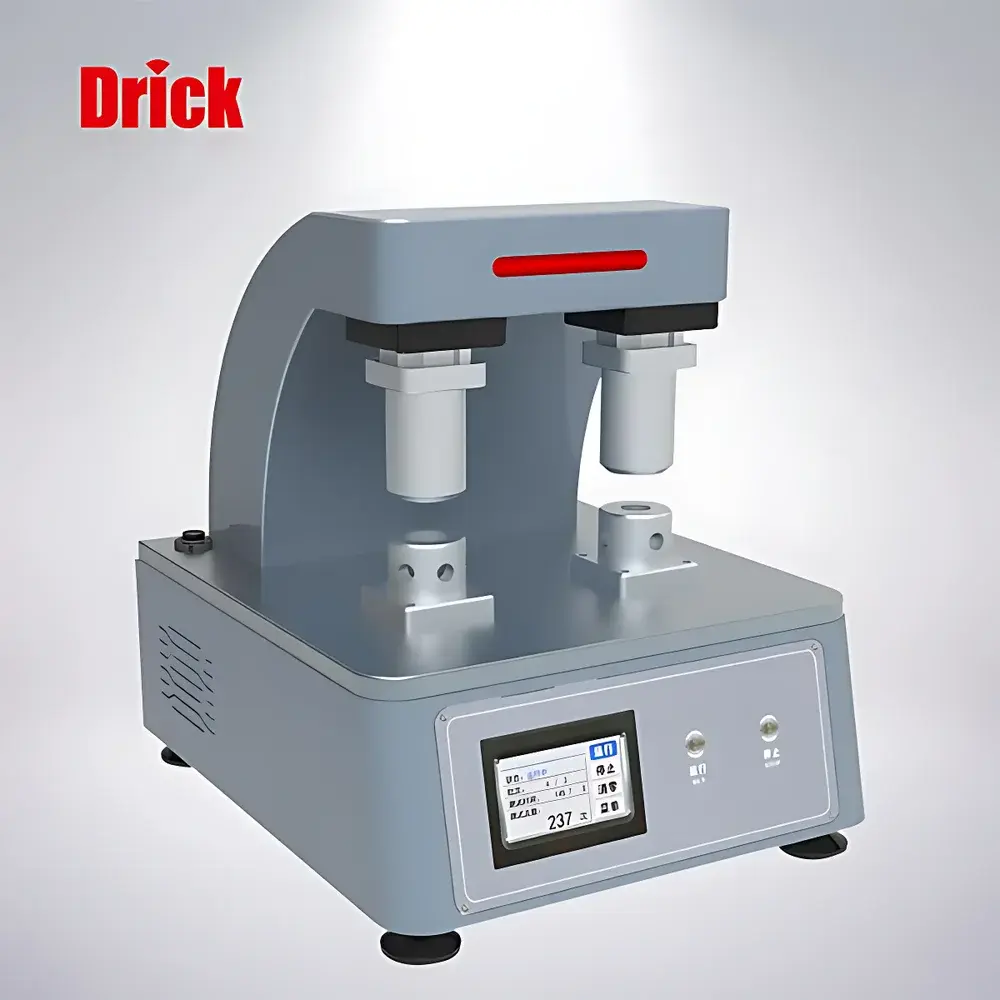
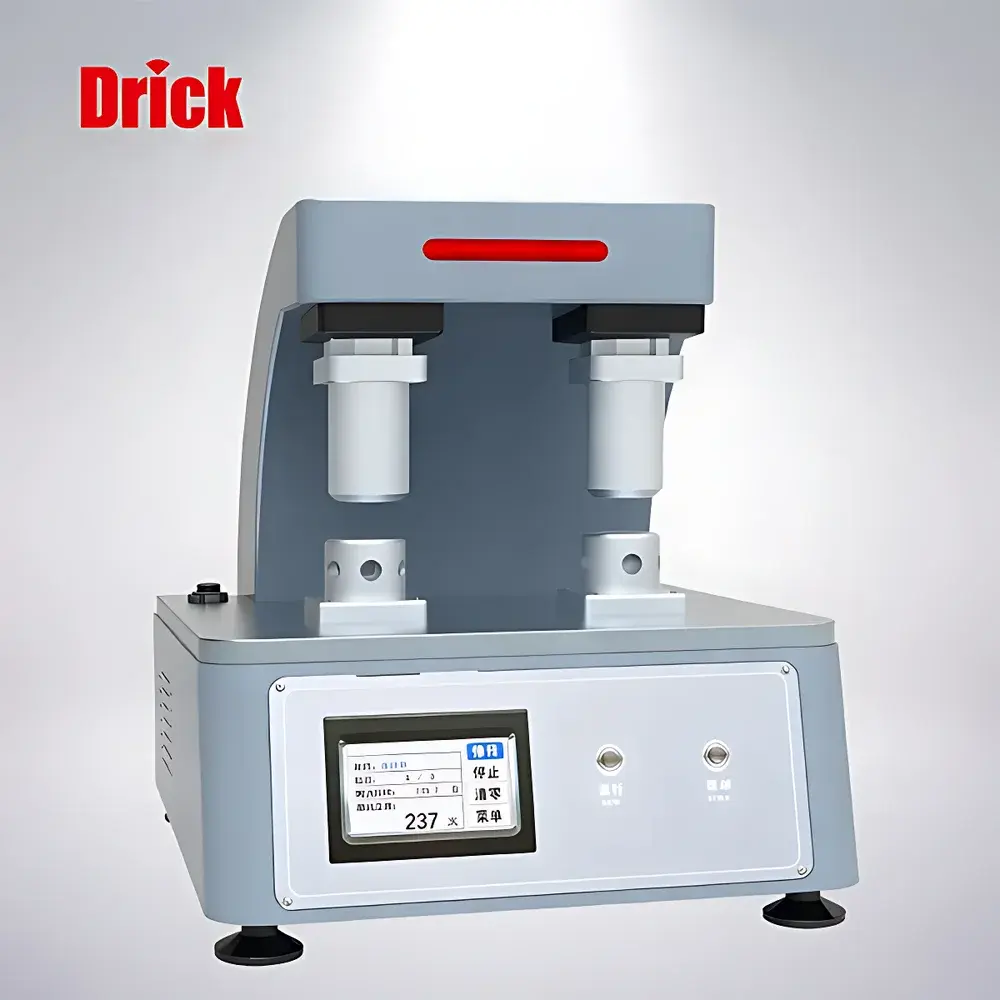
Drick DRK463 Gurley-Type Air Permeability Tester for Lithium-Ion Battery Separators
| Brand | Drick |
|---|---|
| Origin | Shandong, China |
| Manufacturer | Drick Instrument Co., Ltd. |
| Model | DRK463 |
| Pressure Control | BELLOFRAM precision pressure regulator (USA) |
| Pressure Reduction | Swagelok pressure-reducing valve (USA) |
| Pressure Sensor | High-accuracy piezoresistive transducer |
| Buffer Volume | Integrated large-capacity buffer tank |
| Test Stations | Dual independent stations (6.42 cm² & 3.21 cm² test areas) |
| Sample Thickness Range | 3–25 µm |
| Sample Width Range | 25–50 mm |
| Test Duration | 1–999 s (typical completion in ≤3 s) |
| Air Supply | Compressed air source |
| Flow Measurement | Thermal mass flow meter (≤200 cc/min, ±1% FS |
| optional ranges | 30 cc/min or 1000 cc/min) |
| Repeatability | ≤2 sec/100 cc (same location, n=3) |
| Accuracy Stability | ≤3 sec/100 cc vs. reference standard across material types |
| Clamping | Pneumatic dual-face clamping with hardened 40Cr steel jaws (quenched & ground) + integrated sealing system |
| Interface | 7-inch color TFT touchscreen (bilingual: English/Chinese), menu-driven UI |
| Data Output | Built-in thermal printer port |
| Connectivity | RS-232 serial interface for PC communication |
| Software | Dedicated Windows-based acquisition & analysis software (real-time data streaming, CSV export, MES-compatible API-ready output) |
| Calibration | Onboard certified reference standard for daily verification |
| Compliance | Designed to support ASTM D737, ISO 9237, and GB/T 5453 test protocols |
Overview
The Drick DRK463 Gurley-Type Air Permeability Tester is an engineered metrology instrument designed specifically for the quantitative evaluation of air permeability in microporous polyolefin separators used in lithium-ion battery manufacturing. It operates on the fundamental principle of Gurley-type resistance measurement: a controlled volume of compressed air is driven through a standardized test area of the separator under regulated differential pressure, and the time required for a fixed volume (typically 100 cm³) of air to pass through is recorded as the Gurley number (seconds per 100 cm³). This value inversely correlates with pore interconnectivity, tortuosity, and effective porosity—critical quality attributes directly linked to ionic conductivity, dendrite suppression, and thermal shutdown performance. The DRK463 implements a closed-loop pneumatic architecture with dual independent test stations, enabling concurrent validation of heterogeneous separator batches or comparative testing of asymmetric membranes. Its design adheres to the physical constraints and procedural rigor defined in ASTM D737 (“Standard Test Method for Air Permeability of Textile Fabrics”), ISO 9237 (“Textiles — Determination of Air Permeability of Fabrics”), and GB/T 5453 (“Determination of Air Permeability of Fabrics”)—all widely adopted as technical baselines for separator qualification in cell production environments.
Key Features
- Dual-station configuration with independently configurable test areas (6.42 cm² and 3.21 cm²), supporting both wide-format roll samples and narrow lab-cut specimens without mechanical reconfiguration.
- Precision pressure regulation via BELLOFRAM Series 1000 high-stability diaphragm regulators (USA), delivering ±0.05 psi control stability over full operational range (0–50 kPa).
- Swagelok SS-4R-SS-8 stainless-steel pressure-reducing valve (USA) upstream of the test chamber ensures consistent inlet pressure conditioning and safeguards sensitive downstream components from supply fluctuations.
- Integrated 5-liter stainless-steel buffer tank mitigates transient pressure decay during rapid airflow events, preserving measurement integrity during short-duration tests (≤3 s).
- Thermal mass flow sensor with digital linearization (±1% full-scale accuracy) enables real-time volumetric monitoring and leak detection prior to formal test initiation.
- Pneumatically actuated clamping system utilizing hardened 40Cr alloy steel jaws (HRC 58–62, surface-ground to Ra ≤0.4 µm) ensures uniform compressive load distribution and eliminates edge leakage—validated by helium leak testing (<1×10⁻⁶ mbar·L/s).
- 7-inch resistive touchscreen with industrial-grade firmware supports bilingual operation (English/Chinese), password-protected method storage, and audit-trail-enabled parameter logging.
Sample Compatibility & Compliance
The DRK463 accommodates separator films ranging from 3 µm to 25 µm in thickness and 25 mm to 50 mm in width—covering standard dry-process and wet-process PE/PP monolayer and trilayer architectures. Its clamping geometry conforms to the dimensional tolerances specified in IEC 62660-1 for separator mechanical handling during QC testing. All pneumatic and electronic subsystems are CE-marked and compliant with EN 61000-6-2 (immunity) and EN 61000-6-4 (emissions). The instrument’s calibration traceability chain extends to NIM (National Institute of Metrology, China) via factory-certified reference standards, satisfying internal QA requirements for ISO/IEC 17025-accredited laboratories. While not FDA-registered, its data integrity framework—including user access control, electronic signature support, and timestamped audit logs—aligns with ALCOA+ principles and facilitates compliance with GMP Annex 11 and USP analytical instrument qualification protocols.
Software & Data Management
The DRK463 is supplied with DrickLab™ v3.2—a Windows-based acquisition platform supporting real-time visualization of pressure, flow rate, and elapsed time during each test cycle. Data is streamed continuously via RS-232 at 115.2 kbps and stored locally with embedded metadata (operator ID, sample ID, test date/time, environmental temperature/humidity if external sensors are connected). Export formats include native .drl binary files and ANSI-compliant CSV (UTF-8 encoded), compatible with Excel, MATLAB, Python pandas, and MES/SCADA systems via RESTful API adapters. The software enforces 21 CFR Part 11 readiness through role-based permissions, electronic signatures for report approval, and immutable audit trails recording all parameter changes, test executions, and calibration events. Raw data files retain unprocessed sensor timestamps at 100 Hz resolution, enabling retrospective waveform analysis for root-cause investigation of outlier results.
Applications
- Quality release testing of incoming separator rolls against OEM-defined Gurley specifications (e.g., 250–450 sec/100 cm³ for automotive-grade NMC cells).
- In-process monitoring during coating, stretching, and extraction stages to correlate process parameters with final permeability performance.
- Comparative evaluation of alternative separator chemistries (e.g., ceramic-coated vs. untreated PP) under identical test conditions.
- Stability assessment of aged or thermally stressed separators using accelerated aging protocols per UL 1642 Annex C.
- Supporting DOE studies on calendering pressure effects on Gurley number drift and pore closure kinetics.
FAQ
What standards does the DRK463 comply with for separator testing?
It supports method execution aligned with ASTM D737, ISO 9237, and GB/T 5453, and its mechanical design meets dimensional and pressure-control criteria referenced in IEC 62660-1.
Can the DRK463 measure Gurley values below 100 sec/100 cm³?
Yes—the instrument’s sub-second timing resolution (10 ms) and high-speed flow sensing enable reliable measurements down to 20 sec/100 cm³, subject to sample homogeneity and clamp seal integrity.
Is calibration traceable to national metrology institutes?
Each unit ships with a factory-calibrated reference standard traceable to NIM (China); users may extend traceability via third-party accredited labs using ISO/IEC 17025 procedures.
Does the software support automated pass/fail decision logic based on specification limits?
Yes—DrickLab™ allows user-defined upper/lower specification limits per test station, with visual alerts and automatic flagging of out-of-spec results in exported reports.
How is data integrity ensured during long-term deployment in regulated environments?
All test records include cryptographic hash signatures, operator authentication tokens, and tamper-evident file headers—fully compliant with ALCOA+ data governance expectations for pharmaceutical and battery QC applications.






