
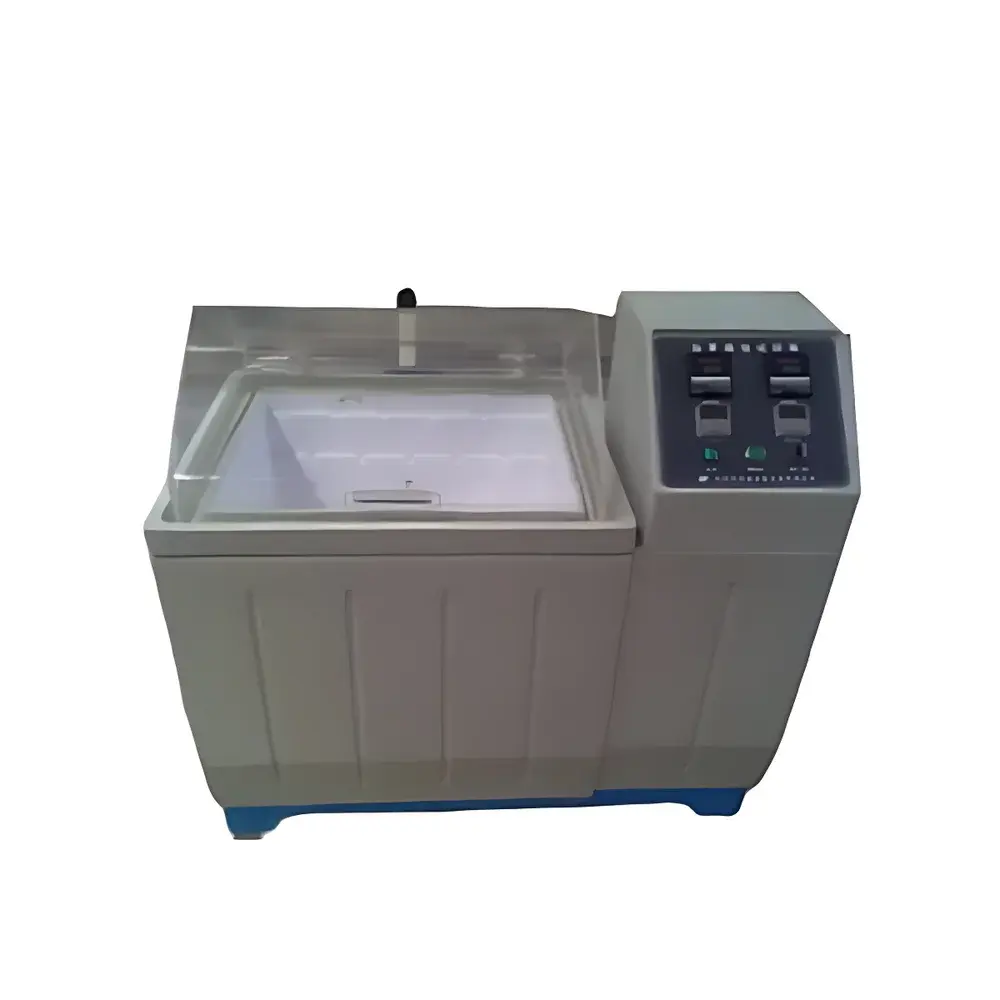
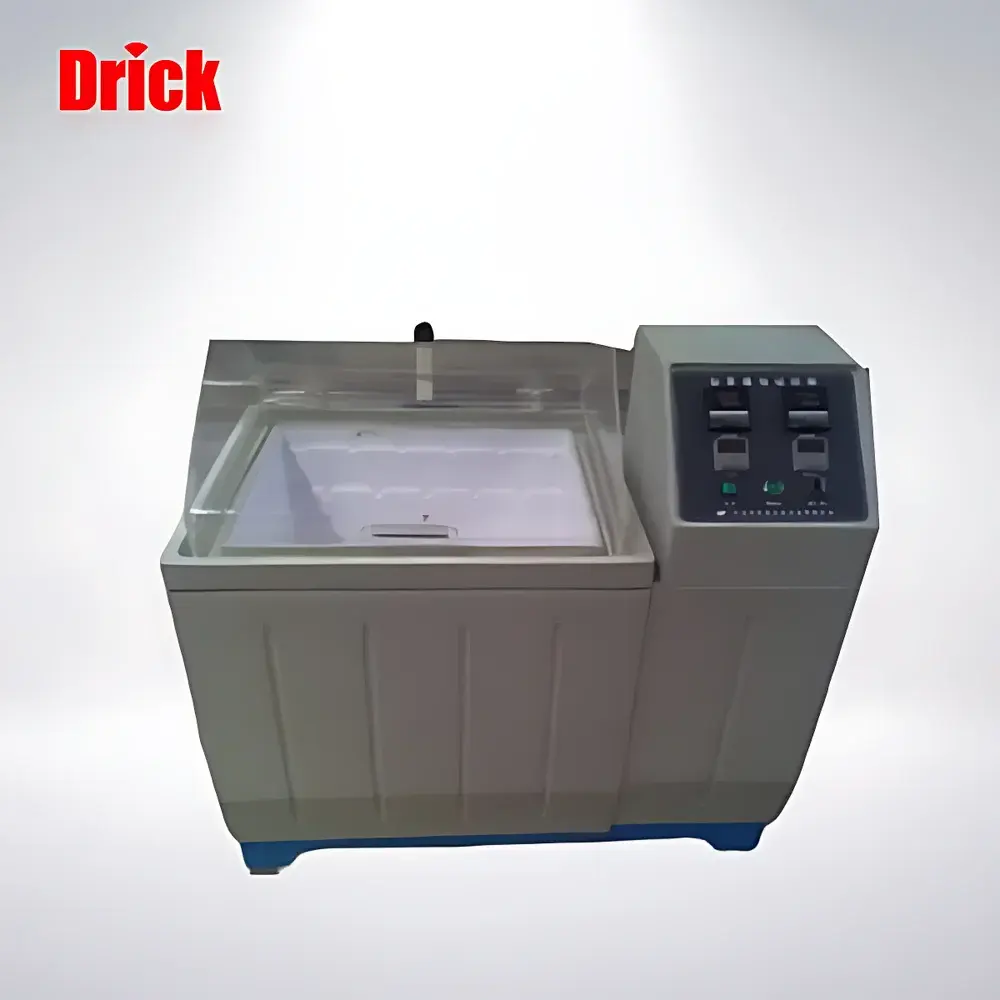
Drick DRK643 Salt Spray Test Chamber
| Brand | Drick |
|---|---|
| Origin | Shandong, China |
| Manufacturer Type | Manufacturer |
| Model | DRK643 |
| Spray Method | Tower-type air-driven atomization |
| Salt Fog Deposition Rate | 1–2 mL/80 cm²/h |
| Temperature Range | 35°C (NSS), 55°C (CASS) |
| Temperature Uniformity | ≤2°C |
| Temperature Fluctuation | ≤±0.5°C |
| Internal Chamber Dimensions (W×D×H) | 500 × 630 × 450 mm |
| External Dimensions (W×D×H) | 680 × 1220 × 1100 mm |
| Chamber Construction | Integral molded fiberglass-reinforced plastic (FRP), corrosion-resistant and leak-proof |
| Controller | RKC-CD701 (Rikoh, Japan) or Fuji brand PID controller |
| Heating System | Stainless steel heating tubes + saturated steam humidification |
| Salt Solution Tank Capacity | 20 L |
| Distilled Water Tank Capacity | 10 L |
| Sample Rack | Dual-tier PVC-coated stainless steel |
| Safety Protections | Over-temperature alarm (Rainbow, Korea), leakage protection, pressure-sensing spray regulation, fuse protection, fully sheathed terminal blocks |
| Power Supply | 220 VAC, 3 kW |
| Compliance Standard | GB/T 2423.17–2022 (equivalent to ISO 9227:2022 for neutral salt spray testing) |
Overview
The Drick DRK643 Salt Spray Test Chamber is an engineered environmental test system designed for standardized accelerated corrosion evaluation of metallic substrates and protective coatings under controlled saline atmospheric conditions. It operates on the principle of continuous or cyclic salt fog generation via tower-type air-driven atomization—where compressed air saturates and propels a pre-conditioned sodium chloride (NaCl) solution through precision nozzles to produce a uniform, stable fog field within the test chamber. The unit supports both Neutral Salt Spray (NSS) per ASTM B117 / ISO 9227 and Copper-Accelerated Acetic Acid Salt Spray (CASS) testing at elevated temperatures (up to 55°C), enabling comparative assessment of coating integrity, galvanic protection performance, and substrate passivation behavior across industrial sectors including automotive, aerospace, electronics, and infrastructure materials.
Key Features
- Integral molded fiberglass-reinforced plastic (FRP) chamber construction ensures long-term resistance to acid mist, mechanical vibration, and chemical cleaning agents—eliminating structural leaks and maintaining dimensional stability over extended operational cycles.
- Precision temperature control with ±0.5°C fluctuation and ≤2°C uniformity across the working volume (500 × 630 × 450 mm), validated per IEC 60068-3-5 requirements for thermal performance verification.
- Tower-type air-driven spray system delivers consistent fog distribution without nozzle clogging; salt deposition rate maintained at 1–2 mL/80 cm²/h, traceable to gravimetric calibration protocols aligned with ISO 9227 Annex A.
- Dual-tier adjustable sample rack fabricated from PVC-coated stainless steel minimizes interference with fog flow while accommodating heterogeneous part geometries up to 12 kg total load.
- Redundant safety architecture includes Korean Rainbow over-temperature cut-off, real-time inlet air pressure monitoring, dedicated spray pressure regulation, leakage current detection, and fully insulated terminal blocks compliant with IEC 61000-6-2 EMC immunity standards.
- Programmable PID controller (RKC-CD701 or Fuji series) supports time-based cycling of spray-on/spray-off intervals, facilitating modified test regimes such as PROHIBIT, SWAAT, or ASTM G85 Annex A5.
Sample Compatibility & Compliance
The DRK643 accommodates coated metals (e.g., zinc-plated steel, aluminum anodized layers), painted panels, electroplated components, printed circuit board assemblies, and polymer-coated fasteners. Its design conforms to national and international reference standards including GB/T 2423.17–2022 (China’s adoption of ISO 9227:2022), ASTM B117, JIS Z2371, and DIN 50021. While not certified to GLP or FDA 21 CFR Part 11 out-of-the-box, its controller logging capability (via optional RS485/Modbus RTU interface) supports audit-ready data capture when integrated into validated laboratory information management systems (LIMS). All internal wetted surfaces meet ISO 8501-1 Sa2.5 surface cleanliness prerequisites prior to test initiation.
Software & Data Management
The embedded RKC-CD701 or Fuji controller provides local setpoint configuration, real-time temperature/fog status display, and event-triggered alarm logging with timestamping. Optional serial communication enables remote parameter adjustment and acquisition of temperature history and spray cycle logs via third-party SCADA platforms. For regulated environments, users may implement external data acquisition using calibrated thermocouples (Type T, Class 1) and volumetric collection funnels validated against ISO 9227 Annex B. No proprietary software is bundled; raw log exports are ASCII-formatted for CSV ingestion into statistical process control (SPC) tools.
Applications
- Quality assurance of electroplated automotive trim and chassis components per OEM specifications (e.g., GMW14872, Ford CETP).
- Validation of corrosion-inhibiting pretreatments on cold-rolled steel used in white goods enclosures.
- Comparative lifetime modeling of organic coatings (epoxy, polyurethane) on offshore wind turbine towers.
- Failure mode analysis of solder mask adhesion on high-reliability PCBs subjected to coastal humidity exposure profiles.
- Pre-certification screening of military-grade connectors (MIL-DTL-38999) under CASS conditions per MIL-STD-202G Method 209.
FAQ
What standards does the DRK643 comply with?
It meets GB/T 2423.17–2022, which is technically equivalent to ISO 9227:2022, and supports test execution per ASTM B117, JIS Z2371, and DIN 50021.
Is compressed air supply included?
No—the unit requires an external clean, oil-free, dry air source (4–6 bar, dew point ≤ –20°C) connected via standard 6 mm PU tubing; this must be provided by the user.
Can the chamber perform cyclic corrosion tests (CCT)?
Yes—when paired with optional programmable controllers supporting multi-step sequences, it can execute ASTM G85 Annexes A1–A5, though native firmware supports only fixed-cycle NSS/CASS modes.
What maintenance is required for long-term reliability?
Daily drain of condensate from the saturated chamber heater, weekly inspection of spray nozzle orifices and FRP seal integrity, and quarterly calibration of temperature sensors against NIST-traceable references.
Does the system include data export functionality?
Basic controllers output real-time values via analog 4–20 mA or Modbus RTU; full audit trails require integration with external DAQ hardware and compliant LIMS software.



