
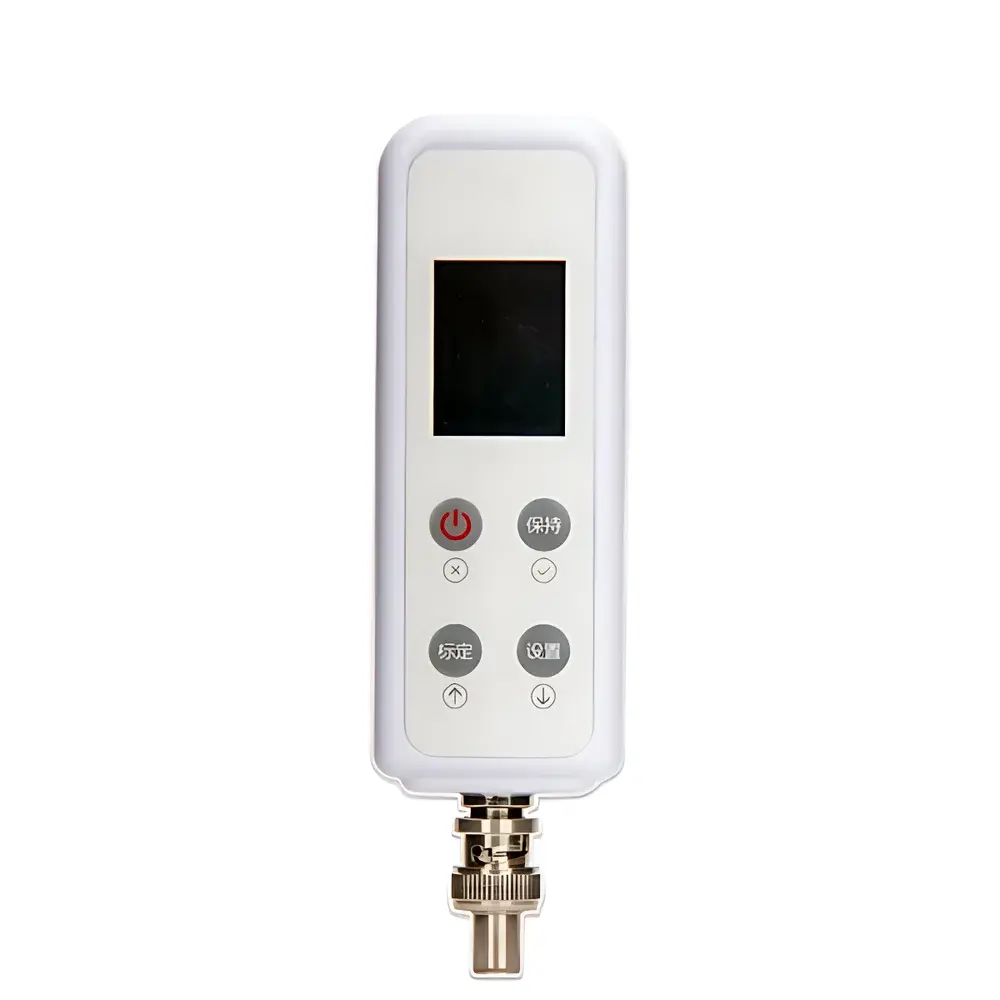


Drick DRK-pHB-6 Portable Pen-Type pH Meter
| Brand | Drick |
|---|---|
| Model | DRK-pHB-6 |
| Type | Pen-style pH Meter |
| Measurement Range | 0.0–14.0 pH |
| Resolution | 0.1 pH |
| Accuracy | ±0.2 pH |
| Stability | ±0.3 pH ±1 digit / 3 h |
| Temperature Compensation | Automatic (ATC) |
| Calibration | Auto-recognition of 1–3 points using NIST-traceable buffers (pH 4.00, 6.86, 9.18) |
| Electrode Interface | BNC |
| Display | Backlit black-matrix LCD with wide viewing angle |
| Power | 2 × AA batteries (1.5 V each) |
| Power Consumption | 0.2 W |
| Operating Environment | 5–40 °C, ≤80% RH |
| Dimensions | 120 × 40 × 34 mm |
| Weight | 0.2 kg |
| Electrode | Integrated long-stem pH electrode with status indicator |
| Battery Level Indicator | Yes |
| Auto-Off | Configurable (3 min inactivity) |
| Self-Test | On power-up |
| Over-range Alarm | Audible & visual |
| Compliance | Designed per JJG 119–2019 (Chinese National Verification Regulation for pH Meters) |
| Data Hold | Yes |
| IP Rating | IP67 (dust-tight and water-resistant to 1 m for 30 min) |
Overview
The Drick DRK-pHB-6 is a compact, handheld pen-type pH meter engineered for rapid, reliable field and benchtop measurement of aqueous solution acidity or alkalinity. It operates on the fundamental principle of potentiometric electrochemistry: a glass pH sensing electrode generates a millivolt potential proportional to hydrogen ion activity (log[H⁺]), which is converted and displayed as a calibrated pH value (0.0–14.0) referenced to standardized buffer solutions. Designed for operational robustness in variable environmental conditions—from municipal water treatment stations and food processing lines to academic teaching labs and environmental sampling sites—the DRK-pHB-6 integrates a long-stem integrated electrode, automatic temperature compensation (ATC), and intelligent diagnostics to minimize operator dependency while maintaining metrological integrity across routine use.
Key Features
- Backlit black-matrix LCD display with wide viewing angle and sunlight-readable contrast—optimized for outdoor and low-light environments.
- Vertical multi-zone interface layout: real-time pH reading, battery status, electrode health icon, temperature value, and calibration mode indicators are simultaneously visible without menu navigation.
- Hold function retains the measured value after electrode removal from solution—critical for spot-checking tanks, pipes, or shallow reservoirs where immersion time is limited.
- Integrated long-stem pH electrode with optimized junction geometry and stable reference system—designed for consistent response in viscous, turbid, or low-ionic-strength samples.
- Auto-buffer recognition during calibration: detects and applies correction factors for pH 4.00, 6.86, and 9.18 standard buffers per JJG 119–2019; supports 1-, 2-, or 3-point calibration routines.
- Real-time ATC via built-in thermistor: compensates for thermal drift across 5–40 °C operating range, reducing systematic error attributable to temperature-dependent electrode slope deviation.
- Electrode health monitoring: dynamic icon-based feedback indicates membrane hydration, junction flow, and reference stability—supporting proactive maintenance and traceable instrument qualification.
- User-configurable auto-power-off (3-minute timeout) and manual override option—extends battery life without compromising measurement continuity.
- Power-on self-diagnostic sequence verifies sensor continuity, analog-to-digital converter integrity, and display functionality prior to entering measurement mode.
- Over-range alert: simultaneous audible beep and flashing display warn operators when pH falls outside 0.0–14.0 scale—preventing misinterpretation of saturated or contaminated electrode signals.
Sample Compatibility & Compliance
The DRK-pHB-6 is validated for direct immersion in aqueous samples including drinking water, wastewater effluent, nutrient solutions, beverage formulations, and mild process streams (pH 0–14, non-aggressive oxidizers or solvents). Its IP67-rated housing ensures resistance to dust ingress and transient submersion (1 m, 30 min), making it suitable for humid industrial zones and field deployment. While not certified for Class I Div 1 hazardous locations, it meets general-purpose safety requirements under IEC 61010-1:2010. Calibration traceability aligns with JJG 119–2019, and its performance envelope supports routine compliance with ISO 5667-3 (water quality sampling) and ASTM D1293 (standard test method for pH of water). For GLP/GMP environments, users may document calibration events, electrode lot numbers, and verification checks manually or via external logbooks.
Software & Data Management
As a standalone portable meter, the DRK-pHB-6 does not feature Bluetooth, USB, or cloud connectivity. All measurements are displayed and retained only during active session hold—no internal memory or data export capability is provided. This architecture prioritizes simplicity, electromagnetic immunity, and regulatory transparency: no firmware updates, no audit trail generation, and no software validation burden. Users requiring electronic records must pair the device with external logging tools (e.g., manual entry into LIMS, spreadsheet capture, or third-party dataloggers interfaced via analog output adapters). The absence of digital storage simplifies 21 CFR Part 11 compliance pathways in regulated settings where paper-based or controlled electronic records are mandated.
Applications
- Field-based potable water quality screening at distribution points and source wells.
- Routine pH verification in aquaculture systems, hydroponic nutrient tanks, and swimming pool maintenance.
- Quick-check verification in food & beverage production lines (e.g., dairy pasteurization, juice blending, brewing).
- Teaching laboratories for introductory electrochemistry and analytical methods courses.
- Environmental monitoring of surface runoff, stormwater outfalls, and soil leachate extracts.
- Pre-screening prior to high-precision lab analysis—reducing unnecessary sample transport and instrument queue time.
FAQ
What buffer standards are supported for calibration?
The DRK-pHB-6 auto-recognizes three NIST-traceable calibration buffers: pH 4.00, 6.86, and 9.18—aligned with JJG 119–2019 requirements for general-purpose pH meters.
Is the electrode replaceable?
The pH sensor is integrated and non-field-replaceable; the entire unit is serviced or replaced upon electrode degradation or physical damage.
Does the meter support manual temperature input?
No—temperature compensation is exclusively automatic via the built-in thermistor; no manual offset or fixed-T mode is available.
Can it measure non-aqueous or high-alcohol-content solutions?
It is designed for aqueous media only; measurements in organic solvents, glycerol, or ethanol >10% v/v may yield inaccurate or unstable readings due to altered liquid junction potentials and glass membrane hydration.
How often should calibration be performed?
Calibration frequency depends on usage intensity and sample matrix; daily calibration is recommended for critical applications, while weekly verification suffices for stable, low-risk environments—always before first use and after exposure to extreme pH or contaminants.







