
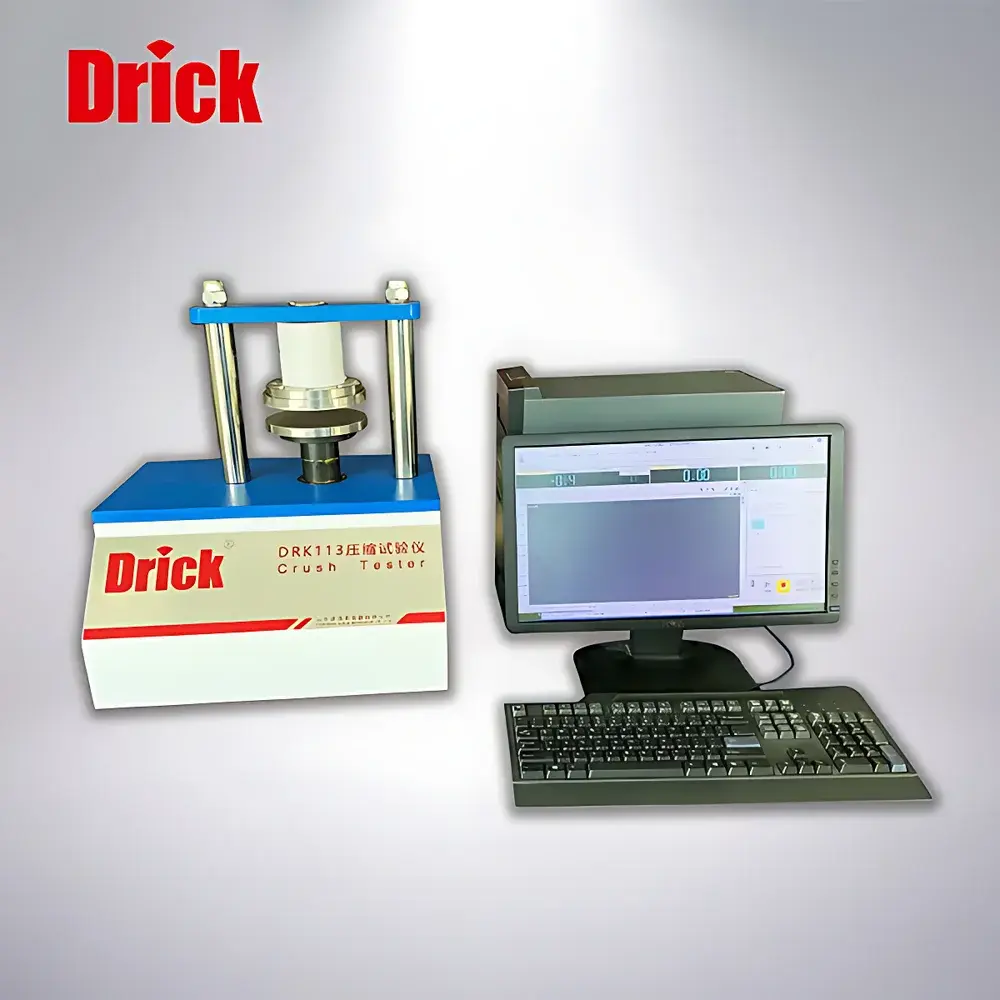
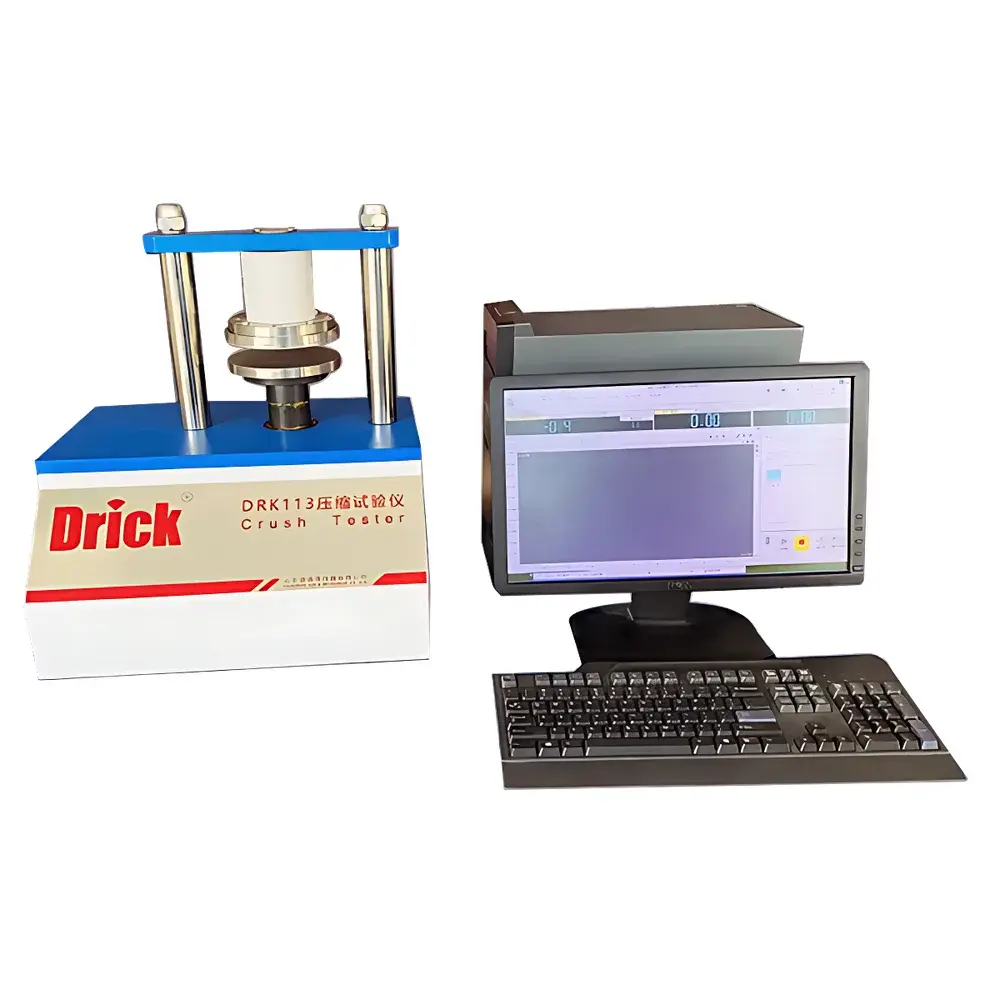
Drick DRK113PC ISO 12192 Computer-Controlled Compression Tester
| Brand | Drick |
|---|---|
| Origin | Shandong, China |
| Manufacturer Type | Manufacturer |
| Regional Classification | Domestic (China) |
| Model | DRK113PC |
| Price Range | USD 7,000 – 14,000 |
| Power Supply | AC 220 V ±10%, 2 A, 50 Hz |
| Force Accuracy | ±1% of full scale |
| Force Repeatability | <1% |
| Resolution | 0.1 N |
| Force Range | 5–5000 N |
| Platen Parallelism | ≤0.05 mm |
| Test Stroke | 1–70 mm |
| Test Speed | 12.5 ±2.5 mm/min |
| Circular Platen Diameter | 135 mm |
| Interface | Windows-based PC software |
| Output | Inkjet printer support |
| Operating Environment | 20 ±10 °C, RH <85% |
| Standards Compliance | ISO 12192, ISO 3035, ISO 3037, ISO 7263, GB/T 2679.6, GB/T 2679.8, GB/T 6546, GB/T 6548, QB/T 1048 |
Overview
The Drick DRK113PC ISO 12192 Computer-Controlled Compression Tester is a precision-engineered mechanical testing instrument designed specifically for quantitative evaluation of compressive resistance in thin-sheet and corrugated paper-based materials. It operates on the principle of controlled uniaxial compression between parallel platens, with force and displacement transduced via a high-accuracy load cell and linear encoder system. The instrument conforms to internationally recognized test methodologies—including ring crush (RCT), edge crush (ECT), flat crush (FCT), flute adhesion (PAT), and core crush (CMT)—as defined in ISO 12192, ISO 3037, ISO 3035, and corresponding Chinese national standards (GB/T series). Its architecture integrates a fixed upper platen, rigid frame construction, and microprocessor-regulated drive system to ensure consistent loading rates and minimal parasitic bending moments—critical for reproducible measurement of low-thickness specimens (0.15–1.00 mm) and small-diameter cylindrical samples (≤60 mm diameter cores or containers).
Key Features
- Fixed upper platen configuration with high-stiffness steel frame to minimize deflection and maintain platen parallelism (≤0.05 mm) across the full stroke range (1–70 mm).
- High-resolution force measurement system (0.1 N resolution, ±1% accuracy, <1% repeatability) using a calibrated S-type load cell mounted directly in the load train.
- Computer-controlled actuation with programmable crosshead speed (12.5 ±2.5 mm/min), synchronized data acquisition at ≥100 Hz sampling rate for precise capture of peak load and deformation onset.
- Windows-based proprietary software enabling real-time plotting of force–displacement curves, automatic detection of failure points, and calculation of key metrics including maximum compressive load, yield point, and energy absorption.
- Modular platen adaptability: standard 135 mm circular platen for RCT/ECT/FCT; optional custom platens available for cup, bowl, tube, and small-box testing per QB/T 1048 and GB/T 6546.
- Fully automated sequence execution—including pre-load application, dwell, ramped compression, and auto-return—with digital zeroing, calibration traceability, and user-defined pass/fail thresholds.
Sample Compatibility & Compliance
The DRK113PC accommodates standardized specimen geometries as specified in ISO and GB/T standards: 15.2 mm × 152 mm strips for ring crush (RCT); 25 mm × 100 mm edges for ECT; 100 mm × 100 mm squares for FCT; and 25 mm × 150 mm bonded flutes for PAT. It supports CMT testing on paper cores up to 60 mm in diameter and is routinely deployed for quality assurance of disposable food packaging (paper cups, bowls, buckets), fiberboard tubes, honeycomb panels, and small-format cartons. All test routines comply with ISO/IEC 17025 documentation requirements for accredited laboratories, and raw data files include embedded metadata (operator ID, timestamp, environmental conditions, calibration certificate ID) to support GLP and internal audit readiness.
Software & Data Management
The integrated Windows application provides full test lifecycle management: method setup (predefined templates for ISO 12192, GB/T 2679.8, etc.), real-time curve visualization, statistical batch reporting (mean, SD, CV%, min/max), and export to CSV, PDF, or XML formats. Audit trails record all parameter modifications, calibration events, and result approvals. Data integrity is maintained through role-based access control, electronic signatures compliant with FDA 21 CFR Part 11 principles (when deployed on validated IT infrastructure), and automatic backup to network drives or cloud repositories. Print outputs include calibrated test reports with instrument ID, standard reference, environmental logs, and uncertainty statements per ISO/IEC 17025 Annex A.
Applications
- Quality control of linerboard, kraft paper, and recycled fiber substrates in pulp & paper manufacturing.
- Validation of corrugated board performance for e-commerce packaging design and ISTA-compliant logistics testing.
- Routine inspection of food-grade paper containers (cups, bowls, trays) for regulatory compliance (e.g., GB 4806.8–2016).
- Research and development of novel fiber-based composites, including molded fiber trays and biodegradable cushioning structures.
- Supplier qualification and incoming material verification in packaging converters and OEM assembly lines.
- Support for technical documentation required under ISO 9001:2015 clause 8.5.2 (Identification and traceability) and clause 8.6 (Release of products and services).
FAQ
What standards does the DRK113PC fully support out-of-the-box?
It natively implements ISO 12192 (ring crush), ISO 3037 (edge crush), ISO 3035 (flat crush), ISO 7263 (flute crush), GB/T 2679.6, GB/T 2679.8, GB/T 6546, GB/T 6548, and QB/T 1048—with preconfigured test methods, units, and pass criteria.
Can the system be integrated into a LIMS environment?
Yes—via CSV/XML export or optional OPC UA interface (hardware-dependent); raw data files contain structured metadata compatible with common LIMS ingestion protocols.
Is third-party calibration certification included with purchase?
A factory calibration report traceable to CNAS-accredited national standards is provided; users may request optional on-site calibration by ISO/IEC 17025-certified service partners.
What maintenance intervals are recommended for long-term accuracy?
Load cell verification every 6 months; mechanical alignment check annually; firmware updates applied per manufacturer release schedule (typically biannually).
Does the software support multi-language UI and report generation?
The base interface is English-only; however, report templates are fully editable in Microsoft Word format, enabling localization of headers, footers, and terminology without code modification.







