
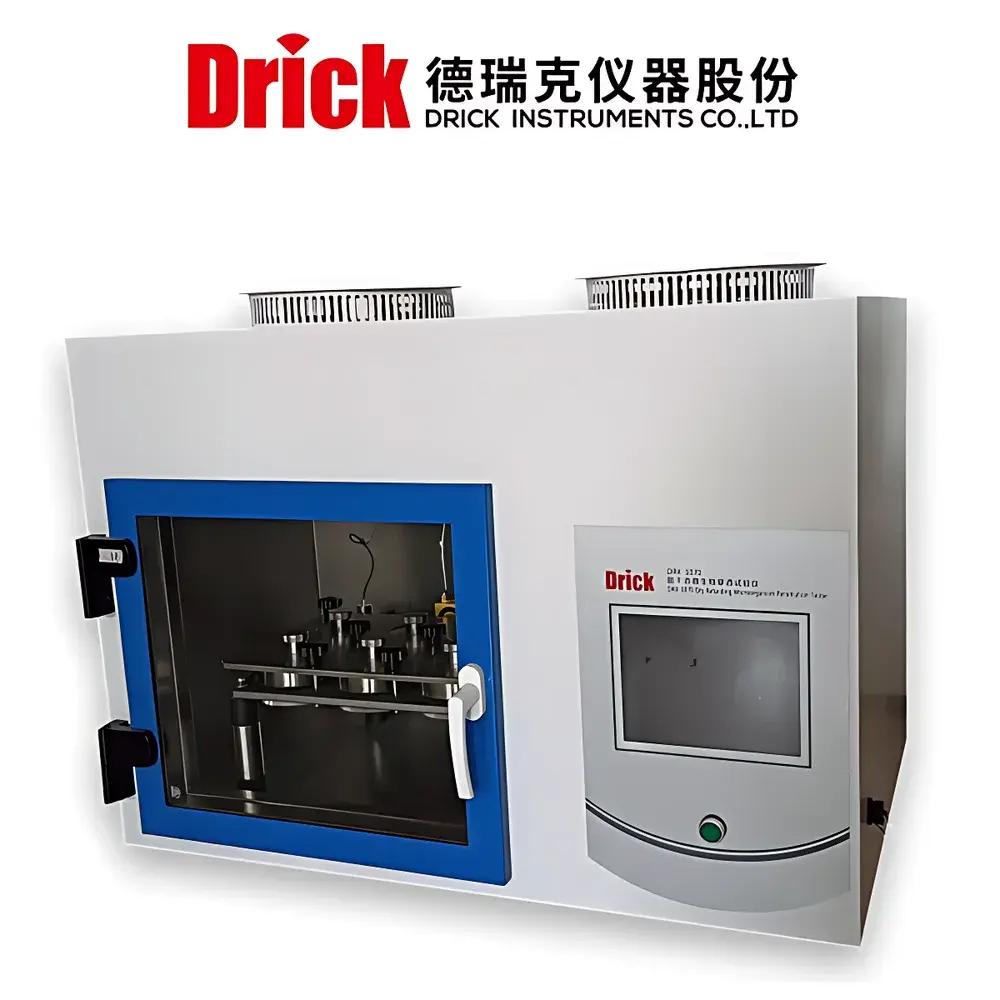
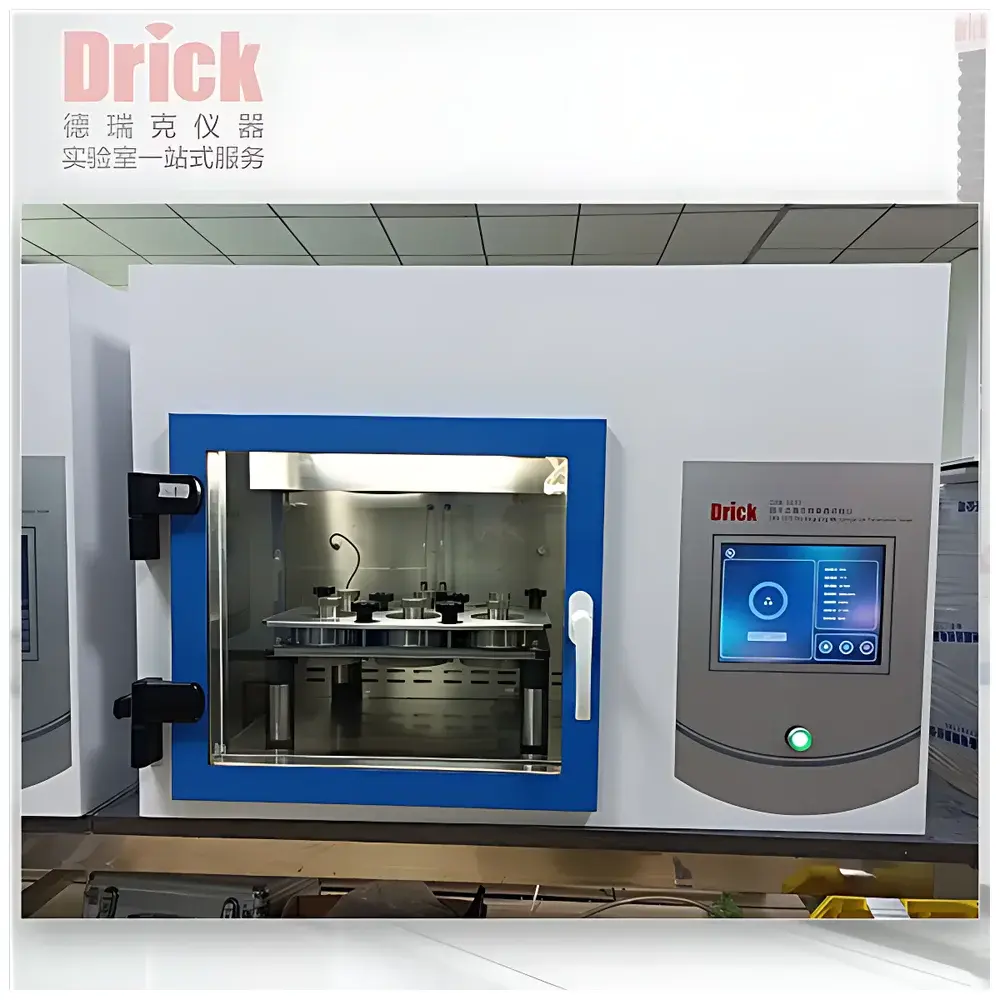
Drick DRK1070 Dry-State Microbial Penetration Tester
| Brand | Drick |
|---|---|
| Origin | Shandong, China |
| Manufacturer Type | Manufacturer |
| Country of Origin | Domestic (China) |
| Model | DRK1070 |
| Instrument Type | Automated Dry-State Microbial Barrier Tester |
| Test Throughput | 6 samples per run |
| Working Power | AC 220 V, 50 Hz |
| Power Consumption | < 2000 W |
| Vibration Mechanism | Pneumatic Spherical Oscillator |
| Vibration Frequency | 20,800 cycles/min (347 Hz) |
| Dynamic Force Output | 650 N |
| Test Platform Dimensions | 400 mm × 400 mm × 10 mm (marble) |
| Test Chamber Count | 6 stainless-steel chambers with piston-type sample holders |
| Negative Pressure Cabinet Range | −50 to −200 Pa |
| HEPA Filtration Efficiency | >99.99% (at 0.3 µm) |
| Cabinet Airflow Rate | ≥5 m³/min |
| Data Storage Capacity | 5000 test records |
| Overall Dimensions (W×D×H) | 1000 mm × 680 mm × 670 mm |
| Net Weight | ~130 kg |
| Compliance Standards | YY/T 0506.5–2009, ISO 22612 |
Overview
The Drick DRK1070 Dry-State Microbial Penetration Tester is an automated, precision-engineered instrument designed to evaluate the resistance of medical textiles—including surgical gowns, drapes, and cleanroom garments—to dry-state microbial penetration under standardized mechanical stress. It operates on the principle of controlled pneumatic oscillation applied to a test specimen mounted over a sterile agar-filled Petri dish, simulating dynamic mechanical challenge in clinical or manufacturing environments. Unlike liquid- or aerosol-based barrier testing methods, this system specifically addresses the ISO 22612 and YY/T 0506.5–2009 protocols for dry-state microbial transmission—where microorganisms are introduced as dried spores (e.g., Bacillus atrophaeus) onto the outer surface of the material, then subjected to high-frequency vibration to assess their ability to traverse the fabric matrix via mechanical displacement. The DRK1070 integrates a calibrated pneumatic spherical oscillator, six independent stainless-steel test chambers, a negative-pressure containment cabinet with HEPA filtration, and a rigid marble platform to ensure reproducible force application and environmental isolation.
Key Features
- High-fidelity pneumatic oscillation system delivering precisely regulated 20,800 cycles/min (347 Hz) at 650 N dynamic force—fully compliant with ISO 22612 mechanical stimulus requirements.
- Six parallel stainless-steel test chambers with integrated piston-type sample holders, enabling simultaneous evaluation of up to six specimens per test cycle while maintaining strict positional repeatability.
- Negative-pressure cabinet with adjustable vacuum range (−50 to −200 Pa) and ≥5 m³/min airflow, equipped with HEPA filters certified to >99.99% efficiency at 0.3 µm—ensuring operator safety and preventing cross-contamination between runs.
- Stable 400 mm × 400 mm × 10 mm solid marble test platform, mounted on four height-adjustable rubber feet for precise leveling and vibration damping.
- Embedded data logging system storing up to 5000 complete test records—including date/time stamp, chamber ID, pressure setpoint, vibration duration, and operator ID—supporting traceability and audit readiness.
- Robust industrial-grade construction with 130 kg net weight and reinforced chassis, minimizing operational drift and ensuring long-term calibration stability in QC laboratories.
Sample Compatibility & Compliance
The DRK1070 accommodates flat, non-porous, and semi-porous textile specimens up to standard dimensions defined in YY/T 0506.5–2009 (typically 100 mm diameter circular samples). Each chamber accepts standard 90 mm Petri dishes placed beneath the specimen via a bottom-mounted slot, allowing direct contact between penetrated spores and nutrient agar. The system is validated for use with Bacillus atrophaeus (ATCC 9372) spore suspensions dried onto carrier films or directly onto test materials. All mechanical and environmental parameters—including vibration frequency, force magnitude, negative pressure profile, and cabinet airflow—are aligned with the normative annexes of ISO 22612:2005 and YY/T 0506.5–2009. The instrument supports GLP-compliant workflows through secure user access control (optional), timestamped audit logs, and exportable CSV-formatted test reports suitable for regulatory submission.
Software & Data Management
The DRK1070 features an embedded microprocessor-based controller with a tactile LCD interface for local parameter configuration and real-time monitoring. While no external PC software is required for basic operation, optional USB data export enables integration into LIMS or ELN platforms. Stored records include full metadata: test ID, operator code, chamber assignment, start/stop timestamps, applied vacuum level, total vibration duration, and pass/fail status per chamber based on colony-forming unit (CFU) enumeration performed post-test in accordance with ISO 11737-1. Data integrity is preserved via non-volatile memory with battery-backed clock and write-protection against accidental overwrite. For facilities operating under FDA 21 CFR Part 11 or EU Annex 11 requirements, optional firmware upgrades support electronic signatures, role-based access levels, and immutable audit trails.
Applications
- Quality control of surgical gowns, drapes, and isolation gowns used in sterile fields.
- Validation of cleanroom garments for pharmaceutical aseptic processing suites.
- Comparative assessment of textile barrier performance across fiber composition, weave density, and coating technologies.
- Regulatory submission support for Class II and III medical devices requiring dry-state microbial barrier evidence.
- In-process testing during textile manufacturing to verify lot-to-lot consistency in barrier integrity.
- Research into mechanical failure modes of protective fabrics under simulated clinical handling conditions.
FAQ
What microorganism is recommended for dry-state penetration testing with the DRK1070?
Bacillus atrophaeus (ATCC 9372) spores are the reference organism specified in both ISO 22612 and YY/T 0506.5–2009 due to their small size (~0.8–1.2 µm), desiccation resistance, and consistent aerosolization behavior.
Is the DRK1070 compatible with USP <71> or ISO 11737-1 sterility testing protocols?
No—the DRK1070 is purpose-built for dry-state barrier evaluation only and does not perform membrane filtration, direct inoculation, or environmental monitoring as defined in sterility test monographs.
Can test parameters such as vibration frequency or negative pressure be customized beyond standard ranges?
The instrument is factory-calibrated to meet ISO/YY compliance limits; deviation from 20,800 cycles/min or −50 to −200 Pa voids conformance with referenced standards and is not supported in routine operation.
Does the system include microbiological culture media or spore preparations?
No—these consumables must be sourced separately and prepared according to ISO 11737-1 and manufacturer instructions for spore suspension validation.
What maintenance is required to sustain measurement accuracy?
Monthly verification of vibration frequency using a calibrated tachometer, biannual HEPA filter replacement, and annual recalibration of pressure sensors and force transducers by authorized service personnel are recommended.





