
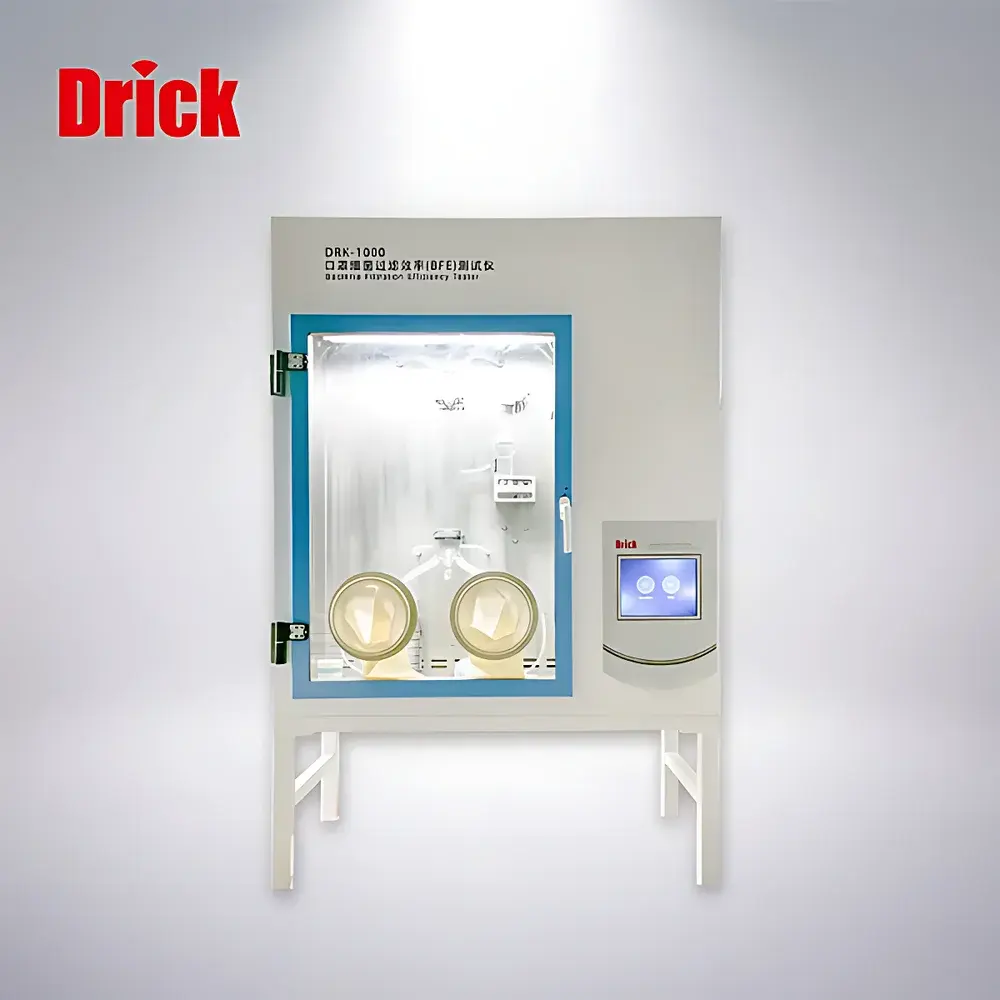
Drick DRK-1000 Bacterial Filtration Efficiency (BFE) Tester for Medical Masks – EN 14683 / ASTM F2101 / YY 0469 Compliant
| Brand | Drick |
|---|---|
| Origin | Shandong, China |
| Manufacturer Type | Original Equipment Manufacturer (OEM) |
| Product Category | Domestic |
| Model | DRK-1000 |
| Price | USD 21,000 (FOB Qingdao) |
| Compliance | EN 14683:2019, ASTM F2101-23, ASTM F2100-23, YY 0469-2011, ISO 18184:2019 (supporting), Q/0212 ZRB003-2011 |
| Sampling Method | Dual-channel parallel Andersen cascade impactor (6-stage) |
| Aerosol Generation | Precision microbial nebulizer with adjustable flow (8–10 L/min) |
| Flow Control | Dual independent peristaltic pumps (0.006–3.0 mL/min) and mass flow controllers (28.3 L/min ±2.5%) |
| Negative Pressure Enclosure | −50 to −200 Pa cabinet pressure, −90 to −120 Pa aerosol chamber pressure |
| Particle Size Distribution | Mass median aerodynamic diameter (MMAD) = 3.0 ± 0.3 µm, geometric standard deviation (GSD) ≤ 1.5 |
| Filter Efficiency | ≥99.99% for particles ≥0.3 µm (HEPA H14) |
| Data Storage | >100,000 test records |
| Display | 10.4″ industrial-grade capacitive touchscreen |
| Interface | USB port for data export (CSV/Excel-compatible) |
| Safety | Front-mounted tempered glass access door, integrated LED illumination, acoustic noise <65 dB(A), CE-marked electrical safety |
Overview
The Drick DRK-1000 Bacterial Filtration Efficiency (BFE) Tester is a fully integrated, regulatory-grade instrument engineered for quantitative assessment of bacterial aerosol filtration performance in medical face masks and respirators. It operates on the principle of controlled microbial aerosol generation followed by dual-path, parallel sampling using six-stage Andersen cascade impactors—enabling simultaneous upstream (challenge) and downstream (filtered) colony-forming unit (CFU) enumeration. This architecture satisfies the core physical measurement requirements of EN 14683:2019 Annex A, ASTM F2101-23 (Standard Test Method for Determining Bacterial Filtration Efficiency of Medical Face Mask Materials), and YY 0469-2011 Appendix B. Unlike single-path systems, the DRK-1000’s dual-flow design eliminates inter-test variability caused by sequential sampling drift, thereby improving intra-laboratory reproducibility and supporting GLP-compliant validation protocols.
Key Features
- Negative-pressure biosafety enclosure (−50 to −200 Pa cabinet pressure) with front-access tempered glass door and internal LED lighting—ensuring operator protection during aerosol handling per ISO 15190:2020 laboratory safety guidelines.
- Dual independent 28.3 L/min constant-flow sampling circuits, each equipped with NIST-traceable mass flow controllers (±2.5% accuracy) and real-time pressure monitoring at flowmeter inlet (−20 to 0 kPa).
- High-fidelity microbial aerosol generator delivering stable, monodisperse Staphylococcus aureus (ATCC 6538) or MS2 bacteriophage challenge aerosols with MMAD = 3.0 ± 0.3 µm and GSD ≤ 1.5—validated per ASTM F2101 Annex A.
- Six-stage Andersen impactor array (stages I–VI capturing particles >7 µm down to 0.6–1.1 µm) installed in both A (challenge) and B (filtrate) paths for size-resolved deposition analysis.
- Embedded industrial PC with 10.4″ high-brightness resistive touchscreen, running deterministic real-time OS for synchronized control of nebulizer flow (8–10 L/min), peristaltic pump delivery (0.006–3.0 mL/min), and environmental logging.
- Onboard data storage (>100,000 test records), USB export capability (CSV format), and audit-ready timestamping aligned with FDA 21 CFR Part 11 principles (user login, action logging, immutable record retention).
Sample Compatibility & Compliance
The DRK-1000 accommodates flat mask specimens up to 150 mm × 150 mm mounted in standardized stainless-steel holders conforming to EN 14683 Clause 6.2 and ASTM F2101 Section 7.3. It supports testing of surgical masks, procedure masks, and layered nonwoven barrier materials—including melt-blown polypropylene, spunbond composites, and electrostatically charged electret media. All operational parameters comply with mandatory clauses of EN 14683:2019 (Type I, II, IIR), ASTM F2101-23 (BFE ≥ 95% at 3.0 µm), and YY 0469-2011. The system includes built-in positive controls (e.g., pre-calibrated S. aureus suspension yielding 2200 ± 500 CFU in upstream sampler) and integrates HEPA H14 filtration (≥99.99% @ 0.3 µm) in exhaust path to meet ISO 14644-1 Class 5 cleanroom exhaust requirements.
Software & Data Management
Firmware v3.2 provides role-based user authentication (administrator/operator modes), automated calculation of BFE (%) via the formula: [1 − (CFUdownstream/CFUupstream)] × 100, and dynamic error propagation reporting based on flow calibration certificates. Raw sensor logs (pressure, temperature, flow rate, time) are stored with millisecond resolution. Exported datasets include metadata fields: test ID, operator ID, date/time, ambient T/RH, challenge organism, dilution factor, and impactor stage deposition counts. Data files are structured for direct import into LIMS platforms compliant with ISO/IEC 17025:2017 clause 7.11 (data control).
Applications
- Quality control release testing of surgical and procedural masks per EN 14683 Type II/IIR classification requirements.
- Material development screening for filtration media R&D labs evaluating charge decay, humidity stability, and fiber morphology effects on BFE.
- Regulatory submission support for CE marking (MDD/MDR Annexes), FDA 510(k), and NMPA registration dossiers.
- Third-party verification by CNAS-accredited calibration laboratories performing inter-laboratory comparison studies (ILCs) under ISO/IEC 17043.
- Validation of sterilization integrity for reusable textile masks undergoing repeated laundering cycles (per ISO 18184:2019 antimicrobial activity correlation).
FAQ
Does the DRK-1000 support virus filtration efficiency (VFE) testing?
Yes—when configured with MS2 bacteriophage (25 nm) or Phi6 (65 nm) aerosols and validated per ISO 18184:2019 Annex C, though VFE is not part of EN 14683 scope.
Is the Andersen impactor calibrated traceable to NIST standards?
Each six-stage impactor undergoes individual aerodynamic cut-point verification using polystyrene latex (PSL) spheres and certified reference aerosols; calibration certificates accompany shipment.
Can the system be integrated into a centralized lab network?
Via optional Ethernet module (IEEE 802.3), enabling remote status monitoring and scheduled firmware updates—compatible with common SCADA architectures.
What maintenance intervals are recommended for the nebulizer and peristaltic tubing?
Nebulizer nozzles require ultrasonic cleaning every 200 test cycles; peristaltic pump tubing must be replaced after 500 hours of cumulative operation or visible deformation.
Does the instrument meet electromagnetic compatibility (EMC) requirements for EU deployment?
Yes—certified to EN 61326-1:2013 (industrial environment) and EN 55011:2016 Class B emission limits, with full CE Declaration of Conformity provided.




