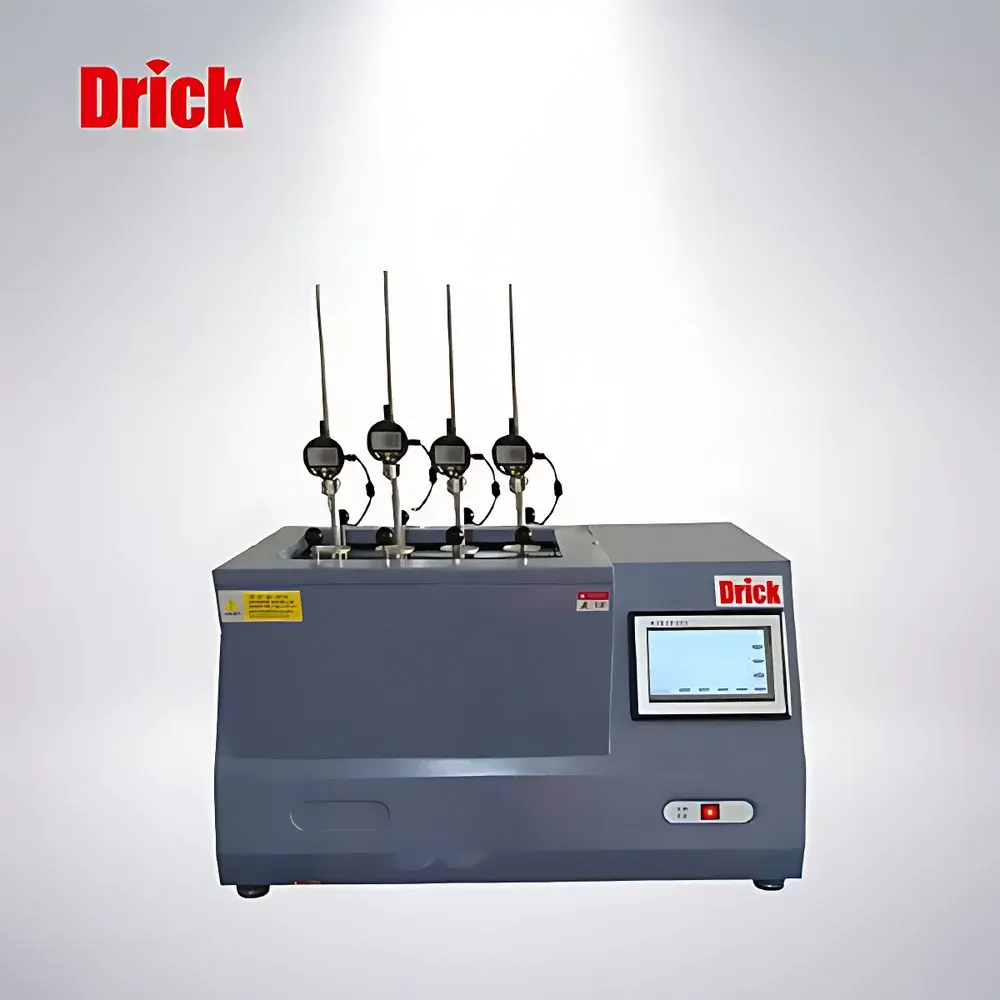
Drick DRK160 Vicat Softening Point and Heat Deflection Temperature Tester
| Brand | Drick |
|---|---|
| Origin | Shandong, China |
| Manufacturer Type | Direct Manufacturer |
| Region of Origin | Domestic (China) |
| Model | DRK160 |
| Heating Medium | Methyl Silicone Oil |
| Temperature Range | Ambient to 300 °C |
| Temperature Accuracy | ±0.5 °C |
| Heating Rates | 5 ±0.5 °C/6 min (Method A), 12 ±1.0 °C/6 min (Method B) |
| Penetration Measurement Range | 0–1 mm |
| Digital Micrometer Accuracy | ±0.003 mm |
| Deformation Resolution | ±0.005 mm |
| Test Loads | 10 N ±0.2 N (GA), 50 N ±1 N (GB) |
| Max. Heating Power | ≤3000 W |
| Power Supply | 220 V, 50 Hz, 30 A |
| Span Options | 64 mm, 100 mm, or Continuously Adjustable |
| Sample Orientation | Horizontal |
| Temperature Uniformity | ±0.5 °C (achieved via 45° dual-helix automatic oil stirring) |
| Safety Features | Upper-temperature cutoff, overflow oil recovery system |
| Cooling Options | Natural air cooling, water cooling, or liquid nitrogen cooling |
| Optional | Motorized test frame lift mechanism |
Overview
The Drick DRK160 Vicat Softening Point and Heat Deflection Temperature (HDT) Tester is a precision-engineered thermal analysis instrument designed for standardized determination of two critical thermomechanical properties of thermoplastic polymers and rigid thermosets: the Vicat Softening Temperature (VST) and the Heat Deflection Temperature under Load (HDT). Based on the principle of controlled thermal ramping under defined mechanical load, the DRK160 applies either a 10 N (GA) or 50 N (GB) axial force via a standardized needle or flat-ended plunger onto a horizontally mounted specimen immersed in a temperature-controlled methyl silicone oil bath. As the bath temperature increases at a regulated rate—either 5 ±0.5 °C per 6 minutes (ASTM D1525 / ISO 306 Method A) or 12 ±1.0 °C per 6 minutes (Method B)—the instrument continuously monitors penetration depth with a high-resolution digital micrometer. The VST is recorded as the temperature at which the probe penetrates 1 mm into the specimen surface; HDT is similarly determined using a three-point bending fixture across a specified span (64 mm or 100 mm). This dual-capability design ensures full compliance with international standards including ISO 306, ASTM D1525, ASTM D648, GB/T 1633, and GB/T 1634.
Key Features
- Integrated dual-test functionality: simultaneous support for both Vicat Softening Temperature (VST) and Heat Deflection Temperature (HDT) measurements per ISO and ASTM protocols.
- High-stability thermal environment: oil bath equipped with a 45° dual-helix automatic stirring system and optimized tank geometry to ensure radial and vertical temperature uniformity within ±0.5 °C across the entire test zone.
- Precision displacement sensing: calibrated digital micrometer with ±0.003 mm resolution and ±0.005 mm deformation accuracy, enabling reliable detection of sub-micron-scale deflection onset.
- Thermal safety architecture: programmable upper-temperature cutoff, redundant overheat protection circuitry, and an integrated overflow oil recovery system to prevent spillage during thermal expansion of high-coefficient methyl silicone oil.
- Flexible thermal management: selectable cooling modes—including natural convection, forced water circulation, or cryogenic nitrogen cooling—to accelerate cooldown between sequential tests and improve throughput.
- Modular mechanical configuration: adjustable test span (64 mm, 100 mm, or continuously variable), horizontal sample orientation, and optional motorized test frame lift for ergonomic operation and repeatable positioning.
Sample Compatibility & Compliance
The DRK160 accommodates standard rectangular specimens (e.g., 10 mm × 10 mm × any thickness ≥4 mm for VST; 127 mm × 13 mm × 3–13 mm for HDT) fabricated from commodity and engineering thermoplastics (e.g., PP, PE, ABS, PC, POM, PA6/66), crosslinked elastomers, and filled polymer composites. All operational parameters—including heating rate tolerance, load verification, temperature calibration traceability, and dimensional repeatability—conform to ISO/IEC 17025 requirements for testing laboratories. The system supports audit-ready documentation for GLP and GMP environments, with configurable test logs that record timestamped temperature, load, displacement, and operator ID—fully compatible with FDA 21 CFR Part 11–compliant data archiving when integrated with validated LIMS or ELN platforms.
Software & Data Management
The DRK160 operates via an embedded industrial controller with real-time PID temperature regulation and synchronized displacement acquisition at 10 Hz sampling. Test sequences are preconfigured per standard method (e.g., ISO 306-A, ASTM D648-12a), with automatic endpoint detection and pass/fail flagging based on user-defined acceptance criteria. Raw data—including time-temperature-deformation curves, derivative profiles (dT/dt, dδ/dt), and statistical summaries (mean, SD, CV%)—are exportable in CSV and PDF formats. Optional PC-based software provides advanced post-processing: multi-curve overlay, baseline correction, interpolation for intermediate temperature reporting, and automated report generation compliant with ISO/IEC 17025 clause 7.8. Audit trails include full change history for calibration constants, method parameters, and user permissions.
Applications
This instrument serves as a core quality control tool in R&D labs, incoming material inspection, and production release testing for polymer compounders, injection molders, automotive component suppliers, and medical device manufacturers. Typical use cases include comparative ranking of heat resistance across resin grades; validation of thermal stabilization package efficacy (e.g., HALS, phosphites); assessment of filler-matrix interfacial effects on thermomechanical performance; and regulatory submission support for ISO 10993 biocompatibility dossiers requiring VST/HDT evidence. Its robust architecture and metrological traceability also make it suitable for accredited third-party testing laboratories performing contract analysis per EN, ASTM, or JIS specifications.
FAQ
What standards does the DRK160 support?
It fully complies with ISO 306 (Vicat), ISO 75 (HDT), ASTM D1525, ASTM D648, GB/T 1633, and GB/T 1634.
Can the DRK160 perform both VST and HDT tests without hardware modification?
Yes—the instrument includes interchangeable fixtures (needle plunger for VST; three-point bending jig for HDT) and software-switchable test protocols.
Is the temperature uniformity verified across the entire oil bath volume?
Yes—verified per ISO 17025 procedures using NIST-traceable PT100 probes at nine spatial locations; uniformity maintained at ±0.5 °C under steady-state and dynamic ramp conditions.
What maintenance is required for long-term calibration stability?
Annual verification of load cells (via certified deadweight sets), micrometer linearity (using gauge blocks), and temperature sensor drift (against reference thermometer in stirred oil bath) is recommended.
Does the system support electronic signatures and audit trails for regulated environments?
When paired with validated external software, full 21 CFR Part 11 compliance—including role-based access, electronic signature capture, and immutable audit logs—is achievable.