
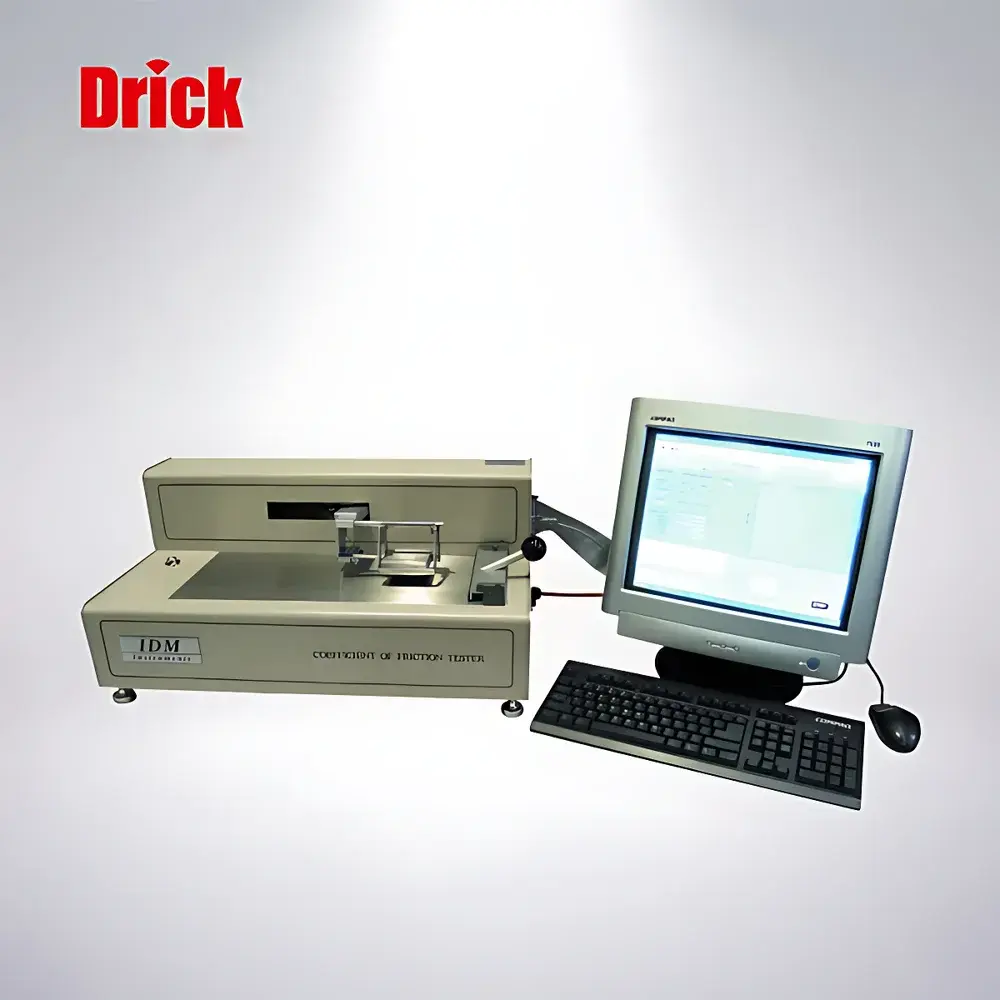
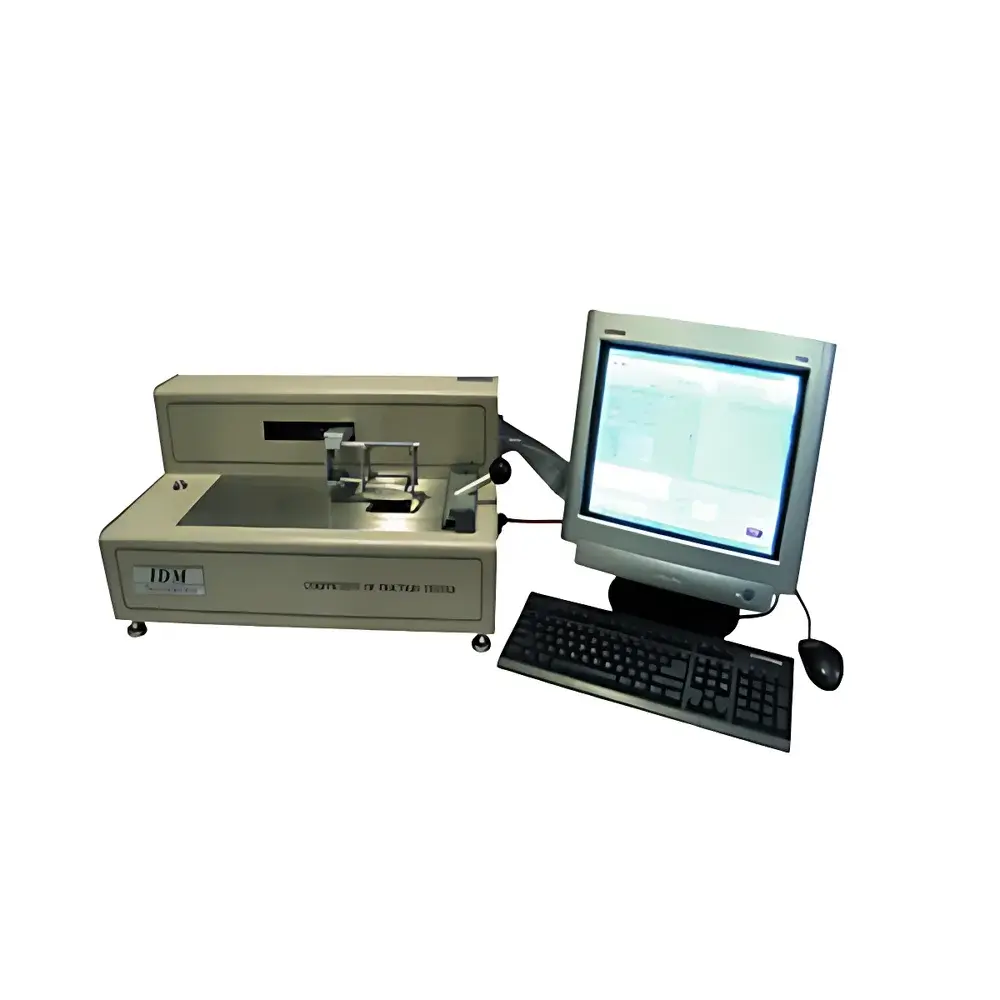
IDM C0041 Coefficient of Friction Tester for Paper and Plastic Films
| Brand | IDM |
|---|---|
| Origin | Shandong, China |
| Model | C0041 |
| Test Speed | 100 mm/min (ISO 8295) / 150 ±30 mm/min (ASTM D1894) |
| Slider Dimensions | 60 × 60 mm ±0.1 mm |
| Slider Mass | 800 g ±5 g |
| Load Range | 0–10 N (typical) |
| Force Sensor Resolution | ≤0.01 N |
| Temperature Range | Ambient only (non-heated slider |
| Power Supply | 220/240 VAC @ 50 Hz or 110 VAC @ 60 Hz |
| Dimensions (H×W×D) | 300 × 650 × 450 mm |
| Weight | 15 kg |
| Compliance | ISO 8295, ISO 15359, ASTM D1894, ASTM D3247, DIN 53375, DIN 6729, TAPPI T 816 pm-92, TAPPI T 549 pm-90 |
Overview
The IDM C0041 Coefficient of Friction (COF) Tester is an electromechanical instrument engineered for precision measurement of static (μs) and kinetic (μk) coefficients of friction between two contacting surfaces under controlled conditions. It operates on the fundamental principle of horizontal pull testing: a standardized slider—loaded with a defined normal force—is drawn across a stationary test specimen mounted on a rigid, non-magnetic, level platen. The force required to initiate motion (static friction) and maintain steady-state sliding (kinetic friction) is captured in real time via a high-stability load cell. The resulting COF values are calculated as the ratio of measured tangential friction force to applied normal force. This methodology aligns strictly with internationally recognized tribological standards including ISO 8295 and ASTM D1894, ensuring metrological traceability and inter-laboratory comparability. Designed specifically for packaging material characterization, the C0041 delivers repeatable, operator-independent results essential for QC/QA workflows in film extrusion, paper converting, laminating, and flexible packaging R&D.
Key Features
- Compliant dual-standard operation: Pre-configured test modes for ISO 8295 (100 mm/min) and ASTM D1894 (150 ±30 mm/min), with automatic speed calibration and dwell-time synchronization.
- High-precision servo-driven actuation system ensures consistent acceleration profile and eliminates inertial artifacts during μs detection.
- Real-time graphical display of friction force vs. displacement, enabling visual identification of stick-slip behavior, transition points, and curve stability.
- Adjustable test parameters: slider mass (standard 800 g ±5 g), travel distance (up to 150 mm), dwell time (0–60 s), and data acquisition rate (10–100 Hz).
- Modular slider interface supports rapid interchange of standardized sliders (60×60 mm, 63×63 mm, 62.5×62.5 mm, 15×75 mm) to meet ASTM D3247, DIN 53375, DIN 6729, TAPPI T 816 pm-92, and other regional specifications.
- Integrated digital display with unit toggle (μ, %, N) and immediate COF calculation—no external software required for basic operation.
Sample Compatibility & Compliance
The C0041 accommodates a broad spectrum of planar, flexible substrates used in packaging applications: biaxially oriented polypropylene (BOPP), polyester (PET), polyethylene (PE), metallized films, coated papers, cardboard laminates, and foil composites. Sample mounting requires flatness ≤0.1 mm deviation over 100 mm and surface cleanliness per ISO 15359 Annex A. All mechanical components—including platen, slider base, and guide rails—are fabricated from non-magnetic stainless steel to prevent magnetic interference with sensor output. The instrument meets mechanical and procedural requirements of ISO 8295:2017, ISO 15359:2018, ASTM D1894–22, ASTM D3247–21, DIN 53375:2020, DIN 6729:2019, and TAPPI T 816 pm-92. While the standard configuration operates at ambient temperature (23 ±2 °C, 50 ±5 % RH per ISO 291), optional heated platens (up to 60 °C) are available for thermal COF profiling in accordance with Clause 7.3 of ASTM D1894.
Software & Data Management
The C0041 includes embedded firmware supporting CSV export via USB port for offline analysis in Excel, MATLAB, or statistical process control (SPC) platforms. Raw force-displacement datasets retain full temporal resolution (100 Hz max), permitting post-test evaluation of coefficient variance, peak-to-peak amplitude, and hysteresis loops. Optional PC-based software (sold separately) provides GLP-compliant audit trails, user access levels (admin/operator), electronic signatures per FDA 21 CFR Part 11, and automated report generation aligned with ISO/IEC 17025 documentation requirements. All stored test records include metadata: date/time stamp, operator ID, sample ID, environmental conditions (if logged externally), slider ID, platen ID, and calibration certificate reference.
Applications
- Quality assurance of slip additives (e.g., erucamide, oleamide) in polyolefin films—monitoring batch-to-batch consistency and shelf-life degradation.
- Evaluation of corona treatment efficacy on PET and PE surfaces through comparative COF shifts before/after treatment.
- Validation of anti-blocking performance in heat-sealable packaging layers under simulated end-use conditions.
- Development of low-friction release liners for medical device packaging and adhesive tapes.
- Regulatory submission support for FDA 510(k) dossiers requiring tribological data on primary packaging materials.
- Root-cause analysis of jamming or misfeeding in high-speed filling lines—correlating laboratory COF values with line performance metrics.
FAQ
Does the C0041 comply with ISO 15359 for paperboard testing?
Yes—the instrument’s platen flatness, slider geometry (60×60 mm), and 800 g nominal load satisfy the mechanical requirements of ISO 15359:2018 for coated and uncoated paper and board.
Can the system perform elevated-temperature COF testing?
The base model operates at ambient temperature only. A heated platen option (±0.5 °C stability) is available for ISO 8295 Annex B and ASTM D1894 Clause 7.3 compliance; the slider remains at ambient to avoid thermal drift in force measurement.
What calibration standards are supported?
The load cell is factory-calibrated against NIST-traceable deadweight standards. Annual recalibration is recommended per ISO/IEC 17025, with certificate including uncertainty budget per GUM (JCGM 100:2008).
Is the slider interchangeable for different standards?
Yes—multiple slider inserts (63×63 mm for ISO 8295, 15×75 mm for DIN 6729) are mechanically keyed and auto-recognized by firmware to enforce correct test parameters.
How is data integrity ensured during export?
CSV files include embedded checksums and timestamped headers. Optional software adds digital signature hashing (SHA-256) and immutable audit logs compliant with 21 CFR Part 11 Subpart B.






