
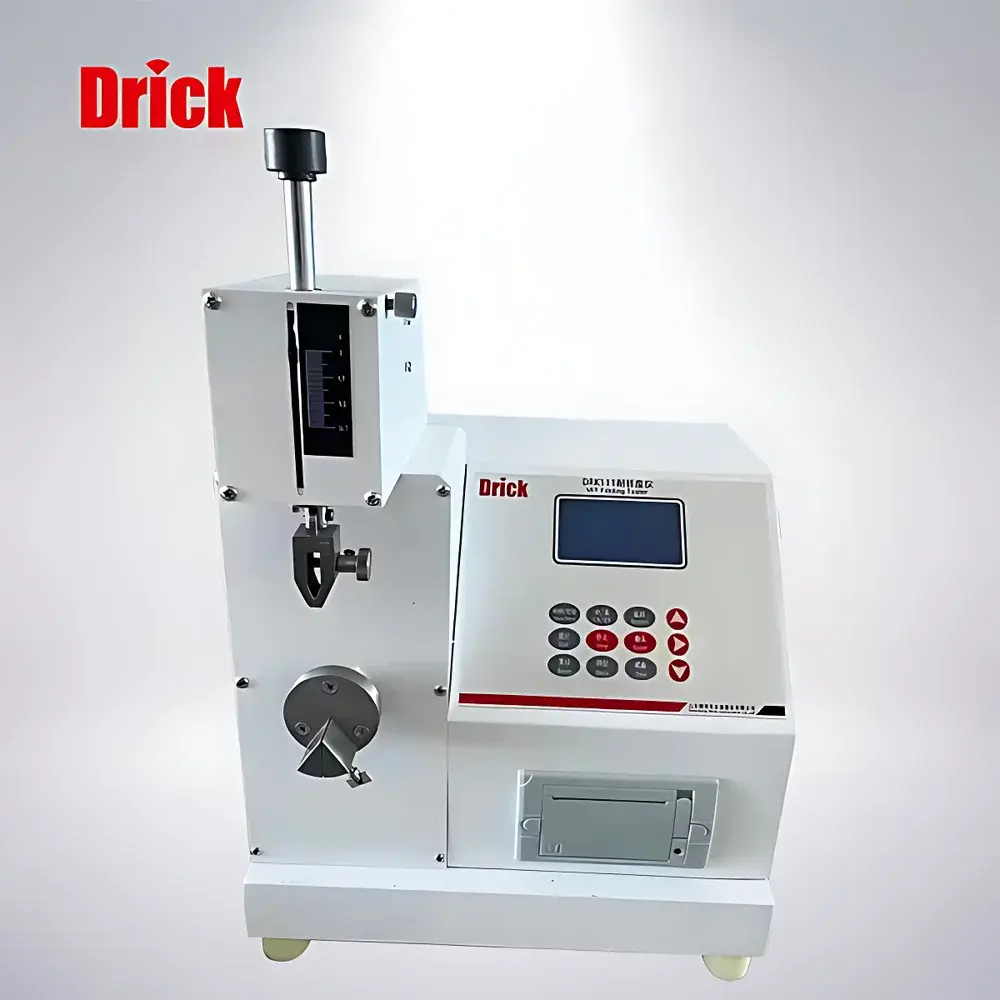
Drick DRK111 MIT-Style Fold Endurance Tester for Paper, Paperboard and Thin Sheet Materials
| Brand | Drick |
|---|---|
| Origin | Shandong, China |
| Manufacturer Type | Direct Manufacturer |
| Country of Origin | China |
| Model | DRK111 |
| Measurement Range | 1–99,999 folds |
| Folding Angle | 135° ± 2° |
| Folding Speed | 175 ± 10 folds/min |
| Tension Adjustment Range | 4.9–14.7 N |
| Folding Head Slot Widths | 0.25 mm, 0.50 mm, 0.75 mm, 1.00 mm |
| Folding Jaw Width | 19 ± 1 mm |
| Folding Edge Radius | R0.38 mm ± 0.02 mm |
| Tension Variation Due to Eccentric Rotation | ≤ 0.343 N |
| Power Supply | AC 220 V ± 5%, 50 Hz |
| Operating Environment | 0–40 °C, RH ≤ 85% |
| Dimensions (L×W×H) | 390 × 305 × 440 mm |
| Net Weight | ≤ 21 kg |
Overview
The Drick DRK111 MIT-Style Fold Endurance Tester is a precision-engineered instrument designed to quantify the fatigue resistance of paper, paperboard, and other thin sheet materials under repeated folding stress. It operates on the principle of controlled double-fold bending—commonly referred to as the MIT fold method—in accordance with internationally recognized mechanical endurance testing protocols. The device subjects a standardized specimen strip to continuous, reciprocating 135° folds at a fixed angular displacement and regulated tension, simulating real-world flexing behavior encountered during packaging handling, bookbinding, corrugated board forming, and label application. Its core architecture integrates a high-stability servo-controlled folding mechanism, optoelectronic position feedback for repeatable jaw alignment, and microprocessor-based logic for autonomous cycle counting, data logging, and statistical computation. Unlike manual or semi-automated alternatives, the DRK111 ensures consistent fold geometry, minimized operator-induced variability, and traceable measurement integrity across test sequences.
Key Features
- Microprocessor-controlled folding actuation with automatic return-to-zero positioning after each test cycle, eliminating manual reset and reducing inter-test downtime.
- Adjustable tension system (4.9–14.7 N) calibrated via precision load cell feedback, enabling compliance with variable material stiffness requirements per ISO 5626 and GB/T 2679.5.
- Interchangeable folding head slots (0.25 / 0.50 / 0.75 / 1.00 mm) accommodate diverse substrate thicknesses while maintaining defined crease geometry and minimizing edge delamination artifacts.
- High-resolution LCD touchscreen interface with dual-language support (English/Chinese), real-time fold count display, and on-device parameter configuration—including optional ambient temperature and humidity input for environmental correlation analysis.
- Integrated thermal printer supporting immediate hardcopy output of individual test records, group statistics (mean, min, max, coefficient of variation), and logarithmic transformation of fold counts (log₁₀ N).
- Onboard non-volatile memory capable of storing up to 510 test groups (10 specimens per group), with timestamped entries accessible via menu navigation—no external PC required for basic operation or historical review.
Sample Compatibility & Compliance
The DRK111 is validated for use with planar, non-woven, and fibrous sheet materials having a nominal thickness ≤ 1.0 mm. Typical applications include kraft linerboard, corrugating medium, folding boxboard, coated offset paper, cigarette packaging substrates, and synthetic film laminates. All mechanical tolerances—including folding jaw width (19 ± 1 mm), edge radius (R0.38 mm ± 0.02 mm), and angular repeatability (±2°)—are maintained within limits specified in ISO 5626:1993, GB/T 2679.5–2022, and QB/T 1049–2018. The instrument’s tension control subsystem meets ASTM D2176 requirements for force stability during cyclic loading, with eccentricity-induced tension deviation held below 0.343 N across full operational range. While not inherently compliant with FDA 21 CFR Part 11, audit trails and data export functionality may be configured to support GLP/GMP-aligned quality systems when integrated into validated laboratory workflows.
Software & Data Management
Data acquisition and processing are handled entirely by embedded firmware without dependency on proprietary desktop software. Each test session captures raw fold count, applied tension, folding speed, slot selection, and environmental notes (if entered). Statistical functions compute arithmetic mean, standard deviation, coefficient of variation (%CV), and log-transformed values per test group. Stored datasets retain full metadata including date/time stamps and operator ID fields (user-assigned). Export options include direct printout and USB flash drive transfer of CSV-formatted logs for integration with LIMS or Excel-based trending analysis. Firmware updates are delivered via USB interface and include version-locked calibration verification logs to ensure metrological continuity between maintenance intervals.
Applications
This tester serves critical roles in QC laboratories of pulp & paper mills, packaging converters, and regulatory testing facilities. It supports routine specification conformance checks against contractual durability thresholds (e.g., minimum 5,000 MIT folds for premium carton board), comparative evaluation of fiber furnish modifications, coating formulation optimization, and accelerated aging studies where fold endurance correlates with shelf-life performance. In R&D environments, it enables systematic investigation of moisture content effects on folding fatigue, assessment of recycled fiber degradation kinetics, and validation of surface treatment efficacy (e.g., plasma or corona discharge) on crack propagation resistance. Its robust mechanical design and low-maintenance drive train ensure stable long-term operation in high-throughput production lab settings.
FAQ
What standards does the DRK111 comply with?
It conforms to ISO 5626, GB/T 2679.5, GB/T 475, and QB/T 1049 for MIT-style fold endurance measurement.
Can the instrument operate under controlled humidity conditions?
Yes—the touchscreen interface accepts user-input environmental parameters (temperature and relative humidity) for contextual annotation; however, it does not include built-in climate control.
Is calibration traceable to national metrology institutes?
Tension calibration is performed using NIST-traceable load cells; angular and positional calibrations follow internal geometric verification procedures aligned with ISO/IEC 17025 principles.
How is data integrity ensured during power interruption?
All active test data is written to non-volatile memory at each fold increment; unsaved results persist through brief outages and resume upon power restoration.
Does the DRK111 support network connectivity or remote monitoring?
No Ethernet or Wi-Fi capability is included; data exchange is limited to USB mass storage and thermal printout.





