
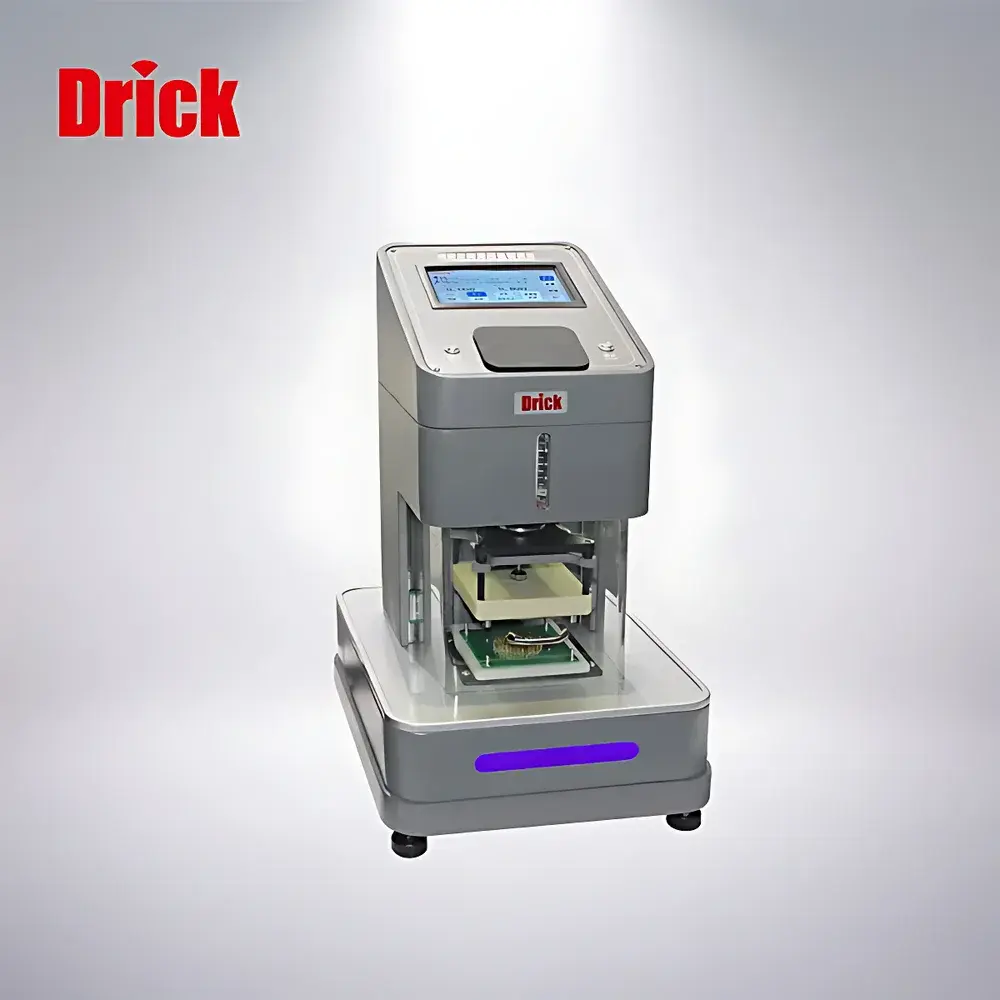
Drick DRK821A Dynamic Liquid Water Transport Tester for Textiles
| Brand | Drick |
|---|---|
| Origin | Shandong, China |
| Manufacturer Type | Direct Manufacturer |
| Country of Origin | China |
| Model | DRK821A |
| Price | USD 7,000 (FOB Qingdao) |
| Compliance | AATCC 195-2011, SN 1689, GB/T 21655.2–2009 & GB/T 21655.2–2019 |
| Test Fluid Conductivity | 16 mS ± 0.2 mS |
| Delivery Volume | 0.2 g ± 0.01 g (0.22 mL) |
| Capillary Tube ID | 0.5 mm |
| Sensor Array | 7 concentric rings, 5 mm ± 0.05 mm spacing |
| Upper Probe Diameter | 0.54 mm ± 0.02 mm |
| Lower Probe Diameter | 1.2 mm ± 0.02 mm |
| Probes per Ring | 4, 17, 28, 39, 50, 60, 72 |
| Test Duration | 120 s |
| Wetting Phase Duration | 20 s |
| Contact Force | <4.65 N ± 0.05 N (475 gf ± 5 gf) |
| Data Acquisition Rate | >10 Hz |
| Power Supply | AC 220 V, 50 Hz, 4 kW |
| Net Weight | 80 kg |
Overview
The Drick DRK821A Dynamic Liquid Water Transport Tester is an engineered instrument designed to quantify the directional movement and redistribution of liquid water through textile substrates under controlled, gravity-assisted conditions. It operates on the principle of dynamic capillary-driven wicking combined with real-time electrical conductivity mapping—leveraging the change in solution conductivity as saline water migrates across a vertically mounted fabric sample. By measuring localized moisture arrival times, radial spread rates, and volumetric absorption kinetics at multiple spatial coordinates, the system generates objective, multi-dimensional metrics that reflect both surface hydrophilicity and bulk transport architecture. This methodology aligns with standardized test protocols used globally for performance evaluation of functional apparel, sportswear, medical textiles, and technical workwear where rapid moisture management directly impacts wearer comfort, thermal regulation, and skin microclimate control.
Key Features
- Precision motorized actuation system ensures repeatable positioning of the test head with integrated load-cell feedback; automatic contact force stabilization at 475 gf ± 5 gf eliminates operator-dependent variability.
- Calibrated droplet dispensing module delivers 0.2 g ± 0.01 g (0.22 mL) of standardized 16 mS/cm saline solution with programmable timing and integrated reverse-pump recovery to prevent crystallization-induced clogging of the 0.5 mm ID delivery tubing.
- Dual-layer sensor array comprising seven concentric conductive rings—each populated with radially distributed gold-plated probes (upper: 0.54 mm Ø; lower: 1.2 mm Ø)—enables high-resolution spatiotemporal mapping of moisture front progression.
- Embedded data acquisition engine samples conductivity signals at >10 Hz across all 212 probe points, enabling robust statistical analysis of wetting onset, peak absorption velocity, lateral diffusion rate, and cumulative transport capacity.
- Industrial-grade 10.1-inch color touchscreen interface supports dual-language operation (English/Chinese), intuitive menu navigation, and one-touch test initiation with full hardware self-check prior to execution.
Sample Compatibility & Compliance
The DRK821A accommodates flat, non-stretch woven and knitted fabrics up to 300 mm × 300 mm in dimension and ≤5 mm in thickness. Samples are clamped in vertical orientation with defined tension to simulate realistic wear geometry. The instrument fully conforms to AATCC Test Method 195–2011 (Liquid Moisture Management Properties of Textile Fabrics), Swiss Norm SN 1689 (Moisture Transport Behavior), and Chinese National Standards GB/T 21655.2–2009 and its updated revision GB/T 21655.2–2019. All measurement outputs—including bottom-side wetting time, top-side wetting time, maximum absorption rate (top/bottom), spreading radius (top/bottom), diffusion speed (top/bottom), cumulative liquid transfer index, and overall moisture management capability (OMMC)—are traceable to these specifications and suitable for inclusion in regulatory submissions, quality audit reports, and ISO/IEC 17025-accredited laboratory documentation.
Software & Data Management
The embedded firmware supports automated report generation in PDF and CSV formats, including raw time-series conductivity logs, annotated graphical overlays of moisture propagation, and tabulated summary statistics compliant with ASTM E29 and ISO/IEC 17025 data integrity requirements. Audit trails record user login events, method parameters, calibration timestamps, and test sequence metadata. Exported datasets retain full timestamp synchronization across all 212 channels, facilitating post-acquisition analysis in MATLAB, Python (Pandas/NumPy), or commercial statistical packages. While native software does not implement FDA 21 CFR Part 11 electronic signature functionality, the system’s deterministic I/O architecture and non-volatile parameter storage support integration into validated LIMS environments under GLP/GMP frameworks when deployed with supplementary IT governance controls.
Applications
- Objective grading of moisture-wicking performance for athletic and outdoor apparel development.
- Comparative evaluation of fiber blends (e.g., polyester/cotton, nylon/spandex, bio-based Tencel® hybrids) and surface modifications (plasma treatment, nano-coating, enzymatic finishing).
- QC release testing for medical gowns, surgical drapes, and wound-contact dressings requiring defined fluid barrier and absorption profiles.
- Research into capillary architecture–property relationships in 3D spacer fabrics, bi-layer laminates, and gradient-density weaves.
- Supporting sustainability claims by quantifying functional durability after repeated laundering cycles (per AATCC TM135 or ISO 6330).
FAQ
What standards does the DRK821A validate against?
It is fully aligned with AATCC 195–2011, SN 1689, and GB/T 21655.2–2009 / GB/T 21655.2–2019 for dynamic liquid water transport assessment.
Is saline solution concentration strictly fixed at 16 mS/cm?
Yes—the system requires a precisely formulated 0.9% NaCl aqueous solution calibrated to 16.0 ± 0.2 mS/cm conductivity at 20 °C; deviations invalidate comparative results.
Can the instrument test elastic or highly extensible fabrics?
Not without auxiliary mounting fixtures; standard clamping assumes minimal dimensional change during wetting. For stretch textiles, users must implement custom tensioning jigs validated per internal SOPs.
How frequently should probe calibration be performed?
Gold-plated probes require no routine recalibration but must undergo visual inspection and cleaning with deionized water after every 50 tests; full system verification using reference fabric sets is recommended weekly.
Does the system support automated pass/fail classification?
No—it outputs quantitative metrics only; pass/fail thresholds must be defined internally per product specification or customer requirement and applied externally during data review.







