
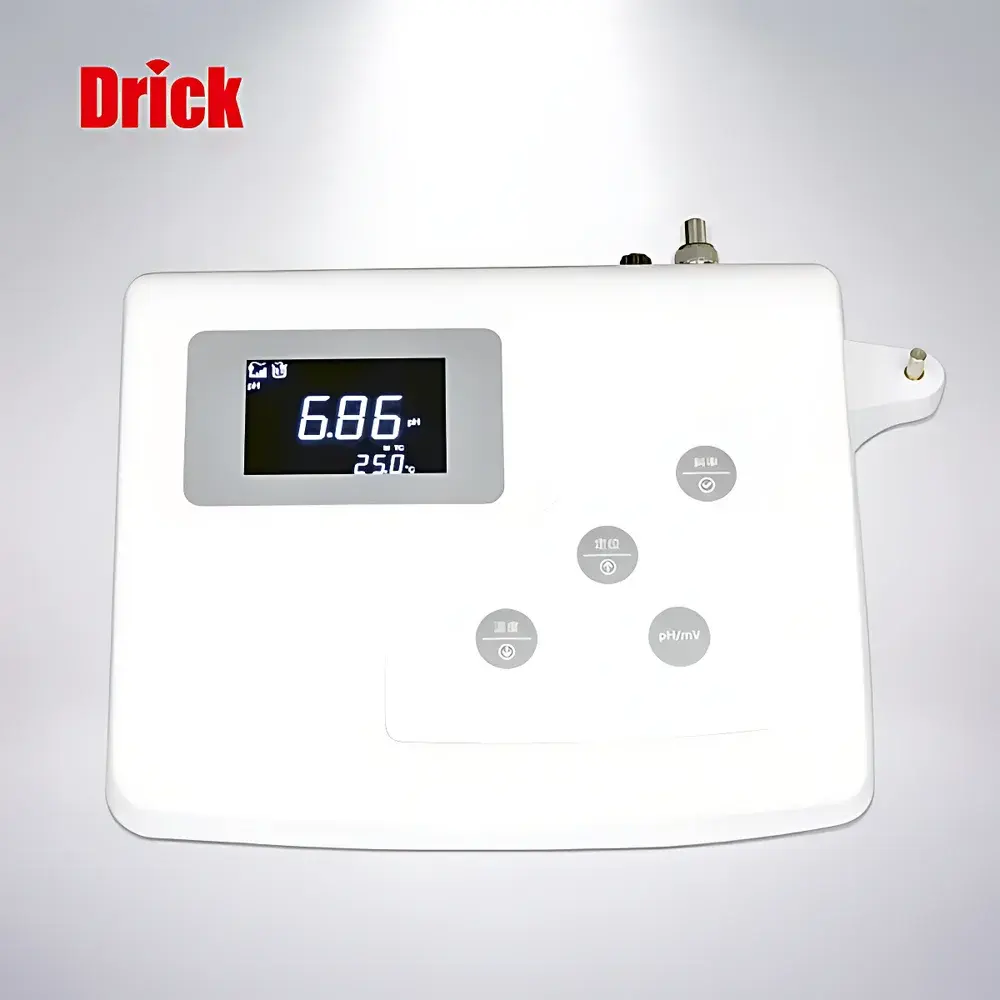
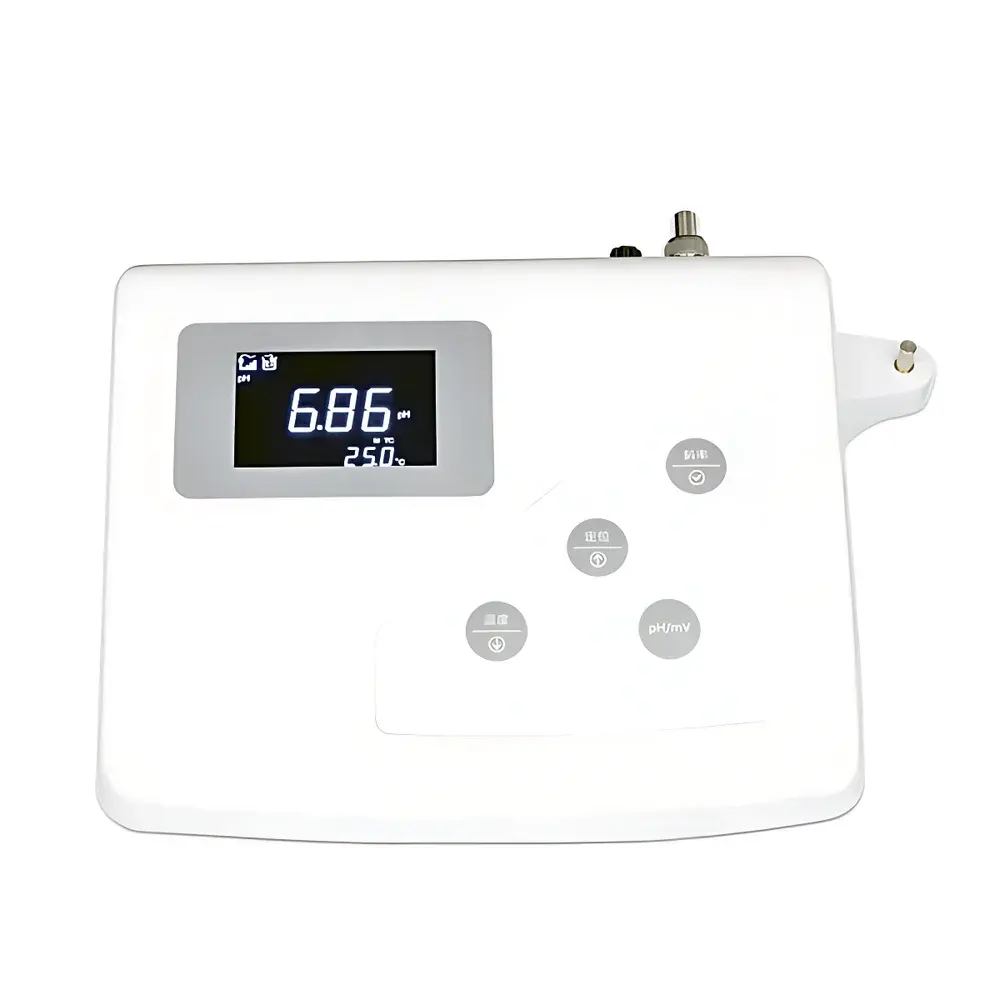
Drick DRK-pHS-25 Benchtop pH Meter
| Brand | Drick |
|---|---|
| Origin | Shandong, China |
| Manufacturer Type | Direct Manufacturer |
| Product Category | Domestic |
| Model | DRK-pHS-25 |
| Instrument Type | Benchtop |
| Parameter Type | Single-parameter (pH/mV) |
| Display | Black-membrane LCD with white LED backlight |
| pH Range | 0.00–14.00 pH |
| mV Range | –1400 to +1400 mV |
| Resolution | 0.01 pH / 1 mV |
| Accuracy | ±0.05 pH / ±0.5 %FS (mV) |
| Stability | ±0.05 pH ±1 digit / 3 h |
| Temperature Compensation | Manual, 0–60 °C |
| Calibration | Automatic 1–3 point using NIST-traceable buffers (pH 4.00, 6.86, 9.18) |
| Electrode Interface | BNC + dual-terminal binding posts |
| Power Supply | DC 12 V |
| Power Consumption | 3 W |
| Operating Environment | 10–30 °C, ≤80 % RH |
| Dimensions (L×W×H) | 200 × 160 × 70 mm |
| Weight | 1 kg |
| Included Electrode | E-331D combination pH electrode |
| Built-in Electrode Holder | Adjustable multi-position stand supporting up to six electrodes |
Overview
The Drick DRK-pHS-25 Benchtop pH Meter is a precision electrochemical instrument engineered for reliable, repeatable pH and millivolt measurements in academic laboratories, quality control environments, and routine industrial process monitoring. It operates on the fundamental principle of potentiometric measurement: a glass pH electrode generates a voltage proportional to the hydrogen ion activity in solution, referenced against a stable internal or external reference electrode. This voltage difference—typically in the range of ±414 mV at 25 °C per pH unit—is converted into a calibrated pH value via high-fidelity analog-to-digital conversion and temperature-compensated Nernst equation computation. Designed to meet JJG 119–2019 (Chinese national verification regulation for pH meters) and aligned with international metrological practice, the DRK-pHS-25 delivers Class 0.1 accuracy per IEC 60746-1, making it suitable for applications requiring traceable, GLP-compliant data acquisition where formal validation protocols are applied.
Key Features
- High-resolution black-membrane LCD display with uniform white LED backlight—optimized for wide viewing angles and legibility under low-light conditions typical in analytical labs.
- Automatic 1–3 point calibration using standard NIST-traceable buffer solutions (pH 4.00, 6.86, and 9.18), with real-time slope and offset diagnostics displayed post-calibration.
- 24-bit analog-to-digital converter paired with a 32-bit ARM microcontroller ensures low-noise signal acquisition, enhanced dynamic range, and robust digital filtering for stable readings in electrically noisy environments.
- Electrode health indicator: visual icon-based feedback reflects measured electrode impedance and asymmetry potential—enabling proactive maintenance and timely replacement before drift compromises data integrity.
- Dual electrode interface (BNC + screw-terminal posts) supports both integrated combination electrodes (e.g., E-331D) and separate indicator/reference configurations—maximizing flexibility across electrode chemistries and legacy hardware.
- Manually adjustable temperature compensation (0–60 °C) with direct numeric entry via virtual keypad—eliminating mechanical dials and reducing parallax error during field deployment.
- Integrated multi-axis electrode holder: height- and angle-adjustable, accommodating up to six electrodes simultaneously—ideal for comparative studies, buffer verification, or parallel sample testing without repositioning.
- Over-range alert and audible keypress feedback enhance operational safety and reduce procedural errors during high-throughput workflows.
Sample Compatibility & Compliance
The DRK-pHS-25 is compatible with aqueous and mildly buffered solutions across the full pH scale (0.00–14.00). It supports common laboratory electrode types—including gel-filled, refillable, and low-ionic-strength variants—when used with appropriate junctions and filling solutions. While not certified for hazardous area use or intrinsic safety, its DC-powered architecture (12 V input) minimizes electrical risk in wet-bench settings. The instrument conforms to electromagnetic compatibility (EMC) requirements per GB/T 18268.1–2010 (equivalent to IEC 61326-1) and meets basic safety standards under GB 4793.1–2007 (IEC 61010-1). For regulated environments, its manual calibration logs, stability metrics, and mV mode support method validation per USP , EP 2.2.3, and ISO 17025 documentation requirements.
Software & Data Management
As a standalone benchtop meter, the DRK-pHS-25 does not include embedded Bluetooth or USB data logging; however, its stable analog output and consistent serial behavior enable integration with third-party DAQ systems via optional RS-232 or TTL-level adapters. All calibration events, measured values, and user-entered temperature settings are retained in volatile memory during operation and persist across power cycles only when backed by an external recording protocol. For audit-trail compliance (e.g., FDA 21 CFR Part 11), users are advised to pair the instrument with validated electronic lab notebook (ELN) software or LIMS interfaces that capture timestamped, operator-identified entries directly from the display or external sensor modules.
Applications
- Academic teaching labs: Demonstrating acid-base equilibria, titration endpoints, and buffer capacity calculations.
- Environmental water testing: Monitoring influent/effluent pH in wastewater treatment plants per EPA Method 150.1.
- Food & beverage QC: Verifying pH stability in dairy fermentation, juice pasteurization, and meat curing processes.
- Pharmaceutical excipient testing: Confirming pH consistency in buffer stock solutions prior to formulation.
- Chemical synthesis: Tracking reaction progress in hydrolysis, neutralization, or catalyst activation steps.
- Calibration verification: Cross-checking field portable meters using standardized buffer sets under controlled lab conditions.
FAQ
What buffer solutions are required for calibration?
The DRK-pHS-25 is optimized for automatic 1–3 point calibration using certified pH 4.00, 6.86, and 9.18 buffers traceable to NIST SRM standards. Other buffers may be used if their certified values at measurement temperature are manually entered.
Can this meter measure ORP (redox potential)?
Yes—the mV mode (–1400 to +1400 mV) supports direct redox potential measurement with a platinum or reversible hydrogen electrode (RHE), provided proper reference electrode selection and junction compatibility are ensured.
Is temperature compensation automatic or manual?
Temperature compensation is manual: users enter the sample temperature via the virtual keypad before measurement. No built-in temperature probe is included, but external Pt100 or thermistor probes can be interfaced via auxiliary inputs on custom-configured versions.
How often should the E-331D electrode be recalibrated?
Recalibration is recommended before each batch of critical measurements, after electrode cleaning or storage, and whenever drift exceeds ±0.05 pH between known standards—consistent with ISO 7870-2 and CLSI EP21-A guidelines.
Does the instrument support GLP-compliant record keeping?
While the meter itself lacks non-volatile audit trail storage, its deterministic calibration sequence, visible slope/offset diagnostics, and stable mV output allow full GLP documentation when paired with external ELN or paper-based logbooks adhering to ALCOA+ principles.
Related Products





