
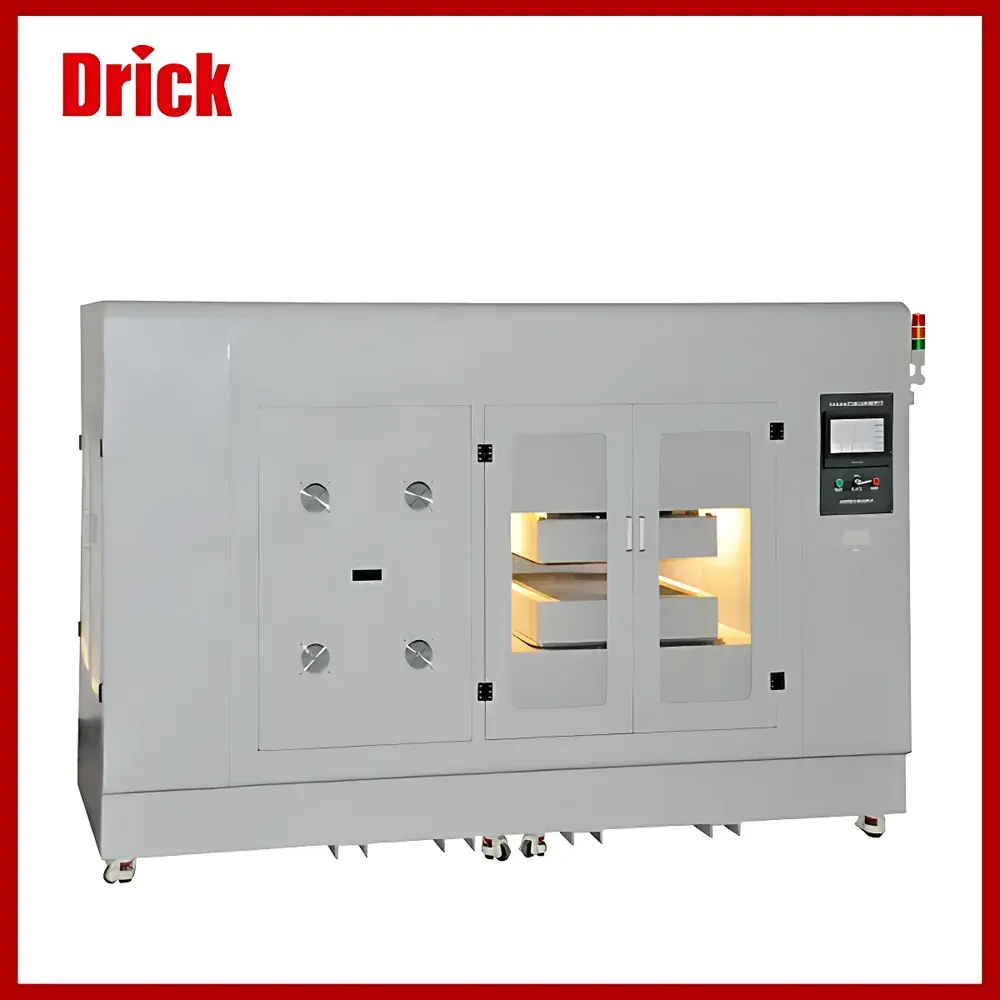
Drick DRK666 Air Filter Efficiency & Pressure Drop Tester
| Brand | Drick |
|---|---|
| Model | DRK666 Air Filter Tester |
| Compliance | ISO 16890-3:2016, ISO 5011, EN 779 (legacy), ASTM D2986 |
| Measurement Principle | Gravimetric Efficiency + Differential Pressure |
| Flow Control Range | 0.5–1000 m³/h (adjustable, ±0.5% FS stability) |
| Pressure Drop Resolution | 0.1 Pa |
| Test Chamber | Dual-zone static pressure ring design with upstream/downstream plenums |
| Flow Stabilization | Integrated pre-regulated laminar flow conditioner and PID-controlled blower system |
| Safety Mode | Negative-pressure test enclosure with HEPA-filtered exhaust and built-in ionizing neutralizer |
| Display | 10-inch industrial capacitive touchscreen (IP65-rated) |
| Data Output | CSV export, USB storage, Ethernet (Modbus TCP / optional OPC UA), GLP-compliant audit trail logging |
Overview
The Drick DRK666 Air Filter Efficiency & Pressure Drop Tester is an engineered laboratory-grade instrument designed for standardized gravimetric efficiency and pressure drop evaluation of flat-panel and pleated air filter media and complete filter elements. It operates on the principle of controlled aerosol challenge—typically using ISO-standardized ASHRAE Fine Test Dust (FTD) or ISO 12103-1 A2 Fine Test Dust—followed by precise pre- and post-test gravimetric analysis of the filter specimen. Simultaneously, it measures the clean-filter and loaded-filter pressure drop across the media under rigorously stabilized volumetric airflow conditions. This dual-parameter methodology enables full compliance with ISO 16890-3:2016 (Particulate Air Filters for General Ventilation – Determination of gravimetric efficiency and pressure drop), as well as supporting validation per ISO 5011 (Internal combustion engines – Air cleaners – Test methods) and legacy EN 779:2012 requirements. The system’s architecture prioritizes metrological integrity: all differential pressure measurements are acquired via traceable, NIST-calibrated, high-stability piezoresistive transducers; flow is maintained within ±0.5% full-scale repeatability using a closed-loop PID-controlled centrifugal blower and integrated laminar flow conditioning.
Key Features
- Gravimetric efficiency measurement per ISO 16890-3:2016, including PM1, PM2.5, PM10 fractional efficiency reporting
- Dual-chamber static pressure ring manifold ensures uniform upstream/downstream pressure sampling across full test area (up to 610 × 610 mm)
- Negative-pressure test enclosure with HEPA-filtered exhaust and interlocked access door—designed to contain hazardous test aerosols and protect operator health
- Integrated corona-type electrostatic neutralizer upstream of the test section eliminates particle charge-induced deposition bias, critical for accurate PMx efficiency calculation
- PLC-based control system with real-time feedback loops for flow stabilization, eliminating transient drift during extended loading cycles
- 10-inch industrial-grade touchscreen HMI with intuitive workflow navigation, multi-language support (EN/DE/FR/ES), and embedded calibration certificate management
- Automated test sequencing: specimen mounting → zero-flow tare → flow ramp → dust injection → timed loading → final weighing protocol
Sample Compatibility & Compliance
The DRK666 accommodates standard filter specimens up to 610 mm × 610 mm (24″ × 24″) and thicknesses up to 300 mm, including rigid panel filters, pocket filters, V-bank configurations, and OEM automotive cabin air filters. Its modular clamping system supports both flat-sheet media testing and full-element evaluation. Regulatory alignment includes full traceability to ISO/IEC 17025:2017 measurement uncertainty frameworks. Data acquisition meets FDA 21 CFR Part 11 requirements when configured with electronic signature-enabled firmware and audit-trail logging (optional). All pressure and flow sensors carry valid factory calibration certificates with stated uncertainties referenced to national standards. System validation documentation—including IQ/OQ templates—is supplied to support GMP/GLP environments in HVAC component manufacturing and Tier-1 automotive filtration R&D labs.
Software & Data Management
The embedded control software provides real-time visualization of differential pressure (Pa), volumetric flow rate (m³/h), elapsed test time, and cumulative dust mass loading (g). Post-test reports auto-generate ISO 16890-compliant summary tables, including initial resistance, final resistance, average resistance, gravimetric efficiency at defined dust mass intervals, and calculated ePM1/ePM2.5/ePM10 values. Raw data streams are logged at 1 Hz resolution and exportable in CSV format for external statistical analysis (e.g., JMP, Minitab). Network connectivity supports remote firmware updates, centralized fleet monitoring via SNMP, and integration into enterprise LIMS via RESTful API (available as licensed module). All user actions—including parameter changes, calibration events, and report generation—are timestamped and stored in an immutable audit trail compliant with ISO 17025 clause 7.7.
Applications
The DRK666 serves core quality assurance and R&D functions across three primary sectors: (1) HVAC filter manufacturers validating product classification per ISO 16890 (e.g., ePM1 ≥ 50%); (2) Automotive Tier-1 suppliers conducting durability and efficiency mapping for cabin air filters under dynamic dust-loading profiles; (3) Industrial filtration system integrators performing comparative media screening for compressed air, paint booth, or cleanroom pre-filtration applications. Its capability to replicate real-world dust loading kinetics—combined with repeatable pressure drop tracking—makes it suitable for ISO 16890 Annex D “Extended Life Testing” protocols and internal filter lifetime modeling. Academic laboratories utilize the platform for fundamental studies on particle capture mechanisms, electrostatic enhancement decay, and fiber-level filtration modeling.
FAQ
Does the DRK666 comply with current ISO 16890 editions?
Yes—it implements the full test sequence and reporting structure required by ISO 16890-3:2016, including fractional efficiency determination across PM1, PM2.5, and PM10 size ranges using gravimetric reference methods.
Can the system be used for testing oil mist or coalescing filters?
No—the DRK666 is specifically engineered for dry particulate aerosol challenges (ASHRAE FTD, ISO A2 dust). It is not configured for liquid aerosol generation, coalescence measurement, or oil separation efficiency testing.
Is third-party calibration certification included with delivery?
Each unit ships with a full factory calibration certificate for pressure, flow, and temperature sensors, traceable to NIST or equivalent national metrology institutes. On-site ISO/IEC 17025 calibration services are available upon request.
What maintenance intervals are recommended for long-term accuracy?
Biannual verification of pressure transducer linearity and annual recalibration of the mass flow controller are recommended. The electrostatic neutralizer emitter pins require cleaning every 200 operational hours; consumable dust filters (HEPA exhaust, pre-filter) follow ISO 16890-specified replacement schedules.
Can test data be exported directly to SAP QM or ETQ Reliance?
Yes—via the optional LIMS Integration Module, which supports direct data push using standard protocols (SAP RFC, ETQ Web Services API) and maps DRK666 test parameters to configurable quality characteristic fields.






