
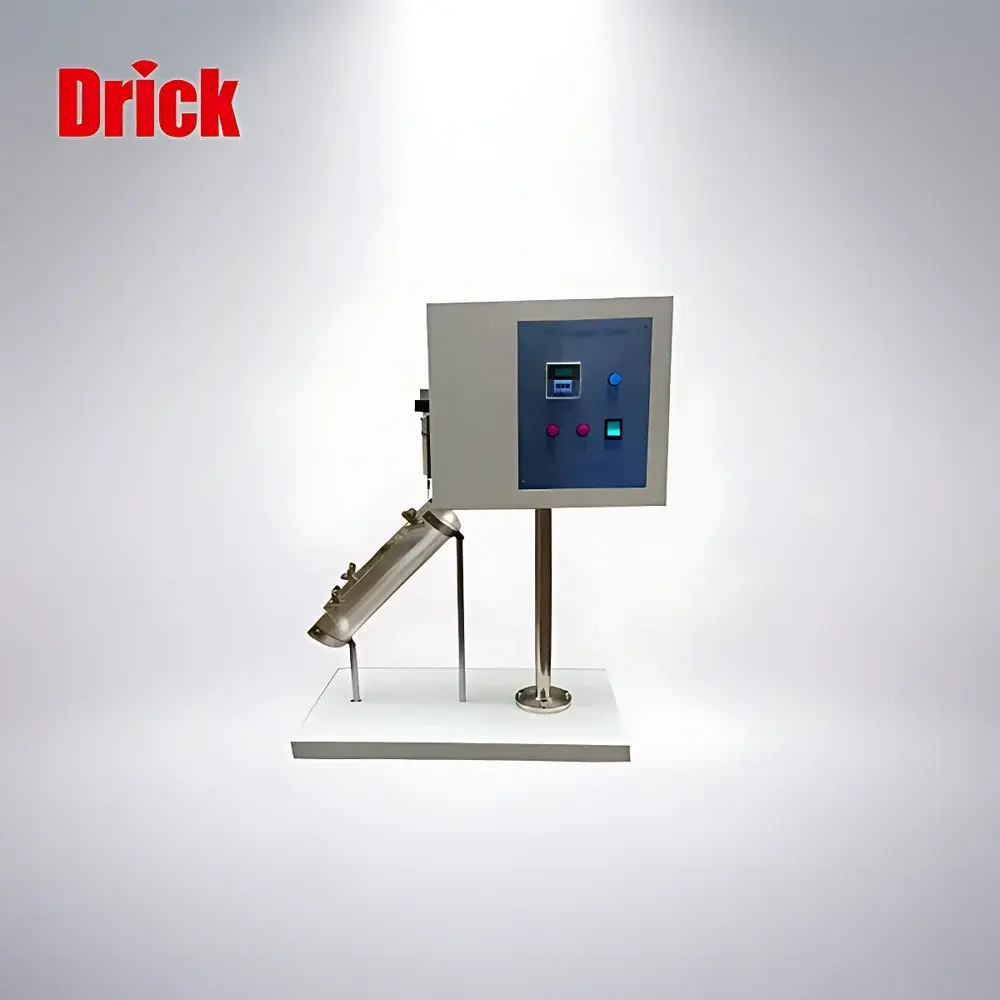
Drick DRK453 Chemical Protective Clothing Resistance Testing System
| Brand | Drick |
|---|---|
| Origin | Shandong, China |
| Manufacturer Type | OEM/ODM Manufacturer |
| Country of Origin | China |
| Model | DRK453 |
| Price | USD 7,000 (FOB Qingdao) |
Overview
The Drick DRK453 Chemical Protective Clothing Resistance Testing System is a tri-functional laboratory instrument engineered for standardized evaluation of textile-based chemical protective clothing against acidic and alkaline hazards. It integrates three distinct test modules—liquid repellency efficiency (per GB 24540-2009 Annex D), hydrostatic pressure resistance (acid column method), and chemical penetration time measurement (electrical conductivity principle)—into a single modular platform. Each module operates independently but shares unified environmental control, sample handling protocols, and data traceability architecture. The system implements core physical testing principles: gravity-driven liquid impingement for repellency assessment; static head pressure application via calibrated sulfuric acid column for barrier resistance quantification; and real-time circuit closure detection for breakthrough onset timing. Designed in strict compliance with GB 24540-2009, it supports quality assurance workflows in PPE manufacturing, third-party certification laboratories, and occupational safety R&D departments requiring reproducible, auditable test outcomes under controlled ambient conditions (17–30 °C, 65 ± 5% RH).
Key Features
- Triple-mode operation: Simultaneous or sequential execution of repellency efficiency, acid hydrostatic pressure resistance, and penetration time tests without hardware reconfiguration.
- Modular test chambers: Interchangeable fixtures—including semi-cylindrical acrylic trough (ID 125 ± 5 mm, L 300 ± 2 mm, 45° incline), vertical acid column assembly (max. 150 mm H₂SO₄ at 80% w/w), and dual-electrode penetration cell (100 × 100 mm sample aperture)—all precision-machined to GB 24540 tolerances.
- Calibrated fluid delivery: 10 ± 0.5 mL syringe with flat-tipped stainless steel needle (0.8 ± 0.02 mm ID), positioned 100 ± 2 mm above trough base for consistent spray dynamics.
- Automated timing & signal capture: Microprocessor-controlled stopwatch triggered by electrical continuity between conductive threads and upper electrode upon liquid breakthrough; resolution ≤ 0.1 s.
- Environmental monitoring: Integrated digital hygrothermograph logs ambient temperature and relative humidity during all test phases, with timestamped CSV export capability.
- Structural integrity: Powder-coated steel frame with corrosion-resistant acrylic and PTFE components ensures long-term stability in aggressive chemical handling environments.
Sample Compatibility & Compliance
The DRK453 accommodates standard specimen dimensions per GB 24540-2009: 360 × 235 mm for repellency testing, Φ32 mm circular coupons for hydrostatic pressure evaluation, and 100 × 100 mm squares for penetration time assays. All clamping mechanisms apply uniform edge pressure without distortion. The system is validated for use with aqueous solutions of sulfuric acid (up to 80% w/w), sodium hydroxide (up to 40% w/w), and other common industrial acids/bases referenced in Annex A of GB 24540. While primarily aligned with Chinese national standards, its mechanical design and measurement methodology are compatible with ISO 6530:2005 (Protective clothing — Liquid chemical protection — Determination of resistance to penetration by liquids) and ASTM F903-22 (Standard Test Method for Resistance of Materials Used in Protective Clothing to Penetration by Liquids). Full traceability documentation—including calibration certificates for syringes, manometric columns, and timing electronics—is provided with each unit.
Software & Data Management
The DRK453 operates via embedded firmware with local LCD interface; no external PC is required for basic test execution. However, optional USB-C data export enables transfer of time-stamped test logs—including ambient conditions, operator ID, sample ID, pass/fail flags, and raw penetration timestamps—to Windows-compatible spreadsheet applications. All stored records comply with GLP audit requirements: entries are immutable post-test, include electronic signatures (via alphanumeric login), and retain full revision history. The system supports 21 CFR Part 11–compliant configurations when integrated with validated laboratory information management systems (LIMS) via RS-232 or Modbus RTU protocols. Audit trails record user actions, parameter changes, and calibration events with ISO 8601 timestamps.
Applications
- Pre-market validation of woven, nonwoven, laminated, and coated fabrics intended for Category III PPE under EU Regulation (EU) 2016/425.
- Batch release testing in ISO 13485-certified medical garment manufacturing facilities producing chemical splash gowns.
- Comparative barrier performance studies across fabric architectures (e.g., microporous vs. monolithic membranes) under standardized acid exposure protocols.
- Root cause analysis of field failures by correlating lab-measured penetration times with real-world incident reports.
- Supporting technical documentation for CE marking dossiers, ANSI/ISEA 101-2014 submissions, and OSHA 1910.132 compliance verification.
FAQ
Does the DRK453 meet international regulatory requirements beyond GB 24540-2009?
Yes—its mechanical configuration and test logic align with ISO 6530:2005 and ASTM F903-22; full equivalence documentation is available upon request.
Can the system be used with organic solvents or mixed chemical formulations?
No—the DRK453 is validated exclusively for aqueous acidic and alkaline solutions per GB 24540. Solvent compatibility requires third-party validation and material compatibility assessment.
Is operator training included with purchase?
Yes—Drick provides on-site or remote installation qualification (IQ) and operational qualification (OQ) support, including hands-on SOP development and personnel competency verification.
What maintenance intervals are recommended?
Syringe calibration every 6 months; acrylic trough inspection before each test series; electrode cleaning after every 10 penetration tests; full system verification annually using NIST-traceable reference standards.
Are spare parts and consumables readily available?
All critical wear items—including flat-tip needles, conductive thread kits, and acid column seals—are stocked globally with lead times under 10 business days.





