
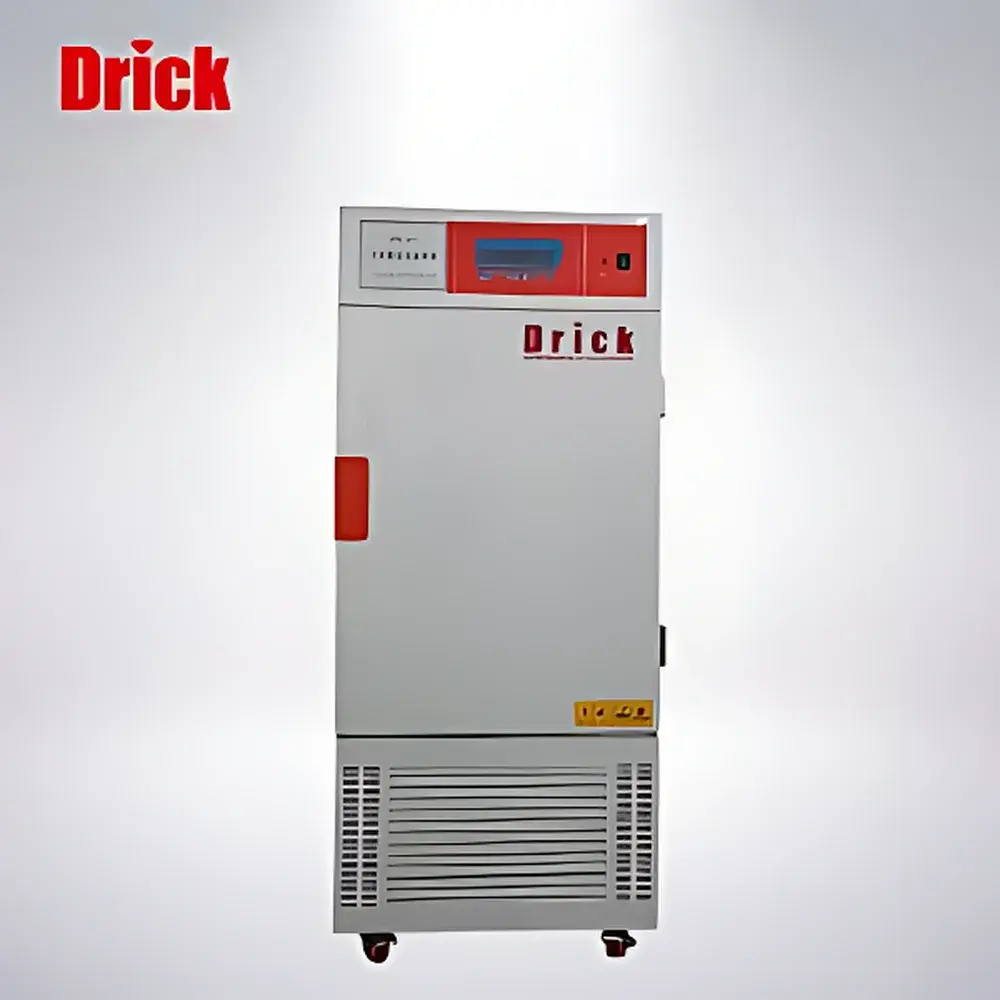
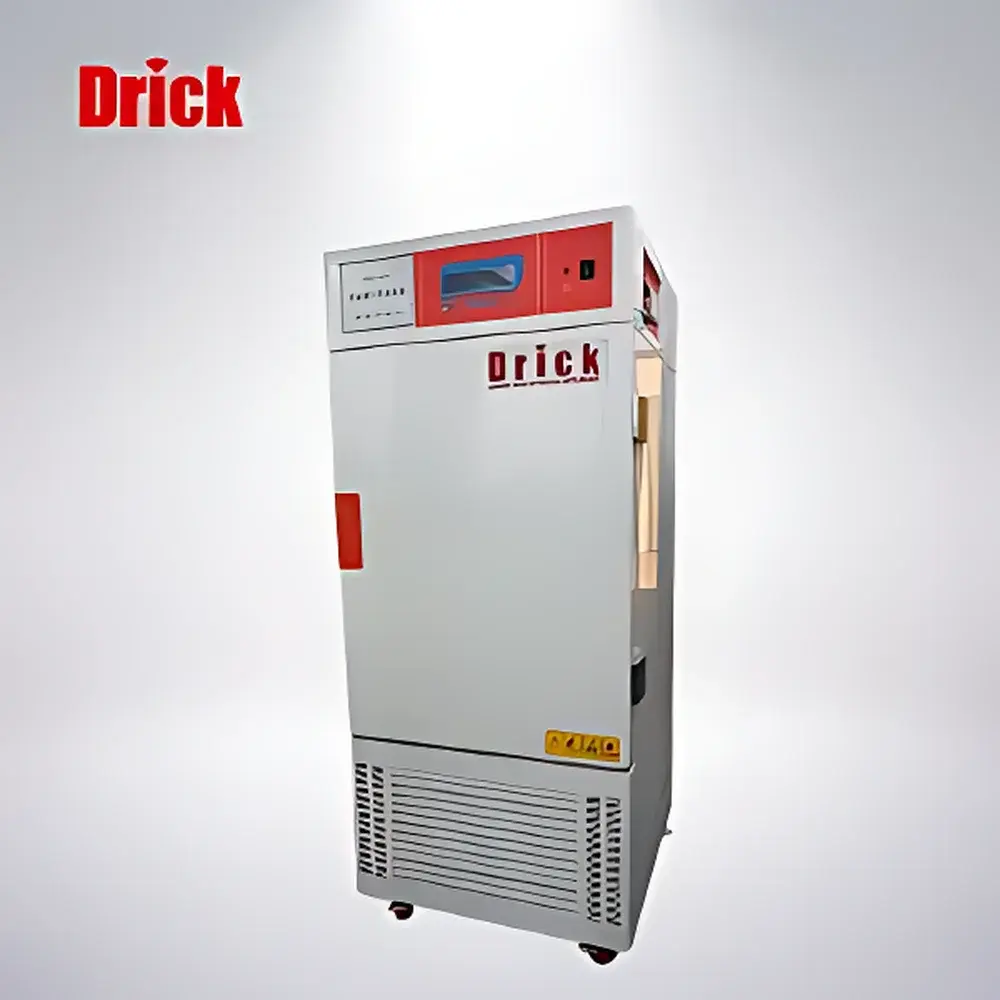
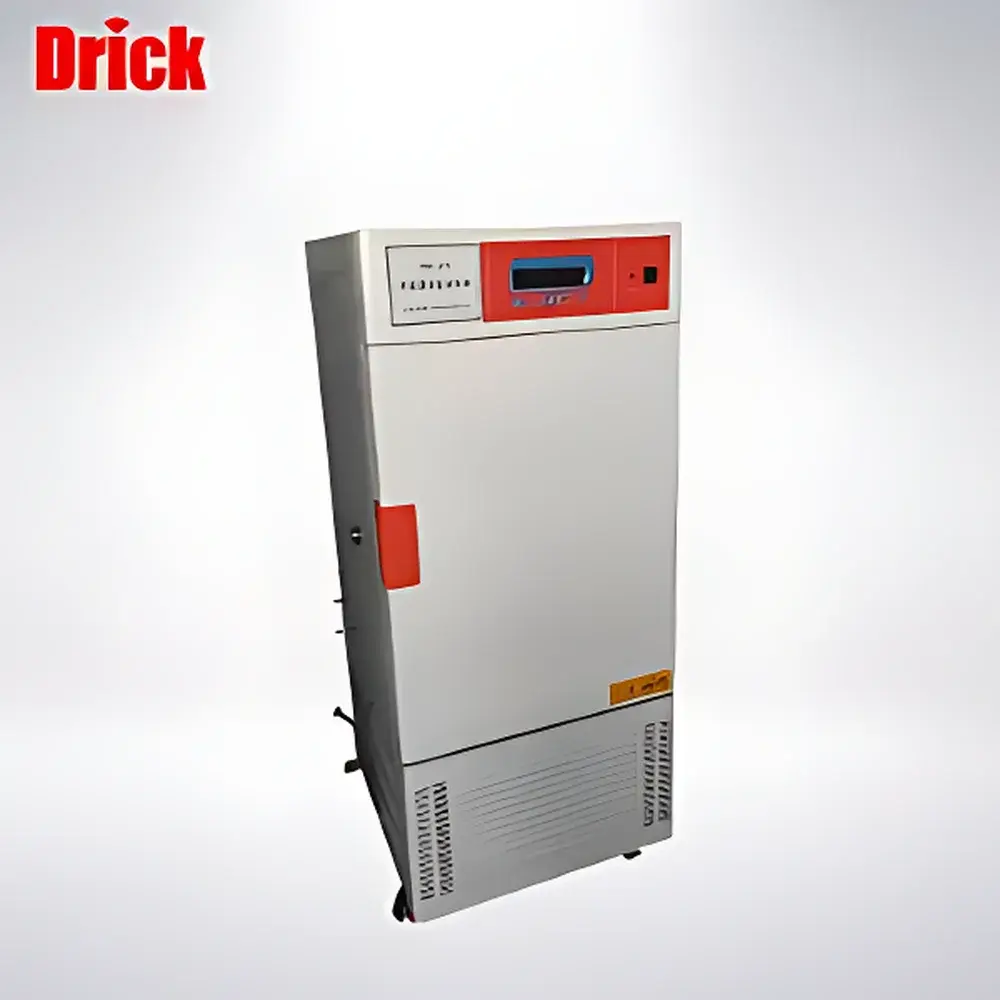
Drick DRK672 Next-Generation Pharmaceutical Stability Testing Chamber
| Brand | Drick |
|---|---|
| Origin | Shandong, China |
| Manufacturer Type | Direct Manufacturer |
| Model | DRK672 |
| Temperature Range (Dark) | 0–65°C |
| Temperature Range (Illuminated) | 10–50°C |
| Temp. Uniformity | ±2°C |
| Temp. Fluctuation | ±0.5°C |
| Humidity Range | 40–95% RH |
| Humidity Deviation | ±3% RH |
| Illuminance Range | 0–6000 lx (adjustable) |
| Illuminance Accuracy | ≤±500 lx |
| Timer Range | 1–99 h per segment |
| Control Method | Balanced Heating & Humidification |
| Refrigeration System | Dual Independent Imported Hermetic Compressors (Auto-Switching) |
| Controller | Programmable LCD Controller |
| Sensors | Pt100 Platinum Resistance Thermometer, Capacitive Humidity Sensor |
| Ambient Operating Temp. | RT+5–30°C |
| Power Supply | AC 220 V ±10%, 50 Hz |
| Power Consumption | 2600 W |
| Dimming | Manual Stepless Illumination Control |
| Internal Volume | 250 L |
| Interior Dimensions (W×D×H) | 600×500×830 mm |
| Exterior Dimensions (W×D×H) | 740×890×1680 mm |
| Standard Shelves | 3 pcs |
| Embedded Printer | Standard |
| Safety Protections | Compressor Overheat, Fan Overheat, Over-Temperature, High-Pressure, Overload, and Low-Water Protection |
Overview
The Drick DRK672 Next-Generation Pharmaceutical Stability Testing Chamber is an engineered environmental simulation system designed to meet the stringent requirements of ICH Q1–Q5 guidelines, USP , and the 2015 Chinese Pharmacopoeia for drug stability evaluation. It operates on the principle of controlled environmental stress exposure—precisely regulating temperature, relative humidity, and photometric irradiance over extended durations—to accelerate degradation pathways and assess shelf-life under defined storage conditions. Unlike conventional chambers limited by thermal cycling fatigue or humidity control drift, the DRK672 employs dual independent refrigeration circuits with automatic compressor switching, enabling uninterrupted operation for >1000 hours—critical for long-term stability studies mandated under ICH Q1A(R2) and FDA 21 CFR Part 211. Its chamber architecture integrates ISO 14644-1 Class 8 cleanroom-compatible airflow dynamics, ensuring spatial uniformity across the entire 250 L working volume without stratification or localized condensation.
Key Features
- Dual redundant hermetic compressors (imported) with intelligent load-balancing logic—eliminates single-point failure risk during multi-month trials.
- Balanced heating/humidification control architecture using PID-driven Pt100 and capacitive RH sensors—achieves ±0.5°C temperature fluctuation and ±3% RH deviation under steady-state conditions (per GB/T 10586–2006 validation protocol).
- Manually adjustable, stepless illumination system (0–6000 lx) with integrated lux meter—enables traceable photostability testing per ICH Q1B, including UV-A (320–400 nm) and visible spectrum compliance.
- 304 stainless steel interior with radius-corner construction and rear-mounted UV-C germicidal lamp (optional)—reduces microbial carryover between batches and supports GLP-compliant cleaning validation.
- Programmable LCD controller with embedded thermal printer (standard), real-time fault diagnostics, and screen-lock function—prevents unauthorized parameter modification during GMP audits.
- 25 mm diameter test port on left sidewall—facilitates in-chamber sensor feedthroughs or continuous external monitoring via calibrated data loggers.
Sample Compatibility & Compliance
The DRK672 accommodates primary and secondary packaging configurations—including blister packs, HDPE bottles, glass vials, and aluminum tubes—without compromising environmental homogeneity. Its 250 L chamber volume and optimized air distribution system (via rear-wall vertical laminar flow) ensure that all sample positions experience statistically equivalent thermal and hygroscopic exposure (validated per ASTM E2234–22). The system conforms to regulatory expectations for stability-indicating capability: it satisfies the temperature accuracy, humidity repeatability, and light intensity linearity requirements outlined in ICH Q5C, WHO TRS 992 Annex 6, and EU GMP Annex 15. All firmware and controller logs support 21 CFR Part 11-compliant electronic records when paired with validated third-party software platforms.
Software & Data Management
While the standard configuration includes a stand-alone programmable LCD controller with 100-program/1000-segment capacity and RS-485 interface, optional upgrades include a 7-inch touchscreen HMI with English/Chinese bilingual UI, real-time trend graphs, and P.I.D. auto-tuning algorithms. Raw sensor data (temperature, RH, illuminance) is timestamped at 1-minute intervals and exportable via USB or serial link. Embedded printer output provides immediate hard-copy verification of setpoints and deviations—essential for audit readiness. When connected to laboratory information management systems (LIMS), the DRK672 supports automated alarm escalation (e.g., out-of-specification excursions), electronic signature capture, and full audit trail generation per ALCOA+ principles.
Applications
- ICH Q1A(R2)-compliant long-term storage studies at 25°C ±2°C / 60% RH ±5% (12 months).
- Accelerated stability protocols at 40°C ±2°C / 75% RH ±5% (6 months) and intermediate conditions (30°C ±2°C / 65% RH ±5%).
- Photostability testing per ICH Q1B: Option A (visible light only), Option B (UV + visible), and Option C (near-UV enhancement).
- High-humidity challenge tests (90–95% RH) for moisture-sensitive APIs and solid dosage forms.
- Stability protocol development for biologics, lyophilized products, and combination devices requiring concurrent thermal, hygric, and optical stressors.
FAQ
Does the DRK672 comply with 21 CFR Part 11 requirements for electronic records?
Yes—when configured with optional audit-trail-enabled software and user access controls, it meets predicate rule requirements for electronic signatures and record integrity.
What is the maximum continuous runtime supported without maintenance intervention?
The dual-compressor architecture enables ≥1200 hours of uninterrupted operation under nominal load; scheduled preventive maintenance is recommended every 6 months per ISO 13485 maintenance plan.
Can the chamber be validated per IQ/OQ/PQ protocols?
Yes—factory-supplied DQ/IQ/OQ documentation packages are available, including sensor calibration certificates traceable to NIST standards and mapping reports per ISO 14644-3 Annex B.
Is remote monitoring supported?
RS-485 and optional Ethernet modules enable integration with SCADA or building management systems for centralized environmental oversight.
How is humidity control maintained at elevated temperatures (e.g., 50°C)?
Capacitive humidity sensors rated for continuous operation up to 85°C eliminate dry-wet bulb drift and ensure stable RH feedback control even during high-temperature photostability cycles.




