
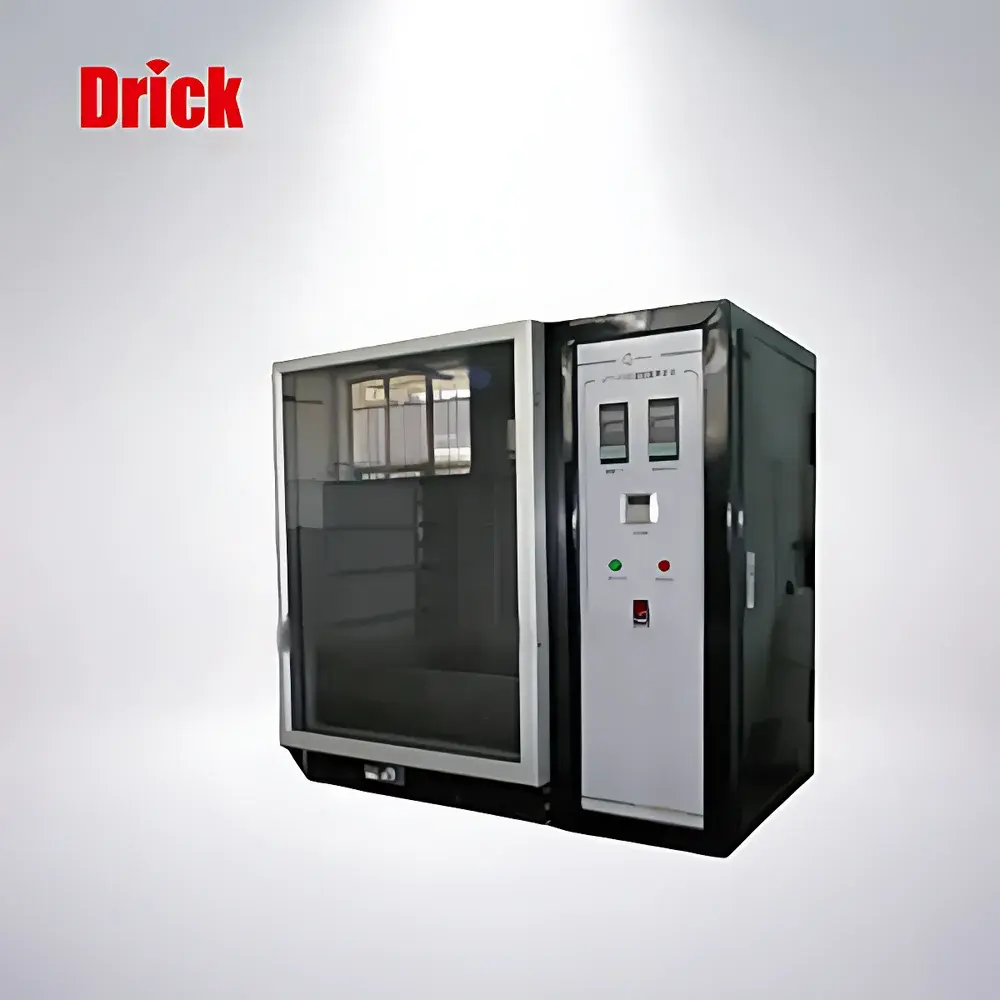
Drick DRK306B Textile Moisture Vapor Transmission Rate (MVTR) Tester for Nonwovens
| Brand | Drick |
|---|---|
| Origin | Shandong, China |
| Manufacturer Type | Direct Manufacturer |
| Model | DRK306B |
| Temperature Control Range | 10–50 °C ±1 °C |
| Humidity Control Range | 50–90 %RH ±2 %RH |
| Air Velocity | 0.02–0.3 m/s |
| Test Duration | 1 s–99 h 99 min |
| Heating Power | 600 W |
| Humidification Capacity | ≥250 mL/h |
| Test Area | ≥3000 mm² (ASTM), 2826 mm² (GB/T) |
| Power Supply | AC 220 V, 50 Hz |
Overview
The Drick DRK306B Moisture Vapor Transmission Rate (MVTR) Tester is a precision-controlled environmental test system engineered for quantitative evaluation of water vapor permeability in textiles and nonwoven materials—including spunbond, meltblown, needle-punched fabrics, thermal insulation battings (e.g., space cotton), and coated or laminated functional textiles. It operates on the gravimetric cup method as defined in GB/T 12704.1–2009 (Method A: Desiccant Method) and aligns with the procedural framework of ASTM E96–00 (Standard Test Methods for Water Vapor Transmission of Materials). The instrument measures the mass change of a desiccant-filled cup sealed beneath a conditioned test specimen over time, enabling calculation of MVTR in g/m²·24h. This parameter directly correlates with physiological comfort in apparel—specifically sweat evaporation efficiency, microclimate regulation, and skin dryness maintenance—making the DRK306B essential for R&D validation, quality control, and regulatory conformance in technical textile manufacturing.
Key Features
- Integrated refrigerated main chamber and dedicated control cabinet ensure stable low-temperature operation down to 10 °C, critical for simulating cold-climate wear conditions and avoiding condensation artifacts.
- Adjustable laminar airflow (0.02–0.3 m/s) across test cups maintains standardized boundary-layer conditions per ASTM E96 Annex A3 and ISO 15496, minimizing convective interference and enhancing inter-laboratory reproducibility.
- Dual-cup configuration support: four ASTM-compliant square cups (for thick, rigid nonwovens) and four ISO/GB-compatible circular cups (for thin, flexible fabrics), plus three additional GB/T-specific cups for parallel testing and statistical robustness.
- PID self-tuning temperature and humidity controllers deliver ±1 °C and ±2 %RH accuracy across the full operational range (10–50 °C; 50–90 %RH), with programmable setpoints traceable to NIST-traceable reference sensors.
- High-resolution digital timer (1-second resolution, up to 99 h 99 min) with dedicated start/stop buttons enables precise synchronization with gravimetric weighing intervals, supporting both short-duration screening and long-term stability studies.
- 600 W heating capacity and ≥250 mL/h humidification output ensure rapid environmental stabilization and sustained saturation under high-RH protocols (e.g., 90 %RH at 38 °C), meeting accelerated aging and extreme-condition test requirements.
Sample Compatibility & Compliance
The DRK306B accommodates specimens up to 3000 mm² (ASTM) or 2826 mm² (GB/T), accommodating standard cut sizes for woven, knitted, and nonwoven substrates—including hydrophobic membranes, breathable laminates, medical barrier fabrics, and hygiene absorbent cores. It supports compliance verification against GB/T 12704.1–2009, ASTM E96–00 (Procedure A – Desiccant Method), ISO 15496:2004, and JIS L 1099:2012 (Method A1). While not inherently 21 CFR Part 11 compliant, its hardware architecture permits integration with validated LIMS or ELN platforms for audit-trail-enabled data capture in GLP/GMP environments. All control parameters are logged with timestamped metadata, facilitating retrospective review per ISO/IEC 17025 documentation requirements.
Software & Data Management
The DRK306B operates via front-panel tactile controls and real-time LED displays—no embedded software or PC dependency. However, raw mass-change data from analytical balances (not included) are manually entered into standardized Excel templates provided with the system. These templates auto-calculate MVTR using ISO 15496 equations, apply temperature/humidity correction factors, and generate summary reports with uncertainty estimates based on balance readability (±0.1 mg recommended) and environmental stability metrics. For automated workflows, optional RS-232 or USB interfaces support integration with third-party data acquisition systems capable of parsing serial weight streams and environmental logs.
Applications
- Development and validation of moisture-managing sportswear and military uniforms
- Quality assurance of surgical gowns, drapes, and isolation barriers per AAMI PB70 standards
- Performance benchmarking of diaper backsheets, feminine hygiene topsheets, and wound contact layers
- Regulatory submission support for FDA 510(k) or CE-marked medical textiles
- Comparative analysis of hydrophilic vs. hydrophobic nonwoven finishes under controlled climatic stress
- Long-term durability assessment of MVTR retention after laundering, abrasion, or chemical exposure
FAQ
What standards does the DRK306B explicitly support?
It is mechanically and operationally aligned with GB/T 12704.1–2009 (Method A), ASTM E96–00 (Procedure A), ISO 15496:2004, and JIS L 1099:2012 (A1). Calibration and validation protocols follow ISO/IEC 17025 principles.
Is the instrument suitable for testing laminated or coated fabrics?
Yes—its dual-cup design and adjustable airflow accommodate multilayer structures, including PU-coated, PTFE-laminated, and nanofiber-enhanced composites, provided surface integrity remains intact during clamping.
Does the system include a balance or data logging software?
No—analytical balances (0.1 mg readability minimum) and external data recording tools must be supplied by the user. Drick provides calculation templates and test report templates compliant with ISO format conventions.
Can the DRK306B operate continuously for 72+ hours?
Yes—the refrigeration system, heater, and humidifier are rated for unattended operation within specified environmental limits; however, periodic manual cup weighing and desiccant replacement (every 24–48 h) are required per standard methodology.
How is traceability maintained for temperature and humidity sensors?
Sensors are factory-calibrated against NIST-traceable references; users receive calibration certificates. Annual recalibration is recommended, and sensor drift checks can be performed using saturated salt solutions per ISO 4677.





