
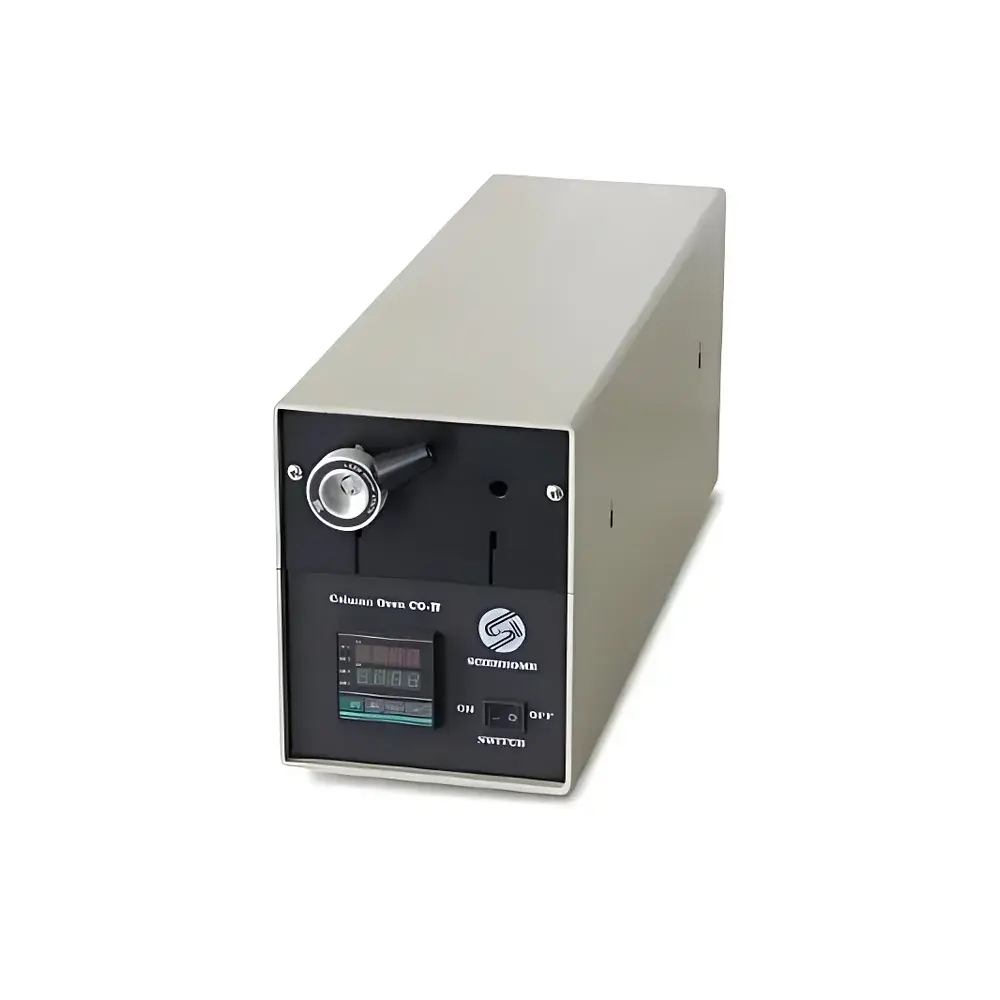
Scienhome CO-IV HPLC Column Oven
| Brand | Scienhome |
|---|---|
| Model | CO-IV |
| Origin | Tianjin, China |
| Power Supply | 220 V ±10%, 50 Hz |
| Temperature Control Range | Ambient +5 °C to 100 °C |
| Temperature Stability | ±0.1 °C at 50 °C |
| Repeatability | ±0.1 °C |
| Max. Power Consumption | 125 W |
| Dimensions (W×D×H) | 440 × 170 × 140 mm |
| Net Weight | 5 kg |
| Over-Temperature Protection | Yes |
| Sample Compatibility | Standard 1/8″ and 1/4″ HPLC columns, up to 30 cm length |
Overview
The Scienhome CO-IV HPLC Column Oven is a precision-engineered thermal management system designed to maintain consistent, stable column temperature during liquid chromatographic separations. In reversed-phase, ion-exchange, and size-exclusion chromatography, column temperature directly governs retention time reproducibility, peak symmetry, resolution, and mobile phase viscosity—factors that collectively determine method robustness and quantitative accuracy. Unlike ambient lab conditions subject to diurnal fluctuations or HVAC-induced drafts, the CO-IV establishes a tightly regulated thermal microenvironment around the analytical column using a combination of PID feedback control and fuzzy logic algorithms. This architecture ensures minimal thermal lag and rapid stabilization after setpoint changes, enabling reliable operation across method development, QC release testing, and long-duration gradient runs. The oven’s heating-only design is optimized for routine laboratory applications where sub-ambient cooling is not required, while its integrated over-temperature protection circuitry safeguards packed columns from thermal degradation above 105 °C.
Key Features
- Precision temperature regulation with ±0.1 °C stability at 50 °C and repeatability within ±0.1 °C across consecutive cycles
- Fuzzy-PID hybrid control algorithm for adaptive response to load changes and ambient perturbations
- Uniform thermal field distribution: validated spatial homogeneity (<±0.2 °C deviation) between column inlet, center, and outlet zones
- Integrated pre-heating zone for injection valve and connecting tubing to eliminate axial temperature gradients in the flow path
- Over-temperature cutoff with independent thermal fuse (trip point: 105 °C) and electronic monitoring
- Compact footprint (440 × 170 × 140 mm) and lightweight (5 kg) design compatible with standard HPLC workbenches and stacked instrument configurations
- Front-accessible column tray accommodating up to two 30 cm columns with 1/8″ or 1/4″ OD tubing routing channels
Sample Compatibility & Compliance
The CO-IV supports all common stainless steel, PEEK, and fused-silica HPLC columns used in isocratic and gradient elution modes—including C18, phenyl-hexyl, HILIC, and SEC columns. Its internal chamber geometry accommodates both straight-column and serpentine configurations without mechanical stress. From a regulatory standpoint, the device meets IEC 61010-1 safety requirements for laboratory electrical equipment and complies with electromagnetic compatibility standards EN 61326-1. While not intrinsically compliant with FDA 21 CFR Part 11, its analog temperature display and manual setpoint interface are suitable for non-auditable environments; when integrated into validated chromatography data systems (e.g., Waters Empower, Thermo Chromeleon), temperature logs can be captured externally via optional analog voltage output (0–5 V DC proportional to setpoint). The unit is routinely deployed in GLP-compliant labs performing ASTM D7097, USP , and ISO 17025-accredited methods where column temperature control is explicitly specified.
Software & Data Management
The CO-IV operates as a standalone hardware module with no embedded firmware or network connectivity. Temperature setpoints and real-time readings are displayed on a high-contrast LED panel with 0.1 °C resolution. For laboratories requiring traceable thermal records, the oven provides an analog output port (0–5 V DC) scalable to the full 0–100 °C range, enabling direct acquisition by data loggers or chromatography data systems (CDS) equipped with analog input modules. This allows synchronization of column temperature metadata with chromatogram acquisition timestamps—critical for audit trails in regulated environments. No proprietary drivers or software installation is required. All calibration and verification procedures follow manufacturer-recommended protocols using NIST-traceable PT100 reference probes, supporting routine IQ/OQ documentation per GMP Annex 15 guidelines.
Applications
- Routine QC analysis of pharmaceutical actives and impurities under ICH Q2(R2)-aligned methods requiring strict column temperature control
- Method development for temperature-sensitive analytes (e.g., chiral separations, thermolabile peptides, oligonucleotides)
- Stability-indicating assays where retention time drift must remain below 0.2% RSD over 24-hour sequences
- Environmental testing per EPA Method 8081B and 8270D, where column oven consistency directly impacts surrogate recovery precision
- Academic and industrial research involving polymer characterization via SEC/GPC, where temperature-dependent elution behavior affects molar mass distribution calculations
FAQ
Does the CO-IV support active cooling below ambient temperature?
No. The CO-IV is a heating-only column oven. Its operational range begins at ambient +5 °C and extends to 100 °C. For sub-ambient applications, a separate refrigerated column compartment or Peltier-cooled oven is required.
Can the CO-IV be used with UHPLC systems operating at 1000 bar?
Yes. The oven imposes no pressure limitations—it houses the column only. All high-pressure integrity is maintained by the column hardware and ferrule connections. Ensure tubing routing avoids sharp bends inside the chamber.
Is temperature calibration performed at the factory?
Each unit undergoes end-of-line verification against a calibrated reference thermometer at three points (30 °C, 50 °C, and 80 °C). A certificate of conformance is included; full calibration per ISO/IEC 17025 requires user-performed verification using traceable standards.
What maintenance is required?
No scheduled maintenance is needed. Periodic visual inspection of the heating element insulation and thermal fuse continuity is recommended annually. Avoid solvent spills inside the chamber; wipe exterior with isopropyl alcohol only.




