
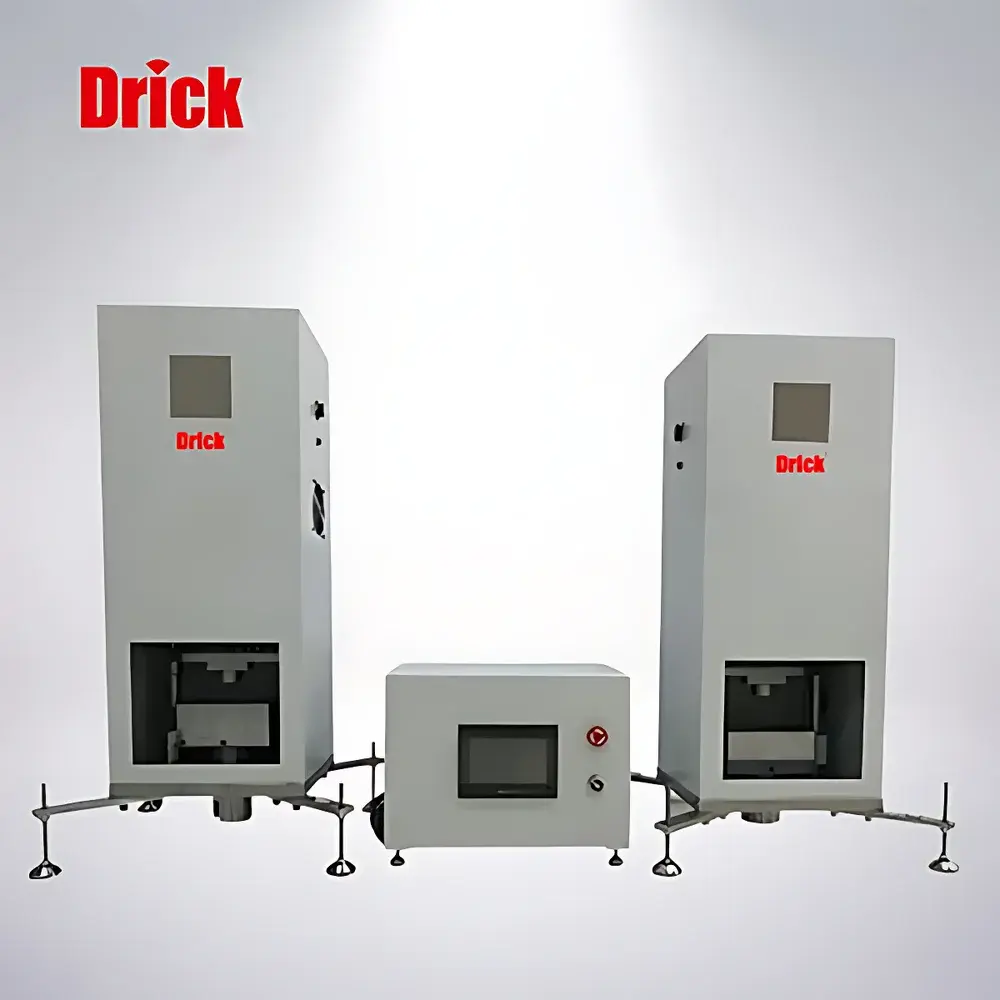
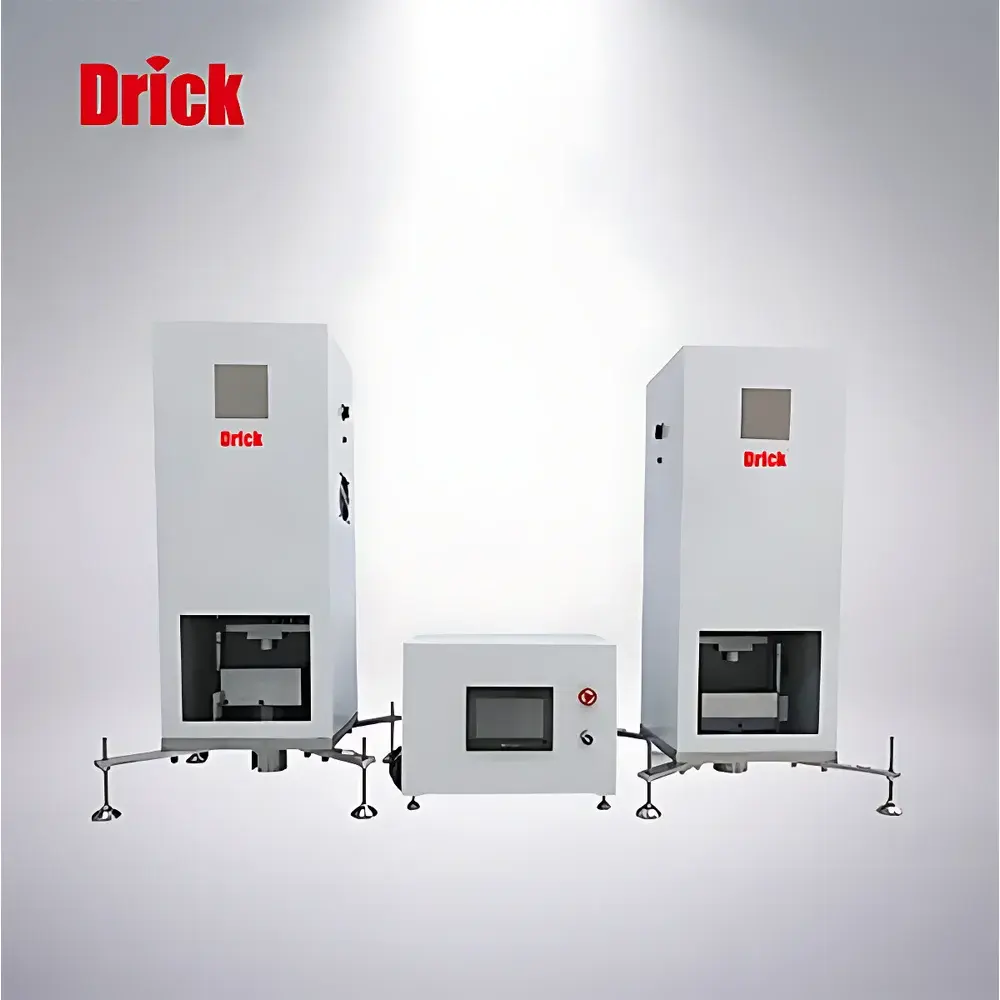
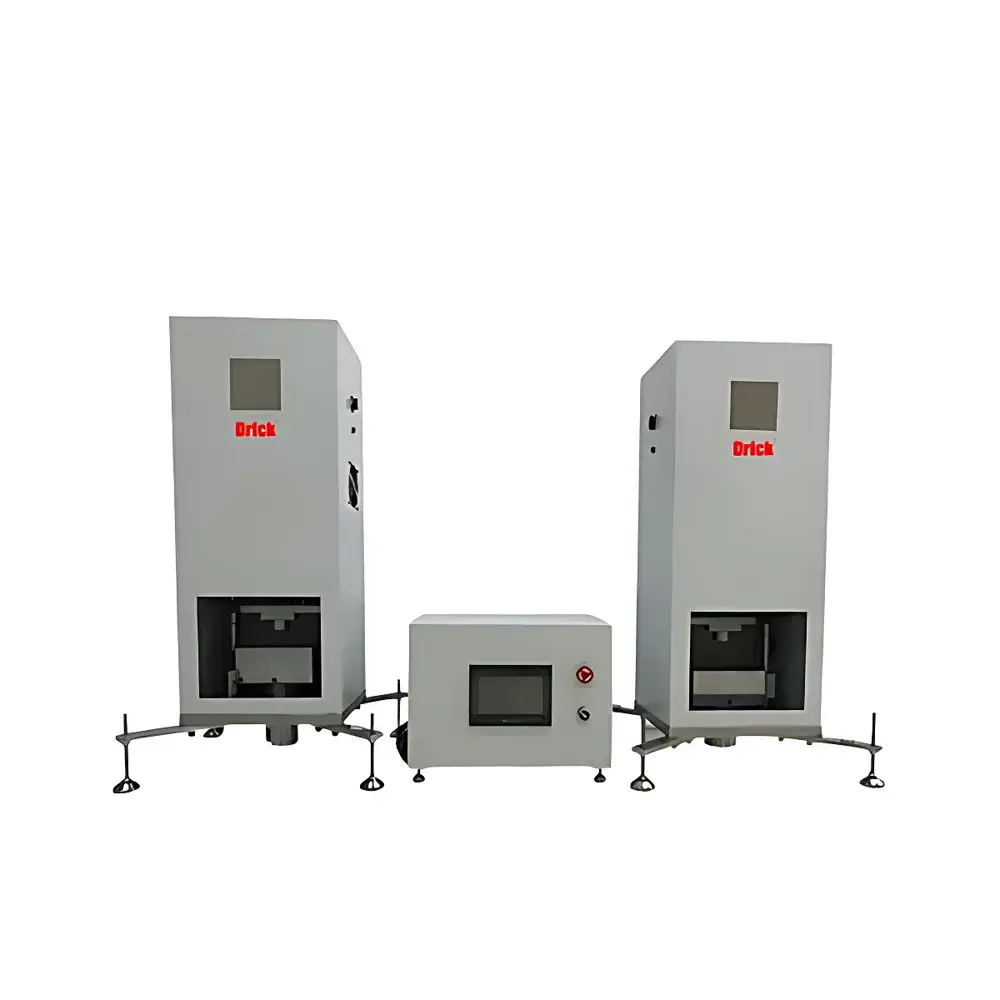
Drick DRK Impact Absorption Tester for Synthetic Athletic Surfaces
| Brand | Drick |
|---|---|
| Origin | Shandong, China |
| Manufacturer Type | Direct Manufacturer |
| Country of Origin | China |
| Model | DRK Impact Absorption Tester |
| Price | USD 7,000 (approx.) |
| Drop Mass | 20.0 kg ± 0.1 kg |
| Drop Height | 55.0 mm ± 0.25 mm |
| Impact Frequency | One complete impact cycle per 60 s |
| Number of Impacts per Test | 4 |
| Hammer Lifting Method | Electric or Manual |
| Automatic Dynamic Zeroing | Yes |
| Spring Stiffness | 2000 N/mm ± 60 N/mm |
| Spring Material | 70Si3MnA alloy spring steel |
| Force Measurement Range | 50–15,000 N |
| Force Accuracy | ±50 N |
| Force Sampling Rate | >2 kHz |
| Displacement Measurement Range | ±10 mm |
| Displacement Accuracy | ±0.05 mm |
| Displacement Resolution | 0.02 mm |
| Displacement Sampling Rate | >2 kHz |
| Zero Point Accuracy | ±0.025 mm |
| Lifting Height Accuracy | ±0.02 mm |
| Overall Lifting Precision | ±0.05 mm |
| Spring Coil Diameter | 69 mm ± 1.0 mm |
| Power Supply | AC 220 V, 50 Hz, 500 W |
Overview
The Drick DRK Impact Absorption Tester for Synthetic Athletic Surfaces is a precision-engineered mechanical property tester designed specifically to evaluate the shock-absorbing characteristics of synthetic sports surfaces—including polyurethane- and rubber-based running tracks, tennis courts, basketball courts, and multi-use athletic fields. It operates on the principle of standardized free-fall impact testing, where a calibrated 20.0 kg mass is dropped from a precisely controlled height of 55.0 mm onto the test surface. The dynamic interaction between the falling mass and the resilient substrate generates transient force and displacement signals, which are captured simultaneously at high temporal resolution (>2 kHz) to compute impact absorption—defined as the percentage reduction in peak deceleration relative to a rigid reference surface (e.g., concrete), per EN 14808:2018 and IAAF Technical Specifications. This measurement directly correlates with injury mitigation potential, user comfort, and long-term compliance with international performance and safety standards.
Key Features
- High-fidelity dual-channel acquisition system: Synchronized force (±50 N accuracy, 50–15 kN range) and displacement (±0.05 mm accuracy, ±10 mm range) sensors enable robust calculation of energy dissipation profiles.
- Automated dynamic zeroing routine prior to each impact sequence ensures baseline stability and eliminates thermal drift or mechanical hysteresis artifacts.
- Electromechanical lifting mechanism with ±0.02 mm height repeatability supports strict adherence to EN 14808 drop-height tolerances; manual override mode available for field verification or calibration checks.
- Integrated PC-based touchscreen control unit runs proprietary firmware compliant with ISO/IEC 17025 traceability requirements—supporting audit-ready data logging, timestamped metadata, and user-access-level permissions.
- 70Si3MnA high-tensile spring assembly (2000 N/mm ± 3%) provides consistent elastic response across ≥10,000 operational cycles without measurable fatigue-induced deviation.
- Modular mechanical architecture enables rapid disassembly for on-site recalibration and third-party verification against national metrology institute (NMI) reference standards.
Sample Compatibility & Compliance
The DRK Impact Absorption Tester accommodates flat, cured synthetic surfaces ranging from 8 mm to 15 mm thickness, including poured-in-place systems, prefabricated rolls, and tile-based installations. It meets functional and dimensional requirements specified in EN 14808:2018 (Impact absorption of sports surfaces), ASTM F2772-22 (Standard Practice for Determining Impact Attenuation of Athletic Playing Surfaces), and IAAF Athletics Facility Manual (2021 Edition). All force and displacement transducers are factory-calibrated to NIST-traceable references, and full calibration certificates—including uncertainty budgets per GUM (JCGM 100:2008)—are supplied with each unit. The system supports GLP-compliant operation through configurable electronic signatures, audit trails, and 21 CFR Part 11–ready data export (CSV, PDF, XML).
Software & Data Management
The embedded software platform delivers real-time waveform visualization, automatic impact absorption calculation (IA% = [1 − (atest/arigid)] × 100), and statistical summary across four consecutive impacts. Raw time-series data (force vs. time, displacement vs. time) is stored in vendor-neutral HDF5 format with embedded metadata (operator ID, ambient temperature/humidity, sample ID, calibration expiry). Reporting complies with A4-format print templates aligned with CNAS-CL01:2018 documentation structure. Export options include encrypted USB transfer, network SMB share, and optional cloud synchronization with role-based access control (RBAC) for multi-lab deployments.
Applications
- Pre-installation quality assurance of synthetic track surfacing materials prior to certification by national athletics federations.
- Periodic in-service performance monitoring of aging sports surfaces to assess degradation trends (e.g., loss of elasticity due to UV exposure or hydrolysis).
- R&D validation of novel elastomeric binders, recycled rubber granules, or nano-reinforced polymer matrices under controlled environmental conditions.
- Third-party conformity assessment laboratories performing accredited testing per ISO/IEC 17025 scope for EN 14808, ASTM F2772, and GB/T 22517.6–2020.
- University biomechanics labs investigating surface–athlete interaction dynamics related to lower-limb joint loading and ground reaction force modulation.
FAQ
What international standards does this instrument directly support?
EN 14808:2018, ASTM F2772-22, IAAF Technical Specifications (2021), and GB/T 22517.6–2020.
Is the system suitable for outdoor field use?
Yes—the base frame features non-slip leveling feet and integrated shock isolation; optional weather-resistant enclosure kit available for ambient operation between 5–40 °C and ≤85% RH.
How is traceability maintained for force and displacement measurements?
Each transducer carries a unique serial number linked to its NIST-traceable calibration certificate; firmware enforces mandatory recalibration alerts at 12-month intervals or after 5,000 impacts.
Can raw sensor data be exported for independent analysis?
Yes—HDF5-formatted time-series files include full metadata headers and are compatible with MATLAB, Python (h5py), and LabVIEW environments.
Does the system support multi-user environments with audit trail functionality?
Yes—role-based login (admin/operator/technician), timestamped action logs, and electronic signature capture comply with ISO/IEC 17025 and FDA 21 CFR Part 11 requirements.
Related Products





