
Drick DRK-505 Leather Flexing Endurance Tester
| Brand | Drick |
|---|---|
| Origin | Shandong, China |
| Manufacturer Type | Direct Manufacturer |
| Origin Classification | Domestic (China) |
| Model | DRK-505 |
| Test Speed | 100 cycles/min |
| Drive Motor | AC Motor |
| Dimensions (L×W×H) | 600 × 450 × 350 mm |
| Power Supply | 1-phase, 220 VAC, 6 A |
| Weight | ~60 kg |
Overview
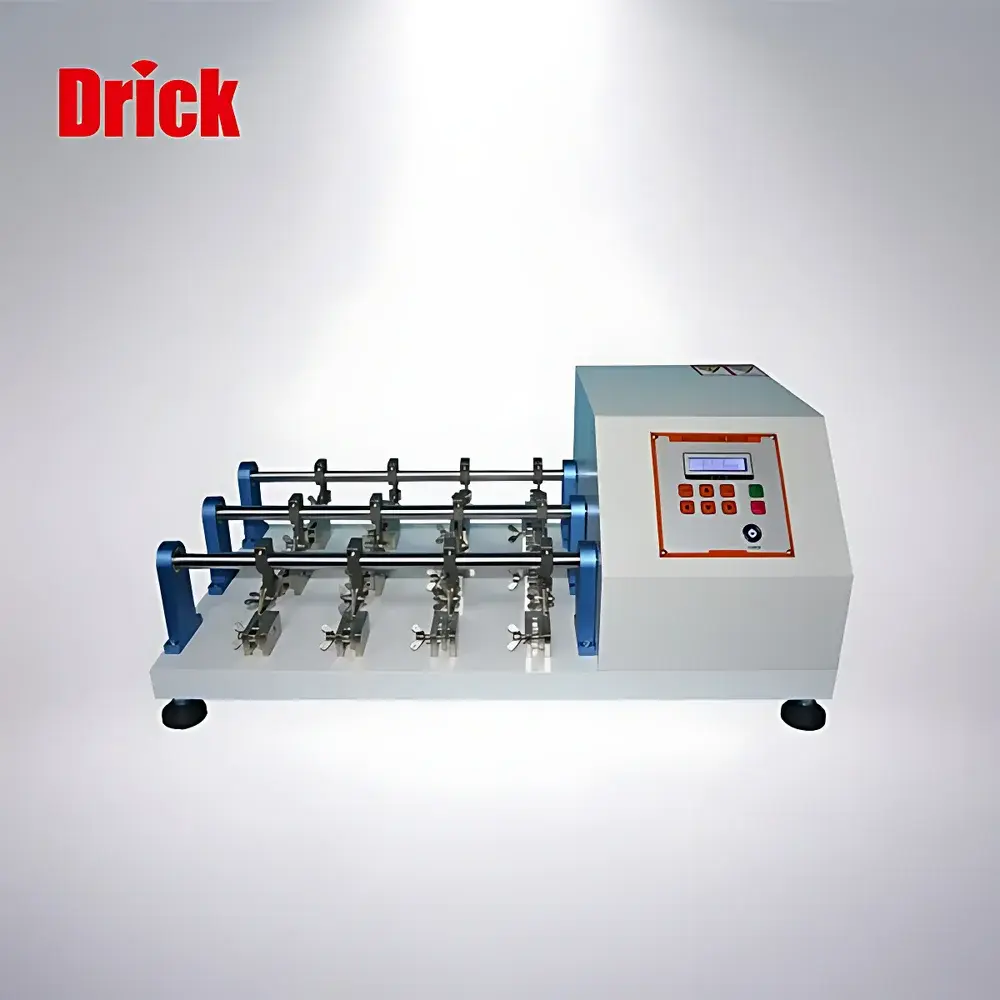
The Drick DRK-505 Leather Flexing Endurance Tester is an electromechanical fatigue testing instrument engineered for standardized assessment of flex resistance and crack propagation behavior in leather, synthetic leather, coated fabrics, and flexible sheet materials. It operates on the principle of controlled cyclic bending—employing a precision AC motor-driven mechanism to reciprocate test specimens between two fixed clamps at a defined angular displacement and frequency (100 cycles per minute). This simulates real-world mechanical stress conditions encountered during product use, such as repeated folding in footwear uppers, handbag flaps, or automotive interior trim. The device complies with core physical testing methodologies referenced in ISO 5423:1993 (Leather — Determination of resistance to flexing), ASTM D2178 (Standard Test Method for Flex Resistance of Paper and Paperboard), and relevant sections of QB/T 2715–2005 (Chinese industry standard for leather flex testing). Its robust architecture ensures repeatable mechanical actuation, making it suitable for QC laboratories, R&D departments, and third-party testing facilities requiring traceable, operator-independent endurance data.
Key Features
- Stable dual-clamp fixture system with adjustable grip pressure—minimizes specimen slippage and ensures consistent bending geometry across test cycles.
- Digitally displayed cycle counter with programmable stop function—enables precise endpoint definition (e.g., 50,000 or 100,000 cycles) and automatic shutdown upon completion.
- Multi-axis probe adjustability—allows fine-tuning of contact point location relative to the flex line, accommodating variations in specimen thickness and stiffness.
- Fixed-frequency drive (100 cycles/min) calibrated to ±2% tolerance—ensures compliance with standard test protocols requiring defined oscillation rates.
- Integrated thermal management design—facilitates continuous operation under ambient laboratory conditions without overheating risk.
- Grounded metal chassis and EMI-shielded control circuitry—meets basic electrical safety requirements per IEC 61000-6-3 and supports stable long-term calibration retention.
Sample Compatibility & Compliance
The DRK-505 accommodates flat, flexible specimens up to 150 mm in length and 50 mm in width, with thicknesses ranging from 0.5 mm to 4.0 mm—including bovine, ovine, and porcine leathers; PU/PVC-coated substrates; microfiber synthetics; and laminated composites. Specimen mounting follows standardized edge-clamping procedures outlined in ISO 5423 Annex A. All test reports generated using this instrument may be documented with full traceability—including operator ID, environmental conditions (temperature/humidity logged separately), cycle count, and visual observation notes per ASTM D618 (Conditioning Plastics for Testing). While the unit itself does not carry CE or UL certification, its mechanical and electrical design adheres to general-purpose industrial equipment safety conventions applicable to non-explosive environments.
Software & Data Management
The DRK-505 operates as a standalone hardware platform with no embedded firmware or PC connectivity. Cycle data is captured exclusively via its front-panel digital counter (0–999,999 range), which retains values after power cycling. For regulatory-compliant recordkeeping (e.g., GLP or internal QA audits), users are advised to manually log results into LIMS or Excel-based tracking templates—including date, sample ID, batch number, observed failure mode (surface cracking, grain separation, delamination), and cycle count at first visible defect. Optional external USB microscope integration (not included) enables high-magnification documentation of crack initiation sites pre- and post-test. No proprietary software, cloud interface, or FDA 21 CFR Part 11 compliance features are provided.
Applications
- Quality assurance of finished leather goods prior to shipment—verifying minimum flex life thresholds per customer specifications.
- Comparative evaluation of tanning process variants (e.g., chrome vs. vegetable retanning) on mechanical durability.
- Validation of coating adhesion integrity in solvent-free or water-based finishing systems.
- Pre-screening of alternative biomaterials (e.g., mushroom mycelium leather analogs) for commercial viability.
- Supporting technical documentation for ISO 9001:2015 Clause 8.5.1 (Control of Production and Service Provision) through objective fatigue metrics.
FAQ
What is the recommended maintenance interval for the DRK-505?
Lubrication of moving joints and pivot points is required every 200 operating hours or quarterly—whichever occurs first—using ISO VG 32 mineral oil.
Can the test speed be adjusted?
No. The DRK-505 operates at a fixed 100 cycles/minute to maintain conformity with ISO 5423 and other referenced standards.
Is calibration certification available?
Drick provides a factory-issued performance verification report (non-accredited) confirming cycle accuracy and motor stability at time of shipment. Third-party ISO/IEC 17025 calibration is possible but requires external service provider engagement.
What failure modes are typically assessed?
Primary indicators include surface cracking, grain layer separation, substrate tearing, and coating chipping—documented visually per ASTM D714 (Evaluating Degree of Blistering) or custom internal severity scales.
Does the unit support automated data export?
No. Data output is limited to the digital display; manual transcription remains the sole method for result capture.




