Drick DRK-WL101 Horizontal Tensile Tester for Soft Composite Packaging Materials (GB 8808 Compliant)
| Brand | Drick |
|---|---|
| Origin | Shandong, China |
| Manufacturer Type | Direct Manufacturer |
| Region Category | Domestic (China) |
| Model | DRK-WL101 |
| Max Load Capacity | 30 N (customizable) |
| Force Resolution | 0.1 N |
| Deformation Resolution | 0.001 mm |
| Test Speed Range | 1–500 mm/min (infinitely variable) |
| Standard Specimen Width | 15 mm |
| Gauge Length Travel | 300 mm (customizable) |
| Accuracy Class | Better than Grade 1 |
| Power Supply | AC 220 V, 50/60 Hz |
| Compliance | GB 8808, GB/T 4850, ASTM D882, ISO 527-2, ASTM D3330, ASTM F88, QB/T 2358 |
Overview
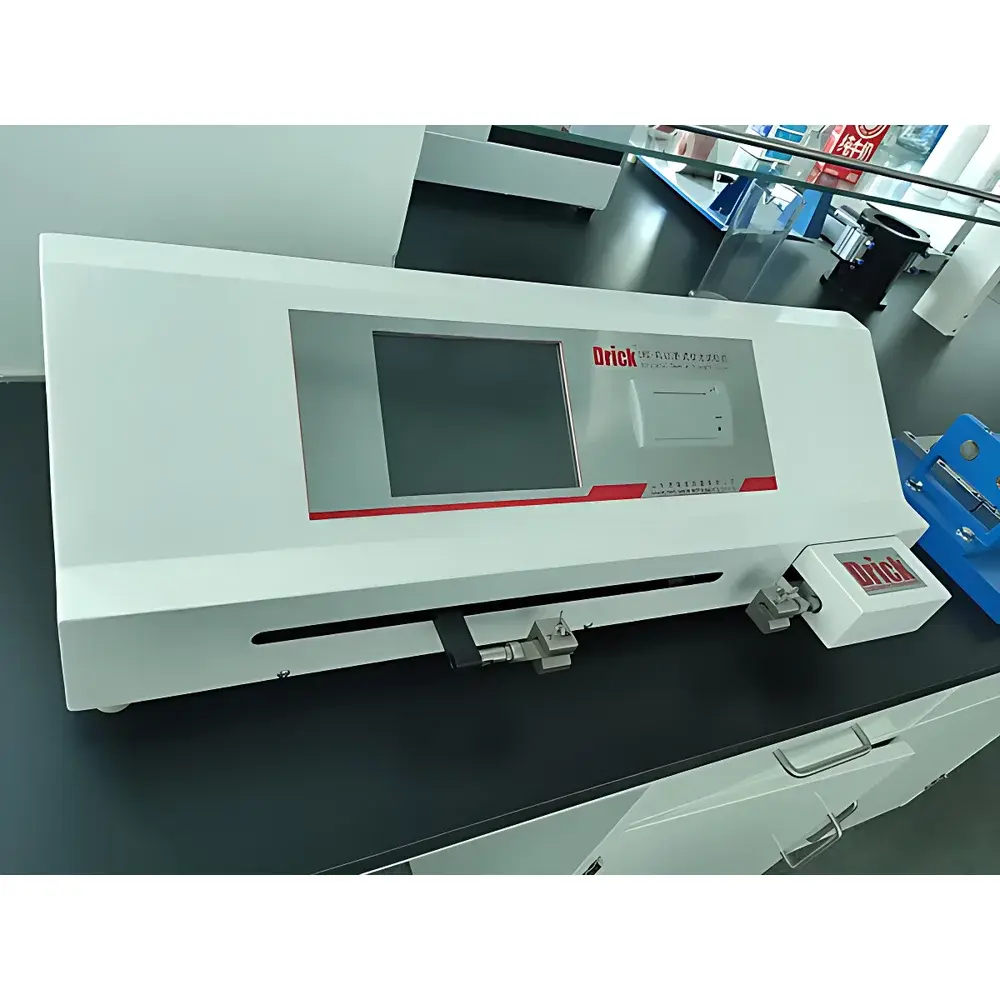
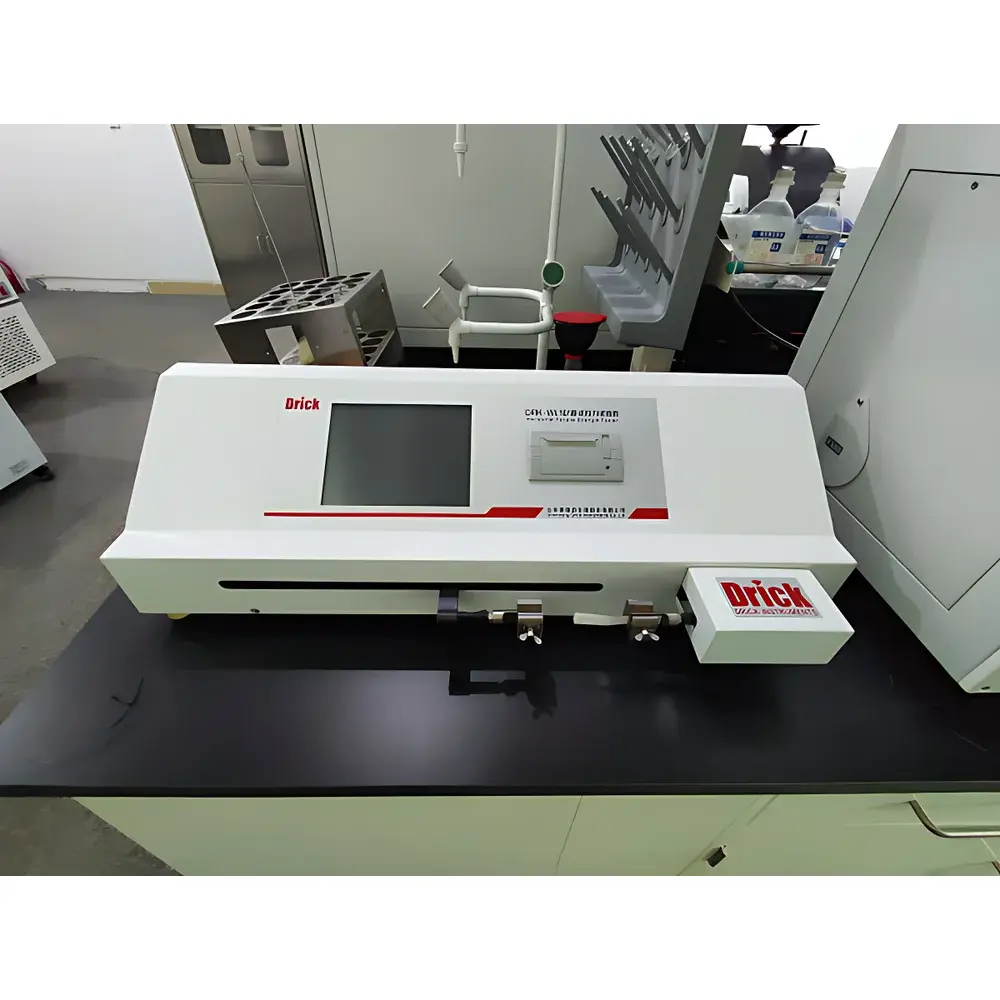
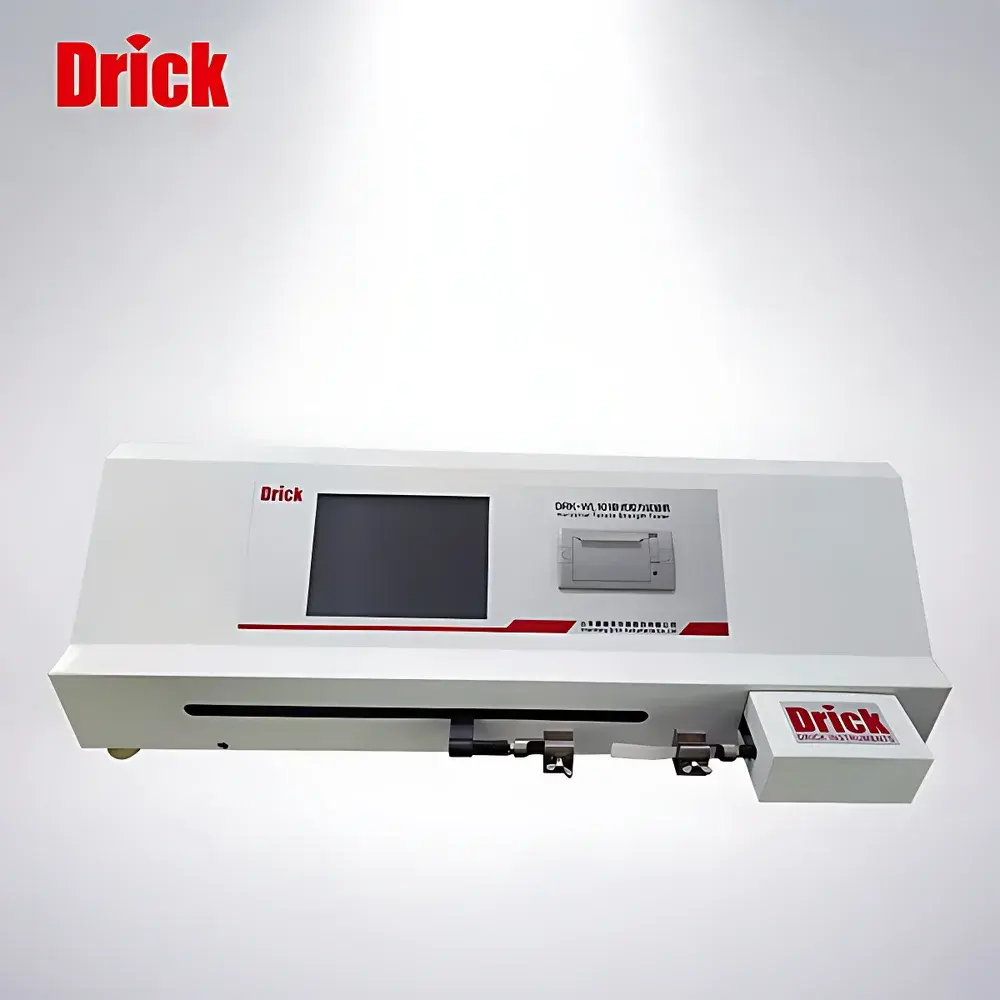
The Drick DRK-WL101 Horizontal Tensile Tester is a precision-engineered mechanical testing instrument specifically designed for evaluating the tensile, peel, and seal strength properties of soft composite packaging materials—including plastic films, laminated foils, paper-based substrates, and flexible pouch structures. Built in accordance with the structural and metrological requirements of GB 8808 (“Test Method for Peel Strength of Plastic Films and Laminated Films”), this horizontal-configured tester employs a dual-column, servo-controlled electromechanical architecture to deliver high reproducibility in low-force range applications (up to 30 N). Its horizontal orientation minimizes gravitational influence on specimen alignment and eliminates sag-related measurement artifacts—critical for thin, low-modulus specimens such as BOPP, PET, PE, and metallized laminates. The system operates on fundamental principles of uniaxial static tension per ISO 527-2 and ASTM D882, where load is applied at controlled displacement rates while force and elongation are simultaneously acquired via high-fidelity transduction.
Key Features
- High-precision mechanical drivetrain integrating imported servo motor, preloaded ball screw, and linear motion guide rails—ensuring smooth, backlash-free actuation and long-term positional repeatability.
- 24-bit high-resolution analog-to-digital conversion (1 / 10,000,000 internal resolution) paired with calibrated S-type load cell (0.1 N force resolution) and sub-micron displacement sensing (0.001 mm).
- Full-touch 7-inch LCD interface with bilingual (English/Chinese) menu navigation; real-time graphical display of force–time, force–displacement, and force–strain curves during test execution.
- Integrated thermal line printer supporting on-the-fly report generation—including mean values, standard deviation, coefficient of variation, and pass/fail status against predefined limits.
- Embedded microcontroller architecture with automatic zero-reset, overload protection (120% FS), self-diagnostic routines, and non-volatile memory for test parameter retention and last-test recall.
- Modular fixture compatibility: standard 15 mm manual clamps included; optional pneumatic clamping, 180° peel fixtures, heat-seal testers, and constant-load/constant-elongation modules available.
Sample Compatibility & Compliance
The DRK-WL101 accommodates specimens up to 300 mm in effective travel length and is optimized for materials with thicknesses ranging from 12 µm to 250 µm. It supports standardized geometries per GB/T 1040.3, ASTM D638 Type V, and ISO 527-3 for thin films. Key tested parameters include tensile strength (MPa), elongation at break (%), modulus of elasticity (MPa), peel strength (N/15 mm), heat seal strength (N/15 mm), and puncture resistance (when configured with auxiliary tooling). All hardware, firmware, and calibration traceability align with national and international regulatory frameworks: GB 8808, GB/T 4850-2000 (peel adhesion), GB/T 1040.2–1040.5 (plastic tensile testing), ASTM D882 (thin plastic sheeting), ASTM F88 (seal strength of flexible barrier materials), ISO 37 (vulcanized rubber), and QB/T 2358 (plastic film peel testing). Instrument validation documentation satisfies GLP-aligned laboratory quality systems and supports audit readiness for ISO/IEC 17025 environments.
Software & Data Management
While the base configuration features embedded firmware with local data storage and thermal printing, an optional PC-based control and analysis software package is available (USB or RS232 interface). This software enables advanced curve overlay, statistical batch reporting (per ASTM E4), export to CSV/Excel, customizable report templates compliant with internal SOPs or external client requirements, and full audit trail functionality—including user login tracking, parameter change logs, and electronic signature support. Data integrity safeguards conform to FDA 21 CFR Part 11 principles when operated in validated mode, including time-stamped raw data archiving and immutable result records. Calibration certificates reference NIST-traceable standards, and periodic verification protocols follow JJG 475 (Chinese national verification regulation for universal testing machines).
Applications
- Tensile characterization of mono- and multilayer packaging films (e.g., PET/PE, OPP/CPP, Alu/PET/PE)
- 180° peel strength assessment of adhesive laminations and foil-to-film bonds
- Hot-tack and heat seal strength evaluation under controlled dwell time/temperature conditions (with optional heated platen)
- Constant-rate elongation testing for creep compliance and stress relaxation profiling
- Quality conformance testing per supplier qualification programs (e.g., AQL sampling per ISO 2859-1)
- R&D screening of new resin formulations, coating adhesion, and surface treatment efficacy
FAQ
What standards does the DRK-WL101 explicitly support out-of-the-box?
It is factory-configured and validated for GB 8808, GB/T 4850, ASTM D882, ISO 527-2, QB/T 2358, and ASTM F88—with default test methods, units, and calculation algorithms embedded in firmware.
Can the instrument be used for non-packaging materials such as medical device films or labels?
Yes—provided specimen geometry and mechanical behavior fall within the 30 N load range and 0.001 mm displacement resolution envelope; users must validate method suitability per ISO 17025 or relevant product-specific standards.
Is third-party calibration certification included with purchase?
A manufacturer-issued calibration certificate traceable to CNAS-accredited standards is supplied; full ISO/IEC 17025 calibration with uncertainty budget requires separate service engagement.
What maintenance intervals are recommended for sustained accuracy?
Biannual verification of load cell linearity and crosshead positioning accuracy is advised; annual mechanical inspection of ball screw preload and guide rail lubrication is required per maintenance log.
Does the system support networked data transfer or LIMS integration?
The optional PC software supports TCP/IP and Modbus RTU protocols for enterprise-level data routing; direct LIMS interfacing requires custom API development or middleware configuration.