
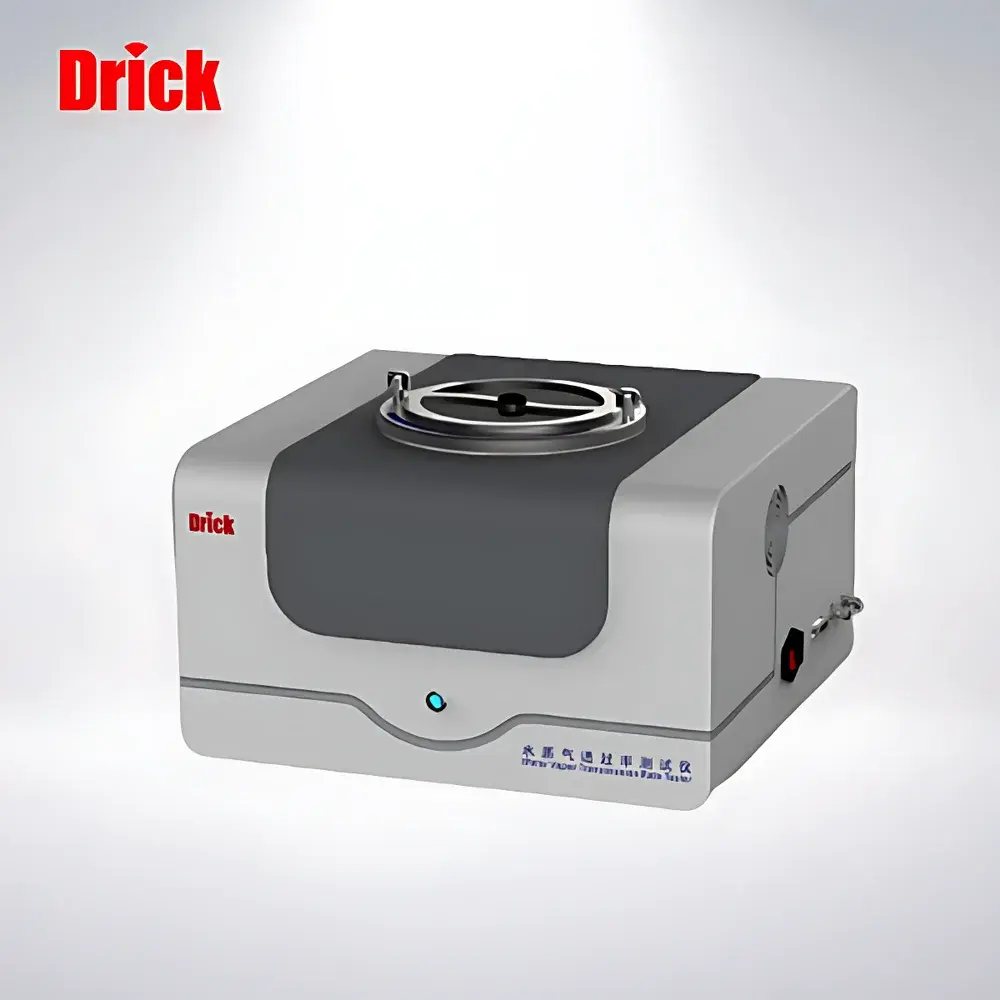
Drick DRK311 Single-Chamber Gravimetric Water Vapor Transmission Rate (WVTR) Tester
| Brand | Drick |
|---|---|
| Origin | Shanghai, China |
| Manufacturer Type | Direct Manufacturer |
| Region of Origin | Domestic (China) |
| Model | DRK311 |
| Price | USD 7,000 (FOB Shanghai) |
| Measurement Principle | Gravimetric (Weight Loss Method) |
| Standards Compliance | ASTM E96, ISO 2528, GB/T 1037, YBB 00092003, GB/T 17146, GB/T 12704, GB 19082-2009, GB/T 21332, QB/T 2414, TAPPI T464, ASTM D1653, YY/T 0471.2, DIN 53122 |
| Test Modes | Upright & Inverted Cup Configuration |
| Temperature Range | 10–50 °C (±0.2 °C stability) |
| Humidity Range | 5–35 % RH (±2 % RH control accuracy) |
| Airflow Velocity | 0.5–2.5 m/s (helical uniform circulation) |
| Test Area | 33 cm² |
| Sample Thickness Limit | <3 mm |
| Container Max Height | 150 mm |
| Container Max Mass | 180 g |
| WVTR Range (Film/Sheet) | 0.05–10,000 g/m²·24h |
| WVTR Range (Container) | 0.0002–30 g/pkg·24h |
| WVTR Accuracy (Film) | ±0.05 g/m²·24h (decreasing toward zero over extended test duration) |
| WVTR Accuracy (Container) | ±0.00002 g/pkg·24h |
| Balance Capacity | 210 g |
| Balance Resolution | 0.1 mg |
| Power Supply | AC 220 V ±10 %, 50 Hz |
| Compressed Air Requirement | >0.3 MPa |
| Dimensions (W×D×H) | 480 × 450 × 320 mm |
| Net Weight | 25 kg |
| Standard Accessories | Main unit, desiccant air dryer tube, proprietary test software, permeation cups (film & container), calibration weights, circular sample cutter |
| Optional Add-ons | GMP-Compliant Computerized System Module (21 CFR Part 11 compliant: user roles, audit trail, electronic signatures), wax-sealing cup kit |
| User-Supplied | Windows-based PC, compressed air source |
Overview
The Drick DRK311 Single-Chamber Gravimetric Water Vapor Transmission Rate (WVTR) Tester is an engineered solution for precise, standardized measurement of moisture barrier performance in flexible packaging materials and rigid containers. It operates on the gravimetric weight-loss principle—defined in ASTM E96 and ISO 2528—where a conditioned test specimen separates two distinct humidity environments: a saturated water reservoir inside a permeation cup and a controlled low-humidity chamber. The resulting vapor pressure gradient drives water vapor diffusion across the specimen; mass loss from the cup is measured at defined intervals using a high-resolution analytical balance (0.1 mg resolution, 210 g capacity). This raw mass-change data, combined with known test area (33 cm²), exposure time, and environmental conditions (temperature: 10–50 °C ±0.2 °C; relative humidity: 5–35 % RH ±2 % RH), is used to calculate WVTR in standardized units (g/m²·24h for films; g/pkg·24h for containers). Unlike sensor-based or infrared methods, the gravimetric approach provides traceable, absolute measurement without calibration drift—making it the reference method for regulatory submissions, quality control audits, and material qualification under GLP and GMP frameworks.
Key Features
- True dual-mode operation: Supports both upright and inverted cup configurations to accommodate hydrophilic, hydrophobic, and asymmetric barrier structures—ensuring consistent interfacial contact and eliminating edge leakage artifacts.
- Thermally isolated microbalance architecture: Integrated thermal shielding and humidity-resistant enclosure maintain long-term balance stability, minimizing thermal buoyancy effects and extending service life under continuous 48+ hour tests.
- Uniform environmental field generation: Helical airflow system ensures laminar, isotropic distribution of temperature, humidity, and velocity (0.5–2.5 m/s) across all test positions—critical for reproducibility per ISO 2528 Annex A.
- Automated test lifecycle management: One-touch initiation triggers full sequence execution—including environmental equilibration, scheduled weighing cycles, real-time slope analysis, automatic endpoint detection, and CSV/PDF report generation.
- Self-diagnostic firmware: Comprehensive power-on system check verifies balance zero stability, humidity sensor linearity, temperature PID response, and airflow integrity prior to test commencement—preventing invalid runs.
- Robust cup design: Permeation cups feature non-hygroscopic metallic bodies (no polymer components), precision-ground sealing surfaces, and anti-torque geometry to prevent specimen distortion during clamping—directly addressing failure modes cited in GB/T 1037 Clause 6.2.
Sample Compatibility & Compliance
The DRK311 accommodates flat specimens up to 3 mm thickness and rigid containers with maximum dimensions of 150 mm height and 180 g mass. Validated substrates include polyolefin films, PVDC-coated papers, aluminum-laminates, silicone-treated textiles, medical-grade nonwovens (per YY/T 0471.2), and sterilization pouches (per GB 19082-2009). All mechanical and environmental controls meet the dimensional tolerances, temporal sampling requirements, and uncertainty budgets specified in ASTM E96 Procedure A (desiccant method) and Procedure B (water method), as well as ISO 2528 Annex B. The system’s humidity control range (5–35 % RH) satisfies low-RH testing needs for high-barrier pharmaceutical packaging per YBB 00092003 and USP , while its temperature stability (±0.2 °C) complies with the thermal uniformity clause in GB/T 17146. Optional GMP-compliant software adds 21 CFR Part 11 functionality—including role-based access, immutable audit trails, and electronic signature workflows—for regulated environments.
Software & Data Management
The embedded Windows-based test software delivers full graphical visualization of mass decay curves, real-time WVTR trend overlays, and statistical summaries (mean, SD, RSD, confidence intervals). All raw weighings, environmental logs, and metadata are timestamped and stored in encrypted local SQLite databases—with automatic backup to external USB media. Power interruption recovery preserves all acquired data points and resumes from last valid weighing cycle. For regulated users, the optional GMP Computerized System Module enables user-level permission tiers (Administrator, Technician, Reviewer), mandatory electronic signatures for report approval, and FDA-auditable audit trails that record who changed what, when, and why—including modification of test parameters or manual data edits. Export formats include PDF (with digital signature watermark), Excel (.xlsx), and XML for LIMS integration.
Applications
- Pharmaceutical packaging validation: Quantifying moisture ingress into blister packs, sachets, and vial stoppers to ensure drug stability per ICH Q5C guidelines.
- Medical device barrier certification: Testing surgical gowns, drapes, and sterilization wraps against AAMI PB70 and YY/T 0471.2 requirements.
- Food packaging R&D: Benchmarking ethylene-vinyl alcohol (EVOH), metallized PET, and bio-based barrier coatings under accelerated aging conditions.
- Building material evaluation: Measuring vapor transmission through roofing membranes, vapor retarders, and insulated concrete forms per ASTM E96 and GB/T 17146.
- Quality assurance in contract manufacturing: Enforcing incoming material specifications for laminates supplied to OEMs in electronics, automotive, and aerospace sectors.
FAQ
Does the DRK311 support both film and container testing in the same hardware configuration?
Yes—the system includes interchangeable permeation cups and fixture adapters for flat specimens (33 cm² test area) and rigid containers (up to 180 g / 150 mm height), with independent calibration protocols for each mode.
How does the instrument mitigate buoyancy errors caused by temperature/humidity gradients near the balance?
A multi-layer thermal isolation chamber surrounds the balance, coupled with active ambient air shrouding and real-time density compensation algorithms based on measured T/RH values—reducing buoyancy-induced uncertainty to <0.005 mg per weighing cycle.
Is third-party calibration documentation available for metrological traceability?
Yes—NIST-traceable calibration certificates for the integrated balance, PT100 temperature sensors, and capacitive RH probes are provided with each unit, with annual recalibration services available via Drick’s ISO/IEC 17025-accredited lab.
Can test data be exported directly to enterprise LIMS or ERP platforms?
The standard software supports ODBC-compliant database connections and configurable API endpoints; the GMP module adds HL7 and ASTM E1467-compliant messaging for seamless integration with major pharma LIMS vendors.
What maintenance is required to sustain ±0.05 g/m²·24h accuracy over 5+ years of operation?
Quarterly verification using certified reference standards (NIST SRM 2821 for mass, NIST SRM 2822 for humidity), biannual cleaning of airflow ducts and cup seals, and annual recalibration of environmental sensors—documented in the included Maintenance Logbook template.
Related Products





