

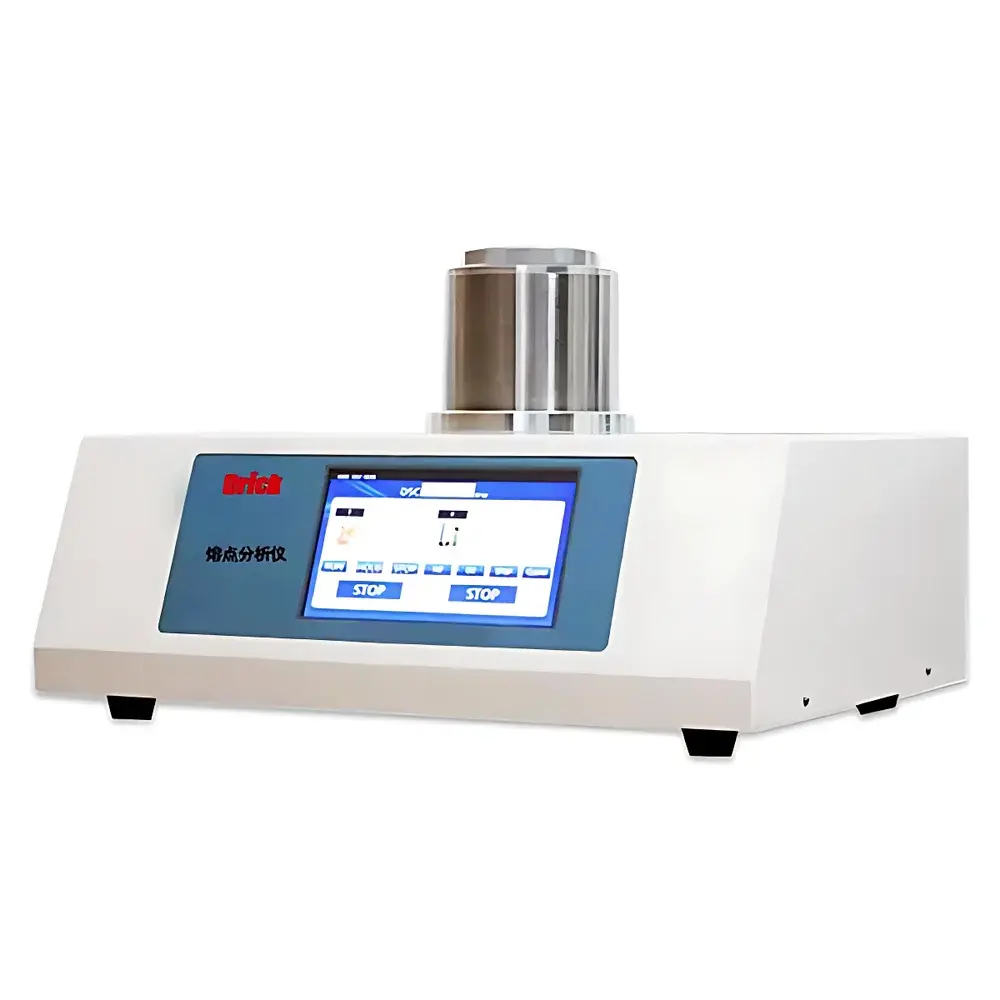
Drick DRK-500A Automated Melting Point Analyzer
| Brand | Drick |
|---|---|
| Model | DRK-500A |
| Temperature Range | Ambient to 500 °C |
| Heating Rate | 0.1–30 °C/min |
| Temperature Repeatability | ±0.1 °C |
| Temperature Resolution | 0.01 °C |
| Power Resolution | 0.001 mW |
| Display | 7-inch 24-bit TFT Touchscreen |
| Dimensions (W×D×H) | 420 × 380 × 270 mm |
| Net Weight | 14.5 kg |
| Power Supply | AC 220 V, 50/60 Hz |
Overview
The Drick DRK-500A Automated Melting Point Analyzer is a precision thermal analysis instrument engineered for accurate, reproducible determination of melting onset, offset, and melt range (melting interval) of crystalline organic solids. It operates on the principle of differential thermal analysis (DTA), wherein the temperature difference between a sample and an inert reference material is monitored under controlled heating conditions. Unlike capillary-based visual methods, the DRK-500A employs dual high-stability platinum resistance temperature detectors (PRTDs) embedded in thermally symmetric sample and reference wells—enabling real-time, non-contact thermal profiling without operator interpretation bias. Its fully automated architecture supports both standalone operation and PC-integrated data acquisition, making it suitable for routine QC laboratories, pharmaceutical development labs, and polymer R&D facilities where regulatory traceability and method robustness are critical.
Key Features
- True dual-sensor DTA architecture with independent PRTD probes for sample and reference—ensuring intrinsic compensation for ambient drift and heater non-uniformity.
- Wide operational temperature range from ambient to 500 °C, accommodating high-melting-point polymers, metal-organic frameworks (MOFs), and specialty pharmaceutical intermediates.
- Programmable linear heating rates from 0.1 to 30 °C/min, enabling method optimization per ISO 11357-3 and USP <741> guidelines.
- Integrated 7-inch capacitive touchscreen with 24-bit color rendering—displaying real-time temperature curves, derivative (dT/dt) plots, and annotated melt transitions without external hardware.
- Standalone functionality: all measurement protocols, calibration routines, and data storage execute natively on the onboard ARM Cortex-A9 processor—no host PC required for routine operation.
- Automated end-of-test notification via audible alert and auto-save to internal flash memory (≥10,000 test records); exportable via USB 2.0 as CSV or PDF reports compliant with GLP audit trails.
- Modular gas control interface (optional) supporting mass flow controllers for inert (N₂, Ar) or oxidative (air, O₂) atmospheres—critical for thermal stability assessment per ASTM E2070.
Sample Compatibility & Compliance
The DRK-500A accepts solid samples in granular, powdered, or compacted pellet form (typical mass: 1–5 mg), with no requirement for capillary loading or pre-drying. Its open-sample well design eliminates optical interference from sample color, opacity, or fluorescence—unlike optical melt point systems reliant on light transmission. The instrument meets essential requirements of ISO 11357-3 (Plastics — Differential Scanning Calorimetry — Part 3: Determination of melting and crystallization temperatures and enthalpies), and supports validation against pharmacopoeial standards including USP <741>, EP 2.2.17, and JP 17. All temperature calibrations are traceable to NIST-certified reference materials (e.g., indium, tin, zinc). Firmware and data management modules comply with ALCOA+ principles for electronic records, supporting 21 CFR Part 11–ready configurations when deployed with validated PC software.
Software & Data Management
The optional PC software (Windows 10/11 compatible, ≥1366×768 resolution, ≥2 GB RAM) provides advanced curve fitting, baseline correction, peak deconvolution, and multi-method comparison tools. Raw DTA signals are stored in vendor-neutral binary format (.drk) with embedded metadata: operator ID, timestamp, calibration status, ambient humidity/pressure (if external sensors connected), and instrument firmware version. Audit logs record all user actions—including parameter edits, calibration events, and report generation—with immutable timestamps. Software updates are delivered via secure HTTPS channel with SHA-256 signature verification; no internet connection is required for offline deployment after initial download.
Applications
- Pharmaceutical quality control: verification of active pharmaceutical ingredient (API) identity and purity per ICH Q5A and Q6A; detection of polymorphic transitions during hot-stage screening.
- Polymer characterization: determination of melting enthalpy (ΔHf) and crystallinity index in polyolefins, polyesters, and biodegradable plastics (e.g., PLA, PHA).
- Organic synthesis monitoring: endpoint confirmation in esterification, amidation, and condensation reactions involving crystalline intermediates.
- Materials science: thermal stability evaluation of phase-change materials (PCMs), eutectic salt mixtures, and energetic compounds.
- Academic research: teaching DTA fundamentals, method development for novel crystalline APIs, and inter-laboratory round-robin studies.
FAQ
Does the DRK-500A require annual recalibration?
Yes—annual traceable calibration using certified reference standards (e.g., indium, tin) is recommended to maintain compliance with ISO/IEC 17025 and internal QA protocols.
Can the instrument operate under nitrogen purge without the optional gas module?
No—the standard configuration lacks integrated mass flow control; inert atmosphere operation requires the factory-installed gas control option with calibrated MFC and sealed sample chamber.
Is raw DTA signal export supported?
Yes—both time-temperature and time-heat-flow (mW) vectors are exportable in ASCII CSV format, enabling third-party analysis in MATLAB, Origin, or Python-based thermal modeling workflows.
What is the maximum sample mass the DRK-500A can accommodate?
The optimal range is 1–3 mg for high-resolution transition detection; up to 5 mg may be used for highly conductive or low-enthalpy materials, though peak broadening may occur.
Does the firmware support user-defined pass/fail criteria for automated reporting?
Yes—up to 10 customizable acceptance rules (e.g., “onset must fall within 148.5–149.5 °C”) can be embedded in method templates, triggering automatic PASS/FAIL flags in exported PDF reports.



