
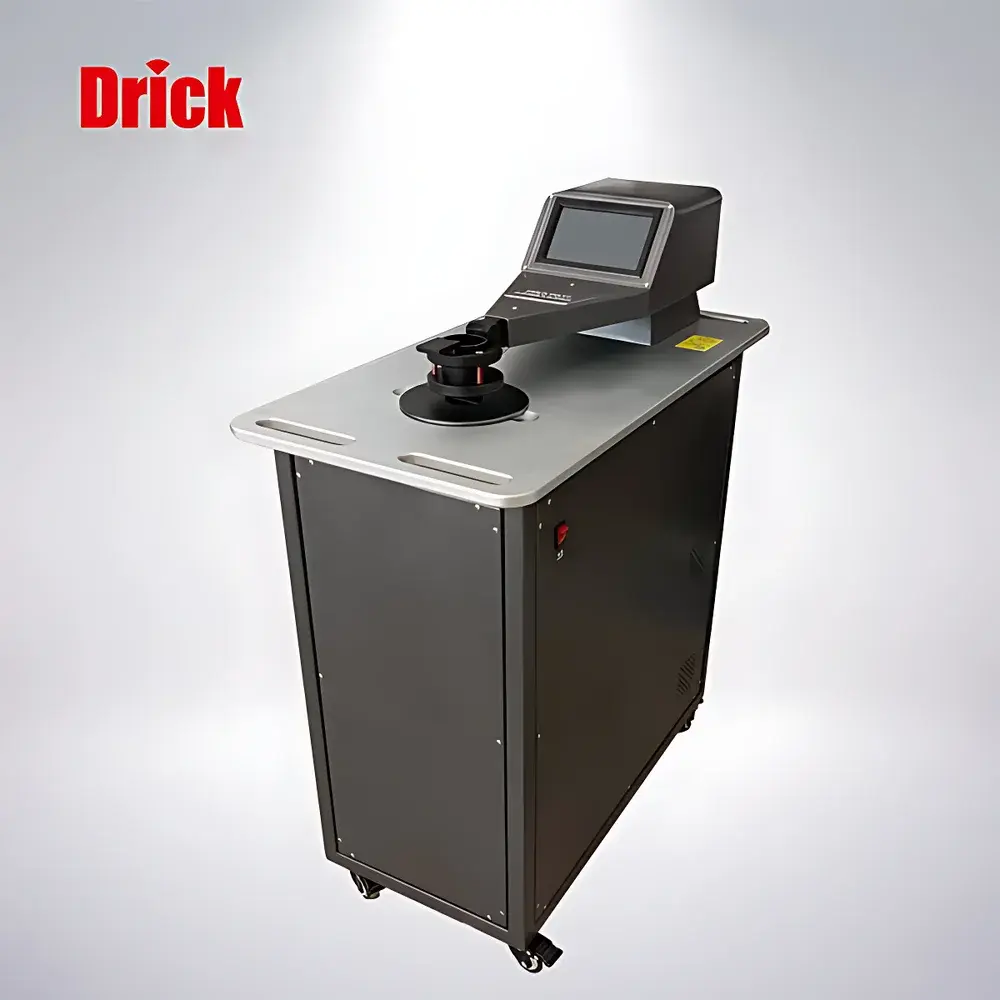
Drick DRK0039 Automated Fabric Air Permeability Tester
| Brand | Drick |
|---|---|
| Origin | Shandong, China |
| Manufacturer Type | OEM/ODM Manufacturer |
| Country of Origin | China |
| Model | DRK0039 |
| Dimensions (W×D×H) | 840 × 430 × 1050 mm |
| Weight | 105 kg (231.4 lb) |
| Test Pressure Differential Range | 1–2400 Pa |
| Measurable Air Permeability Rate | 0.1–14,000 mm/s (standard test area: 20 cm²) |
| Measurement Accuracy | ≤ ±2% |
| Maximum Sample Thickness | ≤12 mm |
| Adjustable Airflow | Closed-loop dynamic feedback control |
| Standard Test Area | 20 cm² (optional areas: 5, 6.45, 10, 25, 38, 50, 100 cm²) |
| Data Storage Capacity | 3200 records |
| Display & Output | Large LCD interface + A4 thermal printer (Chinese-language UI) |
| Units Supported | mm/s, cm³/cm²/s, L/dm²/min, m³/m²/min, dm³/s, CFM |
| Power Supply | AC 220 V, 50 Hz, 1500 W |
Overview
The Drick DRK0039 Automated Fabric Air Permeability Tester is an ISO- and ASTM-compliant instrument engineered for precise, repeatable quantification of air permeability in woven, knitted, nonwoven, laminated, and multi-layer textile materials. It operates on the fundamental principle of differential-pressure-driven airflow: under a controlled pressure gradient across a standardized sample area, volumetric airflow rate is measured and normalized to specimen surface area and time—yielding air permeability values expressed in mm/s or equivalent SI and imperial units. This measurement directly reflects fabric breathability, a critical functional parameter in technical textiles, protective clothing, filtration media, medical gowns, automotive interior fabrics, and HVAC filter substrates. The DRK0039 implements a closed-loop pneumatic control architecture with real-time feedback regulation of suction flow, ensuring stable differential pressure maintenance across the full 1–2400 Pa range—even during dynamic testing of highly variable or low-resistance materials.
Key Features
- Automated pressure differential control with digital PID regulation, enabling stable setpoint maintenance within ±1 Pa tolerance during extended test cycles.
- Modular test head design supporting rapid interchange of orifice plates for seven standard test areas (5–100 cm²), each calibrated traceably to NIST-traceable reference standards.
- Integrated high-resolution mass airflow sensor and dual-range pressure transducer (low-range: 0–250 Pa; high-range: 0–2500 Pa) for optimized signal-to-noise ratio across the entire permeability spectrum.
- Real-time dynamic suction adjustment compensates for sample deformation, edge leakage, or transient resistance changes—minimizing operator intervention and enhancing inter-laboratory reproducibility.
- Rugged welded steel frame with vibration-damped base and ESD-safe enclosure, rated for continuous operation in QC laboratories adhering to ISO/IEC 17025 environmental specifications (23 ± 2°C, 50 ± 10% RH).
- Onboard data logging with timestamped metadata (operator ID, test date/time, pressure setpoint, area selection, ambient T/RH if optional sensor installed).
Sample Compatibility & Compliance
The DRK0039 accommodates flat, flexible textile specimens up to 12 mm thick—including densely packed carpets, coated technical membranes, quilted composites, and hydrophobic nonwovens—without requiring pre-conditioning beyond standard ISO 139 or ASTM D1776 conditioning protocols. Its clamping mechanism applies uniform 25 kPa compressive load across the full test perimeter, eliminating radial leakage and ensuring consistent effective area definition. The instrument is fully compliant with GB/T 5453–1997, ISO 9237:2019, ASTM D737–22, DIN 53887:1992, and JIS L 1096:2010 (Method D). All calibration certificates include uncertainty budgets per ISO/IEC 17025 Annex A.5 and are valid for 12 months under documented laboratory conditions.
Software & Data Management
While the DRK0039 operates as a standalone unit with embedded firmware, its A4 thermal printer outputs fully traceable test reports containing raw permeability values, statistical summaries (mean, SD, CV%), pass/fail status against user-defined limits, and compliance statements referencing applicable test standards. For integration into GLP/GMP environments, optional RS-232/USB output enables direct data export to LIMS or Excel-compatible CSV files. Audit trail functionality (enabled via firmware update) logs all parameter changes, calibration events, and user logins—supporting FDA 21 CFR Part 11 requirements when paired with validated electronic signature workflows.
Applications
- Quality assurance of surgical gowns and isolation drapes per ISO 13688 and ASTM F1670/F1671.
- Development of breathable yet waterproof outerwear membranes (e.g., ePTFE laminates).
- Filter media qualification for HVAC, cleanroom, and respirator applications (EN 1822, ISO 16890).
- Performance validation of geotextiles and agricultural covers under wind-load simulation scenarios.
- R&D benchmarking of smart textiles incorporating micro-perforations or electrospun nanofiber layers.
- Regulatory submission support for textile-based medical devices under MDR Annex II documentation requirements.
FAQ
What pressure differentials does the DRK0039 support, and how is stability maintained?
The instrument delivers precise differential pressures from 1 Pa to 2400 Pa using a digitally regulated vacuum system with active feedback control. Stability is maintained within ±1 Pa over 60-second measurement intervals via continuous airflow modulation.
Can the DRK0039 be used for non-textile materials such as paper or thin foils?
Yes—provided the material is dimensionally stable under 25 kPa clamping force and exhibits measurable airflow within the 0.1–14,000 mm/s range. Validation per ISO 5636-5 is recommended for non-textile applications.
Is third-party calibration certification included with purchase?
Each unit ships with a factory calibration certificate traceable to CNAS-accredited standards. Optional on-site calibration by ISO/IEC 17025 accredited providers is available upon request.
Does the instrument meet requirements for ISO/IEC 17025 accredited testing laboratories?
Yes—the DRK0039’s documented measurement uncertainty, traceable calibration chain, environmental operating specifications, and data integrity features align with Clause 6.4 and Annex A.5 of ISO/IEC 17025:2017.
How is edge leakage prevented during high-permeability testing?
A dual-seal clamping system—comprising primary elastomeric gasket and secondary pneumatic sealing ring—creates >95% effective area utilization even for ultra-low-resistance meshes (<10 mm/s).





