
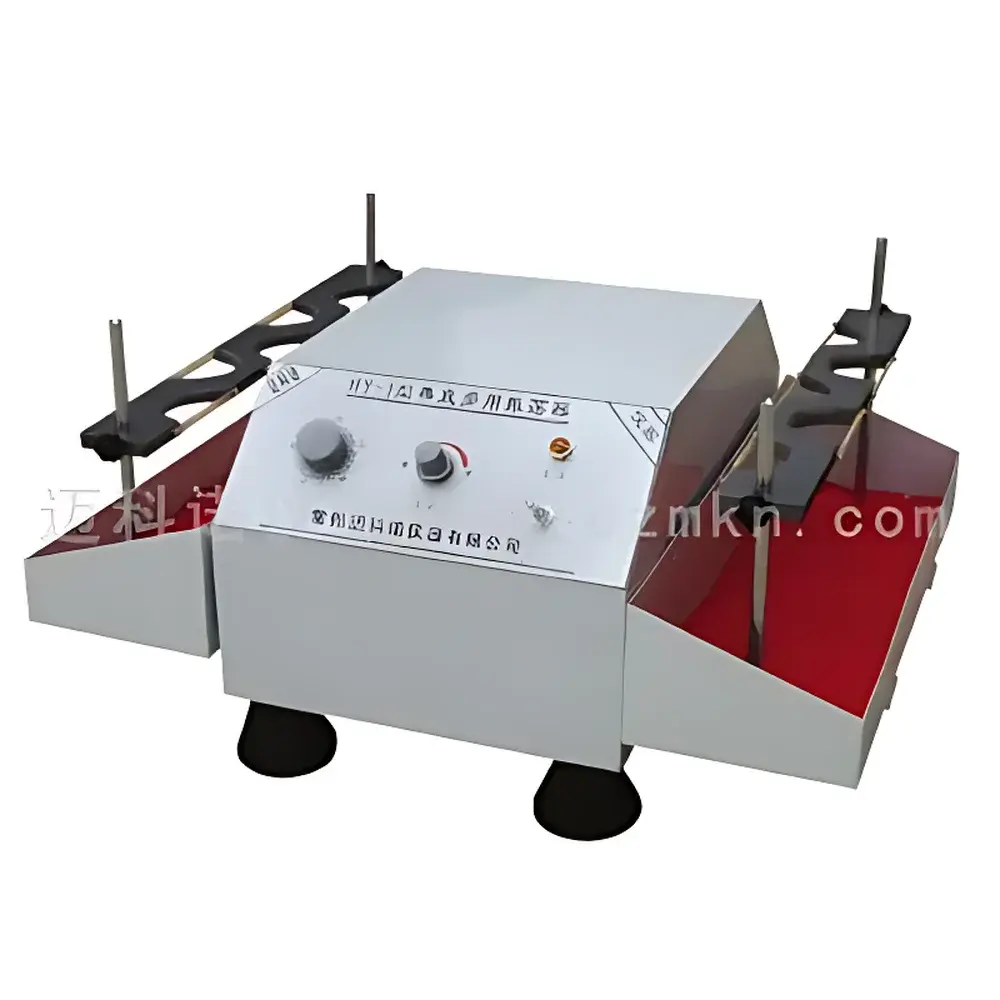
MKN HY-1 Vertical Multi-Function Shaker
| Brand | MKN |
|---|---|
| Model | HY-1 |
| Power Supply | AC 220 V ±10%, 50 Hz ±2% |
| Speed Range | 0–280 rpm (infinitely variable) |
| Stroke | 20 mm (vertical) |
| Timer | 0–120 min |
| Operating Temperature | 0–40 °C |
| Relative Humidity | ≤85% RH |
| Origin | Jiangsu, China |
| Category | Benchtop Vertical Orbital Shaker for Life Science Applications |
Overview
The MKN HY-1 Vertical Multi-Function Shaker is an engineered benchtop platform designed for consistent, low-vibration vertical oscillation in life science laboratories. It operates on a simple yet robust mechanical principle: a balanced eccentric drive mechanism converts rotary motor motion into controlled vertical reciprocating displacement—20 mm stroke amplitude—with minimal lateral deviation and acoustic emission. This architecture ensures high reproducibility across repeated runs, essential for cell suspension, microbial culture propagation, reagent mixing, and sample homogenization where uniform agitation without shear-induced damage is critical. Unlike orbital or rocking shakers, the HY-1’s strictly vertical motion profile minimizes meniscus disturbance in narrow-necked vessels and reduces cross-contamination risk during parallel processing of multiple samples. Its design complies with fundamental safety and electromagnetic compatibility requirements per IEC 61000-6-3 (emission) and IEC 61000-6-2 (immunity), making it suitable for shared lab environments under standard ISO/IEC 17025-aligned quality management systems.
Key Features
- Infinitely variable speed control (0–280 rpm) via precision potentiometer, enabling fine-tuned optimization for sensitive biological suspensions—including bacterial cultures, yeast fermentations, and mammalian cell lines.
- Stable vertical oscillation with 20 mm stroke—mechanically isolated from base frame to suppress transmission of vibration to adjacent instrumentation.
- Integrated digital timer (0–120 minutes) with auto-shutoff; non-volatile memory retains last-used settings after power cycle.
- Universal spring-loaded clamp system accommodates round-bottom flasks (50–2000 mL), test tubes, centrifuge tubes, and custom vial holders—no tools required for rapid reconfiguration.
- Aluminum alloy housing with powder-coated steel base provides corrosion resistance and structural rigidity; footprint optimized for standard laboratory benches (W × D × H: 320 × 280 × 180 mm).
- Thermal protection circuitry prevents motor overload under extended operation or ambient temperatures up to 40 °C.
Sample Compatibility & Compliance
The HY-1 supports common labware used in microbiology, molecular biology, and bioprocess development—including borosilicate glass Erlenmeyer flasks, polycarbonate culture bottles, and polypropylene conical tubes. Its vertical motion profile maintains liquid column integrity in tall-form vessels, reducing foaming and surface denaturation compared to orbital alternatives. While not certified to GLP/GMP Annex 11 or FDA 21 CFR Part 11, the device meets general-purpose laboratory equipment requirements under ISO 13485–compatible workflows when paired with documented operational procedures and periodic performance verification (e.g., speed calibration using traceable tachometer, stroke consistency check per ASTM E2500-13 Annex A3). It is intended for research-use-only (RUO) applications and is not validated for clinical diagnostic or pharmaceutical manufacturing processes.
Software & Data Management
The HY-1 is a standalone analog-controlled instrument with no embedded firmware, network interface, or data logging capability. All operational parameters are set manually and verified visually or with external metrology tools. For labs requiring audit trails or electronic records, integration with third-party environmental monitoring systems (e.g., Vaisala viewLinc, DeltaTrak BlueView) is possible via optional analog voltage output modules (sold separately), enabling speed and runtime telemetry capture. Users implementing ALCOA+ principles must maintain paper-based logbooks or LIMS-integrated manual entry for each run, including date, operator ID, vessel type, speed setting, duration, and observed stability indicators.
Applications
- Maintenance of aerobic microbial cultures (e.g., E. coli, Bacillus subtilis) in shake flasks under standardized aeration conditions.
- Preparation of uniform cell suspensions prior to flow cytometry, plating, or cryopreservation.
- Antibiotic susceptibility testing (AST) using broth microdilution methods requiring homogeneous drug–bacteria interaction.
- Extraction protocols involving solid–liquid phase mixing (e.g., plant metabolite recovery, protein solubilization).
- Teaching laboratories: demonstration of growth kinetics, oxygen transfer limitations, and scale-up correlation principles.
- QC/QA workflows for raw material dispersion, buffer equilibration, and reagent reconstitution where batch-to-batch consistency is mandatory.
FAQ
Is the HY-1 compatible with incubator chambers?
Yes—the unit’s compact height and absence of heat-generating electronics (other than the motor) allow safe placement inside standard CO₂ or ambient-temperature incubators, provided internal airflow is unobstructed and ambient humidity remains below 85% RH.
Can the stroke amplitude be adjusted?
No—the 20 mm vertical stroke is fixed by mechanical design to ensure long-term repeatability and avoid user-induced calibration drift.
What maintenance is required?
Biannual inspection of drive belt tension and clamp spring elasticity is recommended; no lubrication is required. Wipe exterior surfaces with 70% ethanol; avoid solvent contact with control panel seals.
Does MKN provide installation qualification (IQ) or operational qualification (OQ) documentation?
Standard delivery includes a factory calibration certificate and electrical safety test report. Custom IQ/OQ protocol development and execution are available as paid consultancy services upon request.
Is the HY-1 suitable for GMP-regulated environments?
It may be deployed in GMP facilities as a secondary support instrument—provided it undergoes site-specific risk assessment, periodic performance verification, and inclusion in equipment master files—but it does not carry CE marking for medical device use or FDA listing.




