
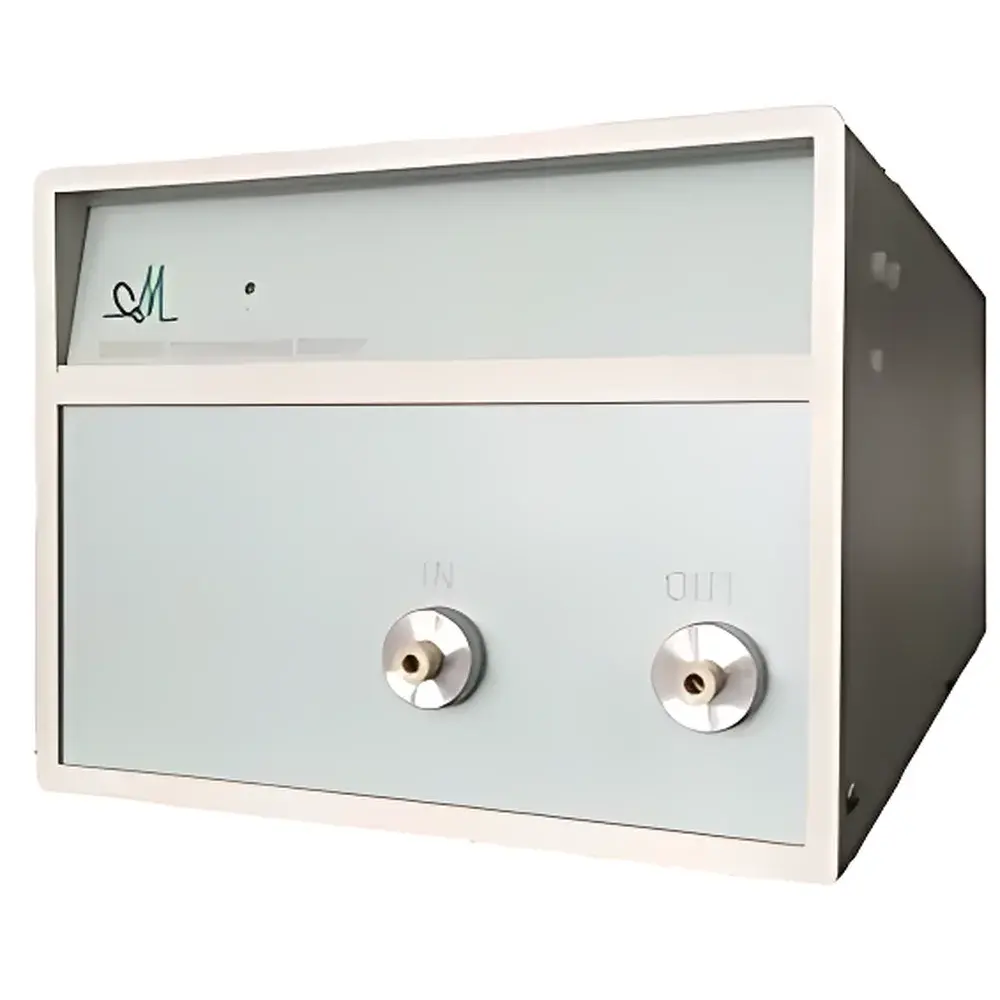
CoMetro 6000PER Photochemical Derivatization Unit
| Brand | CoMetro |
|---|---|
| Origin | Imported |
| Model | 6000PER Photochemical Derivatization Unit |
| Light Source | Cold UV LED |
| Output Power | 8 mW |
| Wavelength | 254 nm |
| Maximum Flow Rate | 3 mL/min |
| Reaction Chamber | Köhler Illumination Design |
| Temperature Control | Forced-Air Cooling |
| Operating Temperature Range | Up to 100 °C |
| Derivatization Type | Post-Column, Reagent-Free Photochemical Activation |
Overview
The CoMetro 6000PER Photochemical Derivatization Unit is a precision-engineered, reagent-free post-column derivatization system designed for high-sensitivity HPLC analysis of mycotoxins—particularly aflatoxin B₁ and G₁—and sulfonamide antibiotics. It operates on the principle of controlled ultraviolet photolysis: incident 254 nm photons induce structural rearrangement or bond cleavage in analytes eluting from the chromatographic column, generating highly fluorescent derivatives *in situ* without chemical reagents. Positioned between the HPLC column outlet and the fluorescence detector, the unit integrates seamlessly into existing LC workflows while preserving chromatographic integrity. Its Köhler illumination reaction chamber ensures uniform, collimated UV exposure across the entire flow path cross-section, minimizing radial intensity gradients and maximizing photoconversion reproducibility. Unlike thermal or chemical derivatization methods, the 6000PER introduces no additional reagent lines, mixing tees, or solvent-phase interfaces—thereby eliminating carryover risk, baseline drift, and peak broadening associated with dead-volume accumulation.
Key Features
- Reagent-free operation: Eliminates need for hazardous chemical derivatizing agents (e.g., bromine, iodine, or o-phthalaldehyde), reducing analytical waste, operator exposure, and method validation complexity.
- Köhler illumination optics: Engineered quartz flow cell with optimized light-path geometry delivers homogeneous 254 nm irradiance across the full 3 mm internal diameter capillary, ensuring consistent quantum yield across varying flow rates (0.2–3.0 mL/min).
- Forced-air thermal management: Integrated fan-cooled heatsink maintains reaction zone temperature ≤100 °C under continuous operation, preventing thermal degradation of labile derivatives and enabling stable long-run performance.
- Zero dead-volume integration: Direct 1/16″ OD stainless-steel tubing connections (with zero-dead-volume ferrules) preserve column efficiency and minimize band broadening (Δσ² < 0.5 µL² contribution).
- UV-stable construction: All wetted surfaces consist of electropolished 316L stainless steel and fused silica; no PEEK or polymer components exposed to UV radiation, ensuring >5,000-hour operational lifetime without photodegradation-induced leaching.
Sample Compatibility & Compliance
The 6000PER is validated for use in regulatory-compliant workflows targeting aflatoxins (AFB₁, AFG₁) per AOAC Official Method 2005.08 and EU Commission Regulation (EC) No. 401/2006, as well as sulfonamide residues in animal tissues per ISO 17025-accredited laboratories. Its reagent-free design inherently supports GLP and GMP environments by removing variable chemical lot dependencies and simplifying change control documentation. The unit complies with IEC 61000-6-3 (EMC emissions) and IEC 61010-1 (safety requirements for electrical equipment for measurement), and its firmware architecture supports audit-trail-enabled operation when integrated with 21 CFR Part 11–compliant CDS platforms (e.g., Thermo Chromeleon, Waters Empower).
Software & Data Management
While the 6000PER operates as a standalone hardware module without embedded microprocessor control, it features dual analog status outputs (TTL-ready UV-on signal and thermistor-based temperature monitor) for synchronization with chromatography data systems. These signals enable automated event tagging in CDS software—e.g., triggering “Derivatization Active” flags in acquisition logs or initiating timed calibration sequences. When deployed with validated instrument control modules (ICMs), the unit supports full electronic record retention of operational parameters—including cumulative UV exposure time, thermal history, and flow-integrated photon dose—meeting ALCOA+ data integrity principles (Attributable, Legible, Contemporaneous, Original, Accurate, Complete, Consistent, Enduring, Available).
Applications
- Quantification of aflatoxin B₁ and G₁ in cereal grains, nuts, and dairy products at sub-ppb levels (LOD < 0.02 µg/kg) using HPLC-FLD per FDA BAM Chapter 9 protocols.
- Multi-residue analysis of 15+ sulfonamides in porcine muscle tissue via gradient RP-HPLC with post-column photoactivation and fluorescence detection (λex/λem = 254/420 nm).
- Stability-indicating assays for photolabile pharmaceutical impurities where thermal derivatization induces degradation artifacts.
- Method transfer between QC labs: Identical photochemical response profiles across instruments eliminate inter-laboratory variability common with chemical derivatization kinetics.
FAQ
Does the 6000PER require routine lamp replacement?
No. It employs solid-state UV LEDs with rated lifetime >10,000 hours at nominal output—no consumable lamps, alignment procedures, or intensity recalibration required.
Can it be used with UHPLC systems operating above 1000 bar?
Yes. The reaction cell is rated to 1,200 bar and compatible with standard 1/32″ ID capillaries; backpressure increase is <15 bar at 1.0 mL/min (acetonitrile/water 60:40).
Is validation documentation provided for GMP audits?
CoMetro supplies IQ/OQ protocol templates, factory test reports (including spectral irradiance mapping and flow-through UV dose calibration), and material compliance certificates (RoHS, REACH, USP Class VI).






