
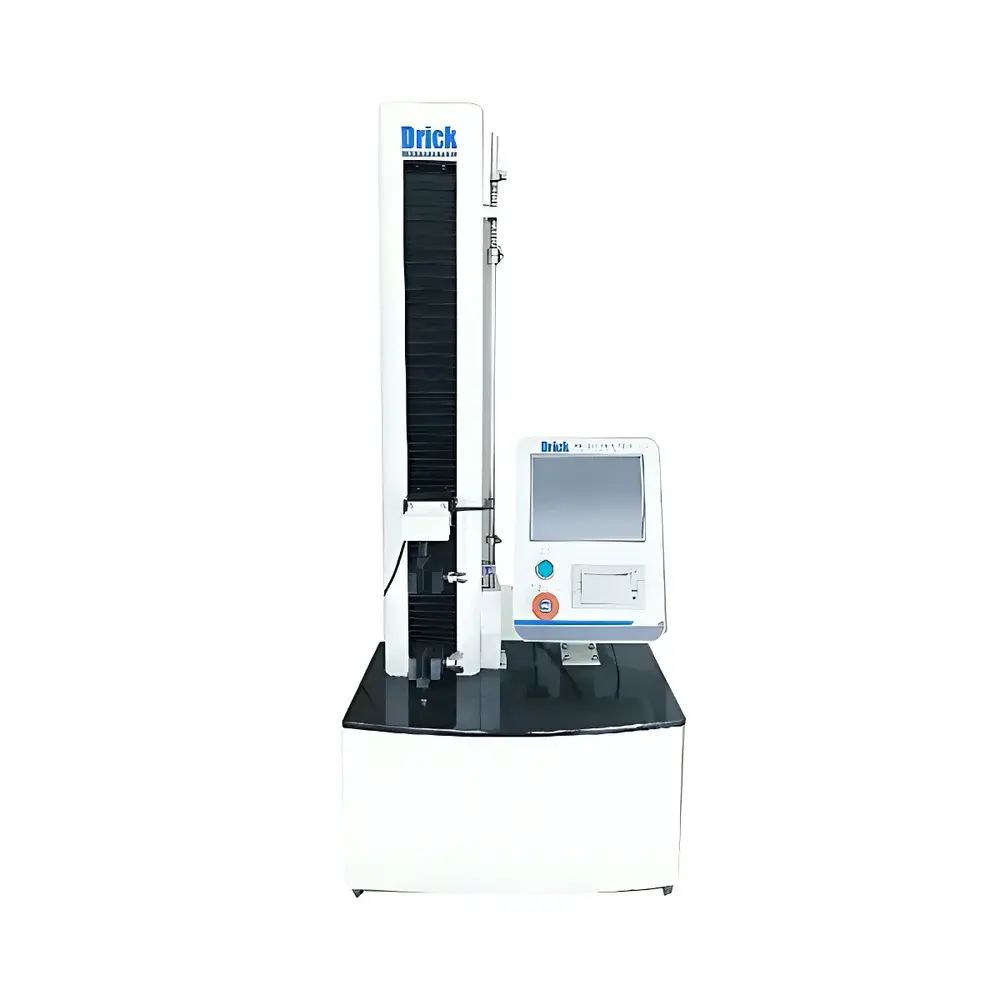
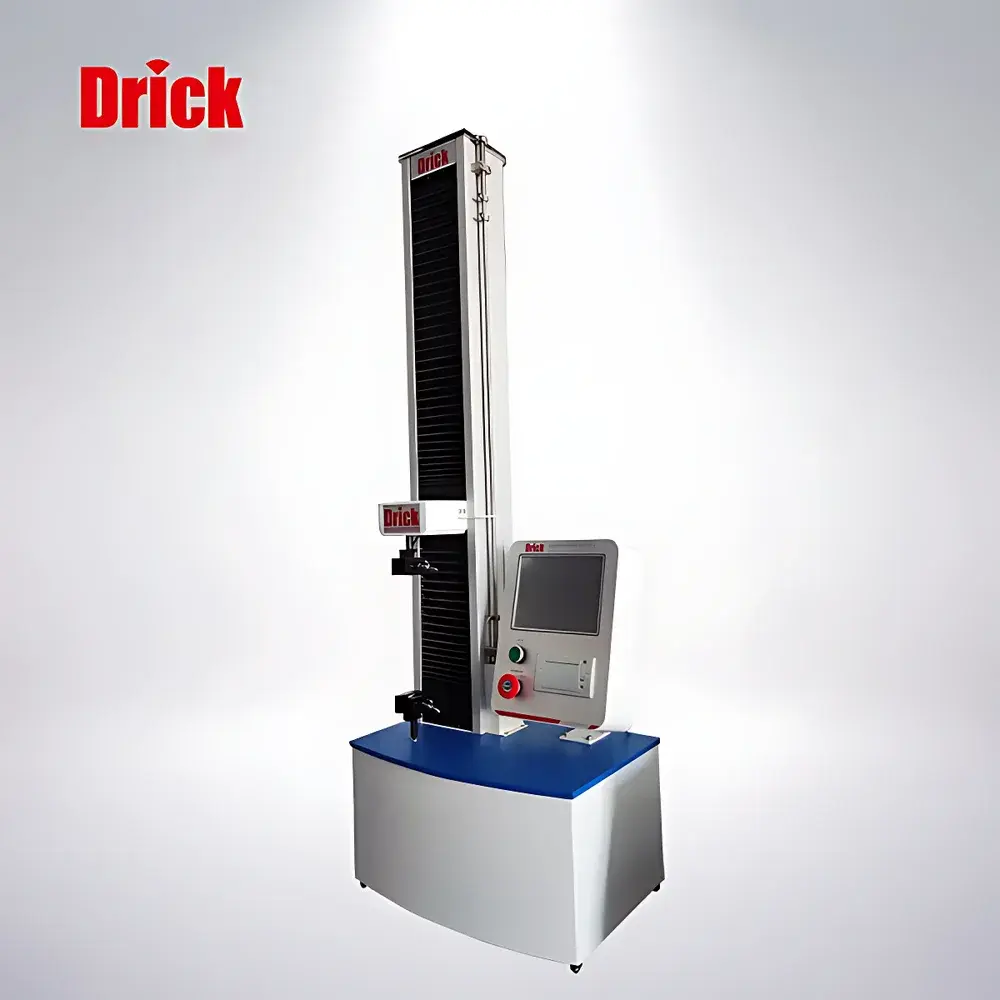
Drick DRK101 High-Speed Universal Tensile Testing Machine
| Brand | Drick |
|---|---|
| Origin | Shandong, China |
| Manufacturer Type | OEM Manufacturer |
| Country of Origin | China |
| Model | DRK101 |
| Load Capacity Options | 100 N to 50 kN (selectable) |
| Structural Configuration | Portal Frame |
| Load Measurement Range | 1–100% of full scale |
| Load Accuracy | ±1% of indicated value |
| Speed Range | 1–500 mm/min (infinitely variable) |
| Speed Accuracy | ±0.2% |
| Displacement Resolution | 0.01 mm |
| Force Resolution | 1/10000 of full scale |
| Standard Fixture | One pair of tensile grips (others optional) |
| Maximum Tensile Travel | 600 mm |
| Dimensions (W×D×H) | 700 × 380 × 1650 mm |
| Power Requirement | 0.8 kW |
| Weight | 450 kg |
| Compliance Standards | GB/T 228.1–2021, GB/T 16826–2008, GB/T 528–2018, GB/T 532–2018 |
Overview
The Drick DRK101 High-Speed Universal Tensile Testing Machine is a microprocessor-controlled electromechanical testing system engineered for precision mechanical property characterization of metallic, polymeric, composite, and elastomeric materials. It operates on the principle of uniaxial force application under controlled displacement or load rate, enabling standardized determination of tensile strength, yield point, elongation at break, modulus of elasticity, compressive strength, flexural properties, peel resistance, and tear propagation. Designed with a rigid portal frame architecture and high-stiffness load train, the DRK101 delivers consistent force transmission and minimal deflection during high-speed testing up to 500 mm/min—critical for dynamic mechanical evaluation and quality assurance in high-throughput production environments. Its closed-loop servo control system ensures stable loading profiles across the full speed range, supporting both quasi-static and accelerated test protocols required by international material standards.
Key Features
- Rugged portal-frame construction with precision-ground lead screws and preloaded ball screws for minimal backlash and long-term dimensional stability
- Wide dynamic range: selectable load cells from 100 N to 50 kN, each calibrated to ISO 7500-1 Class 1 accuracy (±1% FS)
- Infinitely variable crosshead speed from 1 to 500 mm/min, maintained within ±0.2% tolerance via digital encoder feedback
- High-resolution data acquisition: 0.01 mm displacement resolution and 1/10,000 full-scale force resolution
- Manual wedge-action tensile grips with self-aligning geometry—eliminates parasitic bending moments and ensures axial loading alignment per ASTM E8/E8M requirements
- Low-noise, oil-free DC servo drive system compliant with IEC 61800-3 electromagnetic compatibility standards
- Integrated thermal management and overload protection circuitry for continuous operation under industrial conditions
Sample Compatibility & Compliance
The DRK101 accommodates specimens ranging from thin polymer films (≥25 µm) to structural metal coupons (up to 25 mm thick), with standard tensile travel of 600 mm and customizable extensometer integration for strain measurement. It supports ASTM D638, D790, D1876 (T-peel), D624 (tear), ISO 527-1, ISO 178, ISO 1133, and GB/T 228.1–2021 test methods. All hardware and firmware comply with GB/T 16826–2008 (electromechanical universal testing machines) and GB/T 528–2018 (vulcanized rubber tensile testing). The system architecture meets GLP audit requirements for traceability, including timestamped calibration logs, user-access-controlled parameter locking, and electronic signature support for regulated laboratories.
Software & Data Management
The DRK101 is operated via Windows-based TestMaster Pro software, which provides real-time graphical display of stress–strain curves, automatic peak detection, modulus calculation (secant, tangent, chord), and multi-curve overlay for comparative analysis. Raw data export is supported in CSV, Excel, and XML formats, with optional PDF report generation embedding test parameters, metadata, and digital signatures. Software complies with FDA 21 CFR Part 11 requirements through role-based access control, audit trail logging (all parameter changes, test starts/stops, calibrations), and non-erasable electronic records. Custom test templates can be saved and version-controlled, facilitating method transfer across QA/QC labs and contract testing facilities.
Applications
This instrument serves as a primary mechanical testing platform across R&D, manufacturing QC, and third-party certification labs. Typical use cases include: tensile validation of extruded thermoplastic profiles per ISO 1133; peel strength verification of laminated food packaging per ASTM F904; tear resistance assessment of geotextiles and roofing membranes per ASTM D4533; compression testing of polyurethane foams per ISO 3386; and flexural modulus determination of fiber-reinforced composites per ASTM D7264. Educational institutions utilize the DRK101 for undergraduate materials science labs due to its intuitive interface, repeatability (<1.5% RSD across 10 replicate tests on aluminum 6061-T6), and compatibility with ASTM E4 calibration standards.
FAQ
What load cell options are available for the DRK101?
Standard configurations include 100 N, 200 N, 500 N, 1 kN, 2 kN, 5 kN, 10 kN, 20 kN, and 50 kN load cells—each supplied with individual calibration certificate traceable to CNAS-accredited standards.
Is the system compatible with extensometers for strain measurement?
Yes—both clip-on and non-contact video extensometers can be integrated via USB or analog input ports, with software auto-detection and calibration workflows.
Does the DRK101 support automated test sequences?
TestMaster Pro enables batch execution of up to 99 preconfigured test methods, including conditional branching based on pass/fail criteria and automatic report generation.
What maintenance intervals are recommended?
Lubrication of lead screws every 500 operational hours; annual verification of load cell linearity and displacement encoder accuracy using certified reference standards.
Can the machine be integrated into a factory MES or LIMS environment?
Yes—OPC UA and Modbus TCP communication protocols are supported for bidirectional data exchange with enterprise systems, including sample ID push, test initiation commands, and result ingestion.
Related Products





