
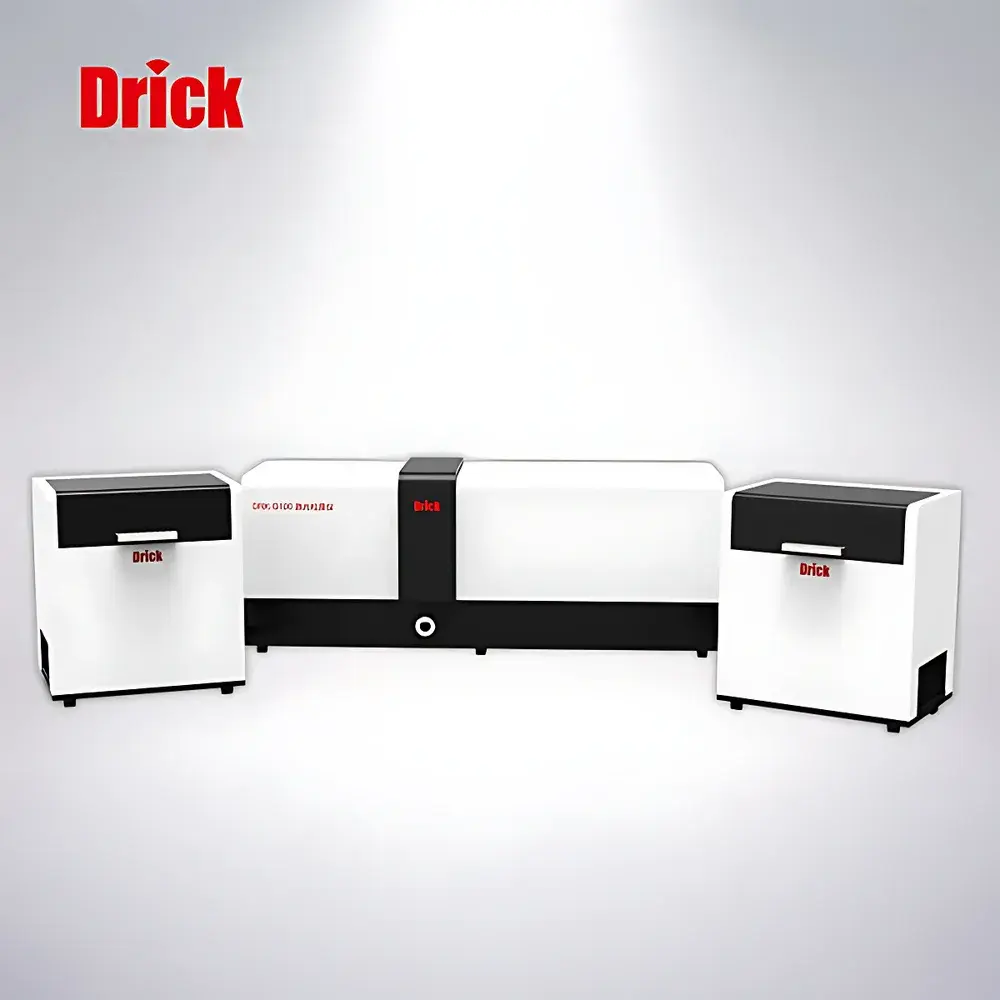
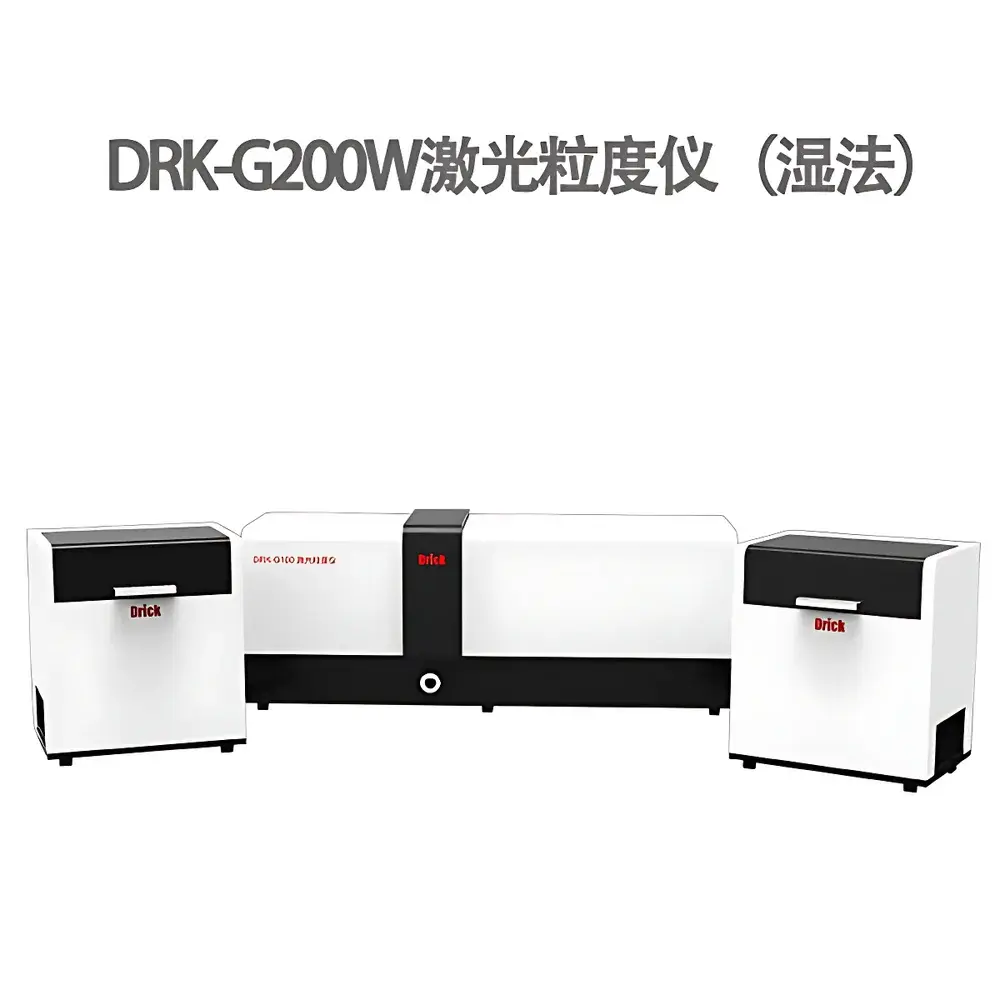
Drick DRK-G200W Wet-Dispersion Laser Particle Size Analyzer
| Brand | Drick |
|---|---|
| Origin | Shandong, China |
| Manufacturer Type | Direct Manufacturer |
| Product Category | Domestic |
| Model | DRK-G200W |
| Dispersion Method | Wet Dispersion |
| Instrument Type | Laboratory Laser Particle Size Analyzer |
| Measurement Range (Wet) | 0.02–2000 µm |
| Repeatability | <1% RSD (D50, certified national standard reference material) |
Overview
The Drick DRK-G200W is a laboratory-grade wet-dispersion laser particle size analyzer engineered for high-precision, reproducible measurement of particle size distribution (PSD) in suspensions and colloidal systems. It operates on the principle of Mie scattering theory, utilizing a dual-lens optical system with a high-stability He-Ne laser (632.8 nm) and an optimized multi-angle detection array (up to 104 photodetector channels). The instrument is calibrated using NIST-traceable standard reference materials and conforms to ISO 13320:2020 (Particle size analysis — Laser diffraction methods) and ASTM E2799-22 (Standard Guide for Laser Diffraction Particle Size Analysis). Designed for routine QC/QA workflows and method development in regulated environments, the DRK-G200W delivers robust performance across diverse sample matrices — including aqueous and organic dispersions of inorganic powders, polymers, pharmaceutical actives, pigments, catalysts, and biological particulates.
Key Features
- Wide dynamic detection range: 0.02 µm to 2000 µm under wet dispersion mode, enabling comprehensive characterization from nanoscale colloids to coarse granules.
- Integrated ultrasonic dispersion unit (20–60 kHz, adjustable power and duration) with programmable degassing and stirring control to ensure complete de-agglomeration and stable suspension.
- Automated flow cell cleaning cycle with solvent flush and air-dry sequence to minimize cross-contamination between samples.
- Modular optical bench with temperature-stabilized laser source and vibration-damped housing, ensuring long-term signal stability and measurement fidelity.
- Compliance-ready architecture supporting audit trails, user access levels, electronic signatures, and data integrity protocols aligned with FDA 21 CFR Part 11 requirements when used with optional validated software modules.
- Compact footprint (W×D×H: 650 × 420 × 380 mm) suitable for standard laboratory benchtop deployment without external chiller or compressed air supply.
Sample Compatibility & Compliance
The DRK-G200W accommodates a broad spectrum of sample types requiring wet dispersion: crystalline APIs, excipient blends, nanostructured ceramics, emulsion droplets, mineral slurries, and polymer latexes. Compatible dispersants include water, ethanol, isopropanol, cyclohexane, and surfactant-stabilized media. All fluidic pathways are constructed from chemically resistant PTFE, borosilicate glass, and stainless steel (316L), minimizing adsorption and corrosion. The system meets ISO/IEC 17025:2017 general requirements for the competence of testing and calibration laboratories. Measurement repeatability is verified per ISO 13320 Annex B using SRM 1963 (NIST) and GBW(E)130014 (Chinese national standard), consistently achieving <1% relative standard deviation at D50.
Software & Data Management
The analyzer is operated via Drick ParticleMaster v4.2 — a Windows-based application supporting GLP-compliant operation. Key capabilities include real-time scatter intensity monitoring, automatic refractive index selection (with built-in database of >200 materials), multi-modal PSD fitting (Rosin-Rammler, Lognormal, General Purpose), and customizable reporting templates compliant with ISO, USP , and EP 2.9.7. Raw data (.dat), processed results (.csv, .xlsx), and instrument logs are stored with time-stamped metadata, version-controlled parameters, and immutable audit trails. Export formats support LIMS integration (ASTM E1482-21) and regulatory submission packages (e.g., CTD Module 3).
Applications
- Pharmaceuticals: Quantification of micronized API particle size for dissolution rate prediction and bioavailability assessment.
- Materials Science: Quality control of battery cathode/anode powders (e.g., NMC, graphite), ceramic precursors, and additive manufacturing feedstocks.
- Chemicals & Coatings: Optimization of pigment dispersion stability, latex particle uniformity, and catalyst support morphology.
- Food & Agriculture: Characterization of starch granules, dairy protein aggregates, and pesticide suspension concentrates.
- Environmental Testing: Analysis of sediment grain size distributions and microplastic particulate fractions in wastewater effluents.
- Academic Research: Fundamental studies of nucleation kinetics, Ostwald ripening, and shear-induced aggregation in colloidal systems.
FAQ
What dispersion media are supported by the DRK-G200W?
The system supports aqueous and non-aqueous solvents including deionized water, ethanol, methanol, acetone, toluene, and xylene — provided they are optically transparent at 632.8 nm and compatible with wet-cell materials.
Is the instrument compliant with FDA 21 CFR Part 11?
Yes — when deployed with the validated ParticleMaster v4.2 software package and configured with role-based user accounts, electronic signatures, and full audit trail logging, the DRK-G200W satisfies core Part 11 requirements for electronic records and signatures.
Can it measure dry powders?
No — the DRK-G200W is specifically designed for wet dispersion only. For dry powder analysis, Drick offers the complementary DRK-D300 series of dry-suction laser diffraction analyzers.
What maintenance is required for routine operation?
Daily cleaning of the flow cell and cuvette; quarterly verification of laser alignment and detector sensitivity using calibration standards; annual optical inspection and recalibration traceable to NIST or CNAS-accredited labs.
Does the system support method transfer between instruments?
Yes — through standardized SOP templates, identical optical configurations, and cross-instrument validation protocols defined in ISO 13320 Annex D, enabling reliable inter-laboratory and multi-site method harmonization.



