
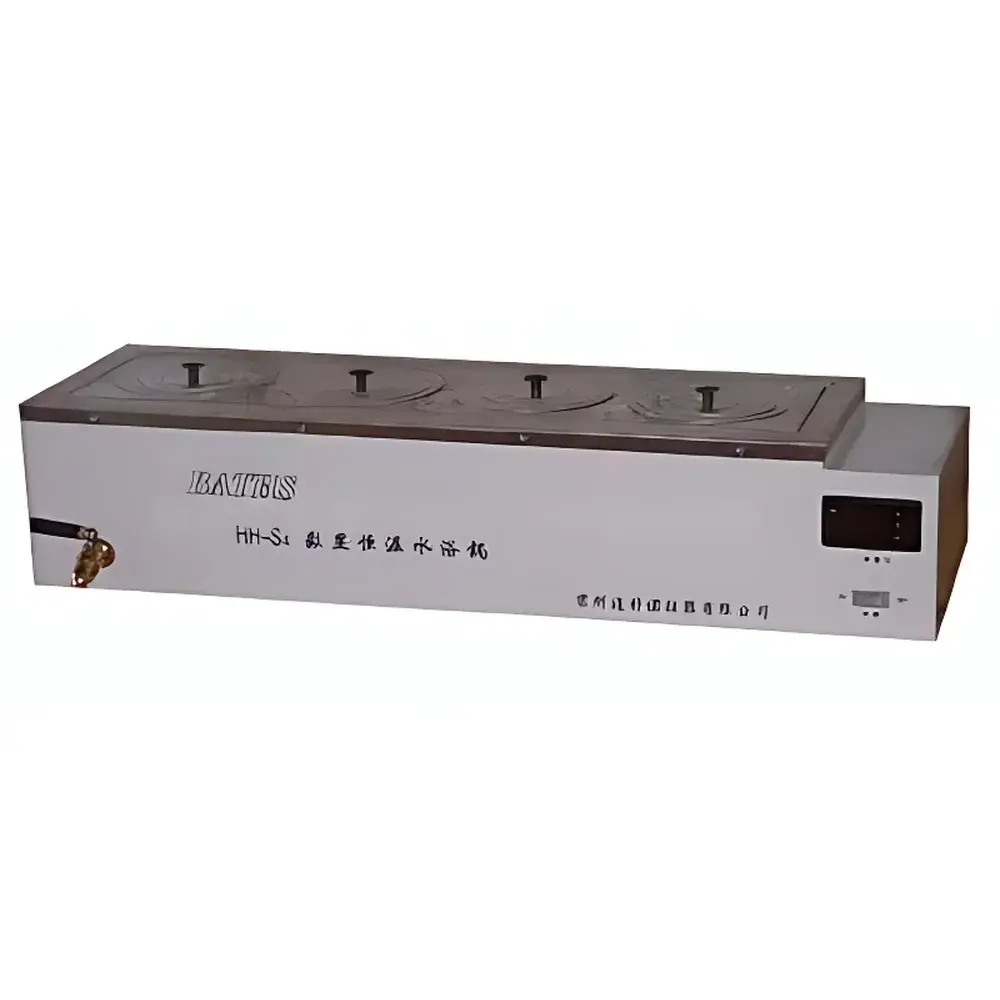
MKN HH-S11.4 Digital Display Single-Row Four-Well Water Bath
| Brand | MKN |
|---|---|
| Origin | Jiangsu, China |
| Model | HH-S11.4 |
| Well Configuration | Single-row, 4 wells |
| Temperature Range | RT+5°C to 100°C |
| Bath Chamber Material | Stainless steel (inner tank, rim, and cover) |
| Heating Power | 1200 W |
| Temperature Uniformity | ±0.5°C |
| Temperature Stability | ±1.0°C |
| Chamber Dimensions (W×D×H) | 600 × 180 × 110 mm |
| Control System | Digital LED display with high-stability op-amp circuitry and dual-integration A/D conversion |
| Heating Method | Far-infrared heating element |
| Application Scope | Evaporation, warming, digestion, extraction, and temperature-sensitive sample conditioning in life science and chemical laboratories |
Overview
The MKN HH-S11.4 Digital Display Single-Row Four-Well Water Bath is a precision-engineered laboratory thermal management instrument designed for reliable, uniform, and repeatable low-to-moderate temperature control in aqueous environments. Operating on the principle of convective heat transfer via water as a thermally stable, high-heat-capacity medium, this unit maintains consistent thermal conditions across four independent wells—each optimized for simultaneous yet isolated sample processing. Its construction integrates 304-grade stainless steel for the inner tank, rim, and lid, ensuring long-term resistance to corrosion, oxidation, and thermal fatigue under continuous operation at temperatures up to 100°C. The bath achieves rapid thermal equilibrium—typically within 15–20 minutes after setpoint adjustment—due to its far-infrared heating element and optimized thermal mass distribution. This design minimizes radial and vertical temperature gradients, delivering spatial uniformity of ≤±0.5°C across all wells when operated at steady state, making it suitable for applications requiring strict thermal reproducibility without active circulation.
Key Features
- Four-well single-row configuration enables parallel processing of multiple samples while maintaining physical separation to prevent cross-contamination.
- Digital LED interface with high-stability operational amplifier circuitry and dual-integration analog-to-digital conversion ensures accurate real-time temperature readout and minimal drift over extended operation.
- Fully enclosed stainless steel chamber—including tank, perimeter rim, and hinged lid—provides mechanical durability, ease of cleaning, and compatibility with mild aqueous reagents and buffer solutions.
- Far-infrared heating system delivers efficient energy transfer with reduced surface hotspots and improved thermal response time compared to traditional resistive coil designs.
- Thermal insulation layer beneath the bath chamber reduces ambient heat loss and improves power efficiency during prolonged incubation cycles.
- Over-temperature protection circuitry (hardware-based cut-off) safeguards against uncontrolled thermal excursion, supporting safe unattended operation in compliance with IEC 61010-1 safety guidelines.
Sample Compatibility & Compliance
The HH-S11.4 accommodates standard laboratory glassware including 10–500 mL beakers, Erlenmeyer flasks, test tubes (up to 25 mm diameter), and sample vials placed directly into the water-filled wells. It is compatible with aqueous buffers, saline solutions, enzyme reaction mixtures, and non-volatile organic solvents with low vapor pressure (e.g., ethylene glycol–water blends). While not rated for flammable solvent use, its sealed stainless steel architecture meets basic requirements for GLP-aligned lab environments. The device complies with CE marking directives for electrical safety (EN 61010-1) and electromagnetic compatibility (EN 61326-1). Though not validated for FDA 21 CFR Part 11 compliance out-of-the-box, its digital display and stable setpoint retention support audit-ready documentation when integrated into SOP-controlled workflows.
Software & Data Management
This model operates as a standalone analog-digital hybrid instrument with no embedded microprocessor or external connectivity (USB/Ethernet). All control and monitoring are performed locally via front-panel push-button interface and LED display. Temperature setpoints and real-time readings are manually recorded; no internal data logging, timestamping, or export functionality is provided. For laboratories requiring electronic recordkeeping, integration with external temperature dataloggers (e.g., Omega OM-CP series or Testo 177 T1) is recommended using calibrated PT100 probe placement in representative wells. Such configurations support traceable calibration verification per ISO/IEC 17025 requirements when paired with accredited lab procedures.
Applications
- Controlled warming of reagents prior to enzymatic assays or cell culture media preparation.
- Constant-temperature incubation of DNA ligation or restriction digestion reactions.
- Evaporation concentration of aqueous extracts in phytochemical or environmental analysis workflows.
- Temperature equilibration of viscosity standards before rotational rheometry calibration.
- Softening of agarose or paraffin wax in histology and molecular biology labs.
- Pre-heating of chromatographic mobile phases to reduce baseline drift in HPLC systems.
FAQ
What is the maximum operating temperature of the HH-S11.4 water bath?
The unit is rated for continuous operation from ambient +5°C up to 100°C.
Can this water bath be used with organic solvents?
It is intended for aqueous media only; use with flammable or low-boiling-point solvents is not advised due to lack of explosion-proof certification.
Is the temperature uniformity verified across all four wells simultaneously?
Yes—manufacturer specifications confirm ≤±0.5°C spatial uniformity across the entire working volume when stabilized at any setpoint between 30°C and 95°C.
Does the HH-S11.4 include a timer or auto-shutdown function?
No; it is a manually controlled analog-digital instrument without programmable timing or scheduled shutdown capabilities.
What maintenance is required to ensure long-term accuracy?
Regular descaling with 5% citric acid solution (every 3–6 months depending on water hardness), visual inspection of heater integrity, and annual verification against a NIST-traceable reference thermometer are recommended practices.



