
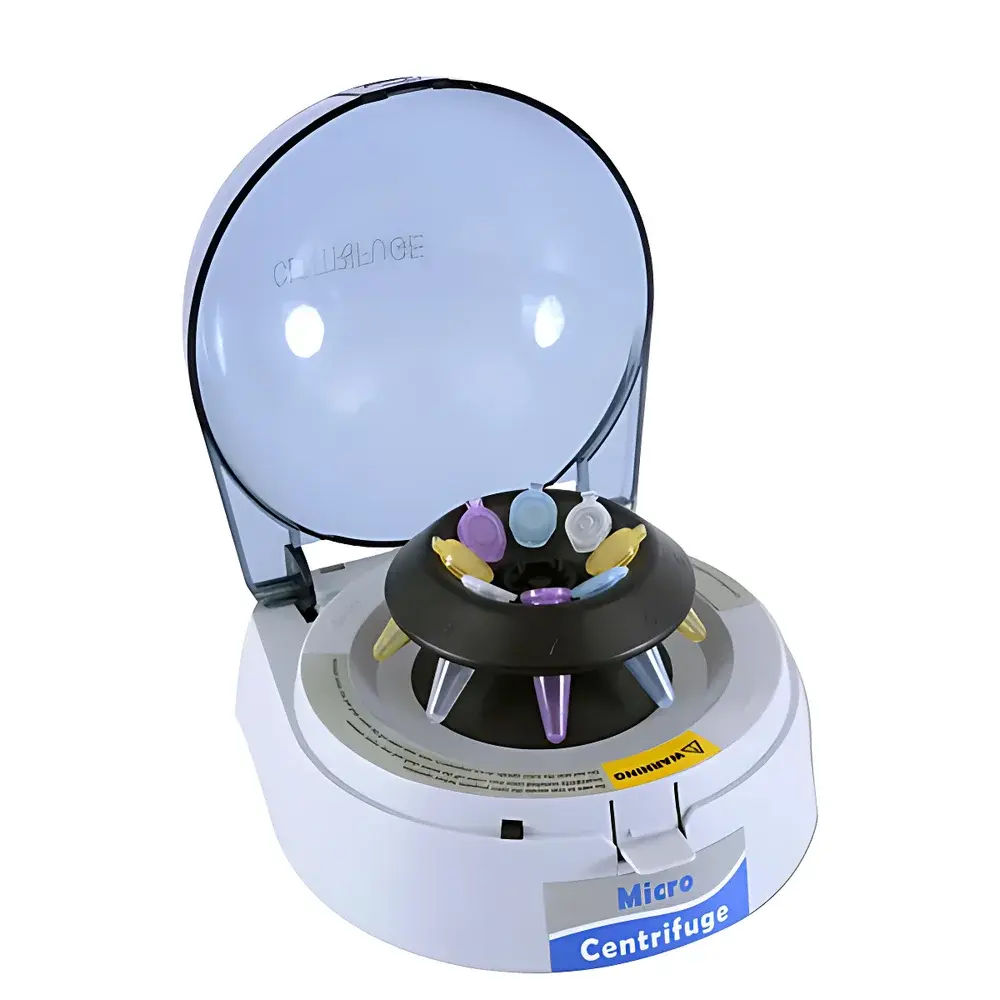
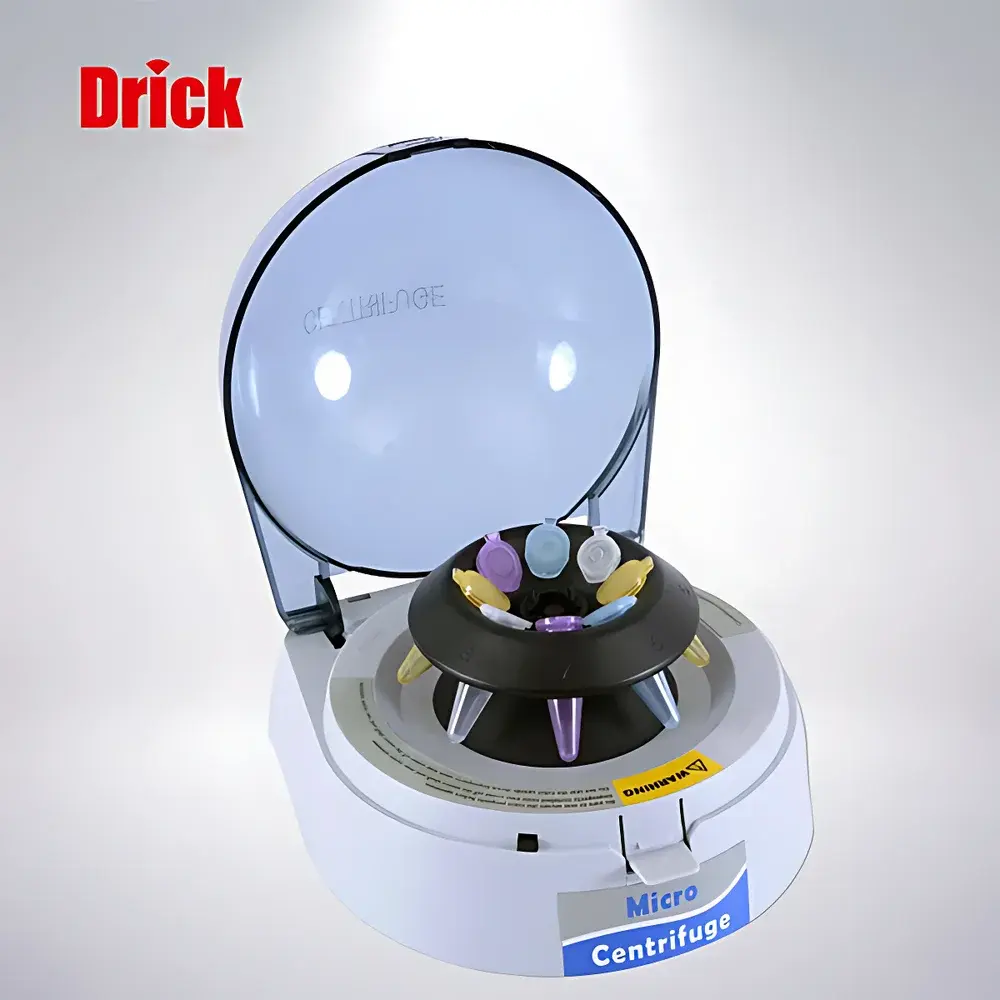
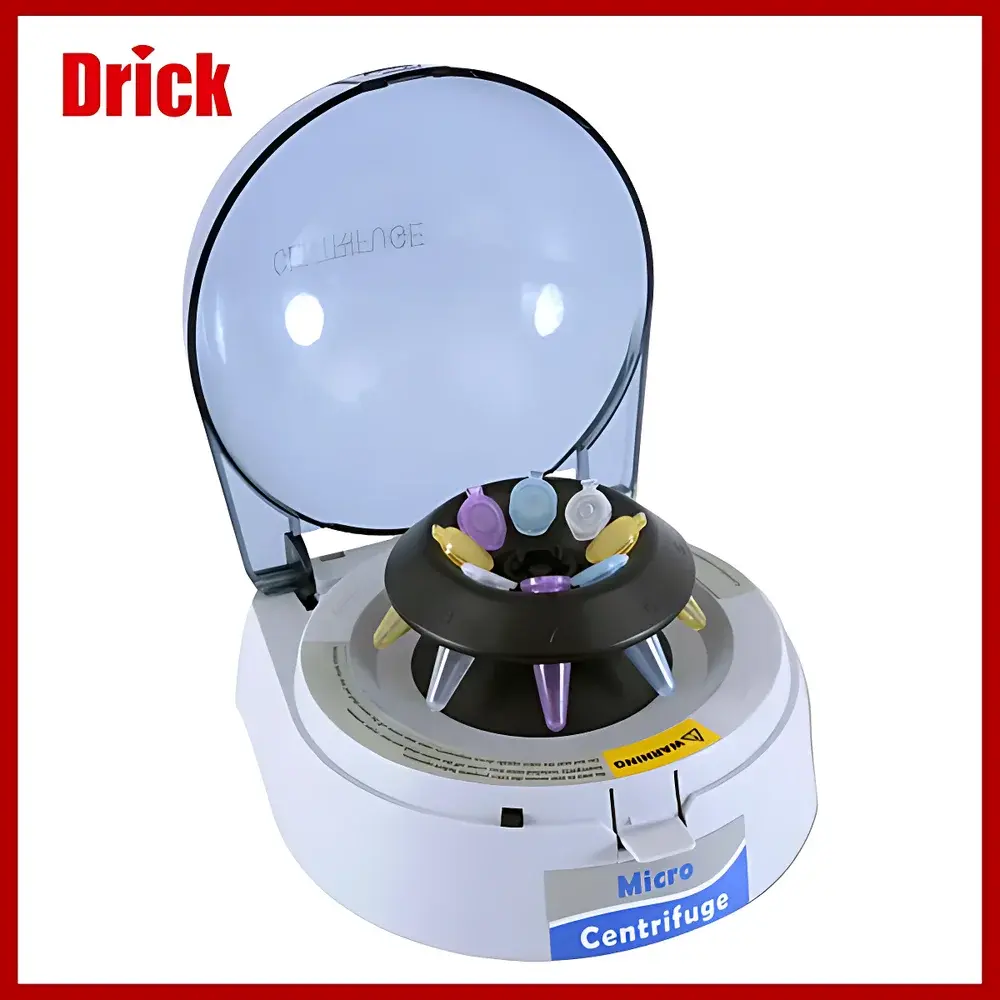
Drick DRK-Mini-4 Portable Microcentrifuge
| Brand | Drick |
|---|---|
| Origin | Shandong, China |
| Manufacturer Type | Direct Manufacturer |
| Product Category | Domestic |
| Model | DRK-Mini-4 |
| Instrument Type | Benchtop Mini Centrifuge |
| Speed Range | Up to 4000 rpm |
| Max RCF | 990 × g |
| Capacity | 8 × 1.5/2 mL tubes |
| Dimensions | 158 × 168 × 118 mm |
| Compliance | CE-marked for laboratory use per IEC 61010-1 |
Overview
The Drick DRK-Mini-4 Portable Microcentrifuge is a compact, high-reliability benchtop centrifuge engineered for rapid, low-speed sedimentation of microvolume samples in routine laboratory workflows. Operating on the principle of radial acceleration-induced separation—where centrifugal force drives denser components toward the tube bottom—the DRK-Mini-4 delivers consistent 990 × g at its maximum rotational speed of 4000 rpm. Designed specifically for applications requiring minimal footprint and immediate accessibility, it serves as an essential tool in molecular biology prep stations, clinical sample processing bays, and quality control labs where space-constrained environments demand functional precision without compromise. Its brushless DC motor ensures stable speed regulation, reduced thermal drift, and extended service life—critical attributes for reproducible low-G separations across repeated daily cycles.
Key Features
- Compact ergonomic footprint (158 × 168 × 118 mm) optimized for crowded fume hoods, biosafety cabinets, and mobile lab carts
- Brushless DC motor with electronic speed control for precise, stepless adjustment from 500 to 4000 rpm in 100-rpm increments
- Instant acceleration/deceleration profile with <12 s ramp-up and <15 s coast-down time—minimizing total cycle duration
- Fixed-angle rotor accommodating eight 1.5 mL or 2.0 mL microcentrifuge tubes simultaneously, balanced for operation without counterweights
- Integrated safety interlock system that halts rotation immediately upon lid opening; automatic rotor identification prevents overspeed conditions
- IP21-rated enclosure with reinforced ABS housing and vibration-dampening feet for stable operation on non-level surfaces
- Low-noise design (<55 dB(A) at 4000 rpm), suitable for open-plan laboratories and shared instrumentation spaces
Sample Compatibility & Compliance
The DRK-Mini-4 supports standard polypropylene and polyethylene microtubes (1.5 mL and 2.0 mL formats), including PCR strip-compatible configurations. It is validated for use with aqueous buffers, saline solutions, cell lysates, serum supernatants, and filtered particulate suspensions—provided density differentials exceed 0.02 g/cm³ and viscosity remains below 10 mPa·s. The device complies with IEC 61010-1:2010 for electrical safety in laboratory equipment and meets EN 61326-1:2013 electromagnetic compatibility requirements. While not certified for biosafety containment (e.g., BSL-2+ aerosol generation), its sealed rotor chamber and drip-resistant base facilitate decontamination per CDC/NIH guidelines. No additional certification is required under FDA 21 CFR Part 11, as the unit operates without data logging or user-accessible software interfaces.
Software & Data Management
The DRK-Mini-4 is a standalone electromechanical instrument with no embedded firmware, network connectivity, or digital display interface. All operational parameters—including speed setpoint, run time (0–99 minutes), and automatic brake activation—are configured via tactile rotary encoder and LED status indicators. As such, it does not generate electronic records, require audit trails, or support GLP/GMP-compliant data archiving. This architecture eliminates cybersecurity vulnerabilities and reduces validation burden in regulated QC environments where traceable manual logs (e.g., paper-based run sheets signed by analysts) remain the accepted documentation standard per ISO/IEC 17025:2017 Clause 7.8.
Applications
- Routine pelleting of bacterial cultures prior to DNA extraction protocols
- Clarification of tissue homogenates and enzyme reaction mixtures in assay development
- Recovery of precipitated proteins following ammonium sulfate fractionation
- Pre-spinning of filter columns in nucleic acid purification kits (e.g., spin-column based RNA isolation)
- Removal of residual debris from clarified serum or plasma samples prior to ELISA or HPLC analysis
- Field-deployable sample stabilization in environmental monitoring programs where refrigerated transport is unavailable
FAQ
What is the maximum relative centrifugal force (RCF) achievable with the DRK-Mini-4?
The unit achieves a peak RCF of 990 × g at 4000 rpm with 1.5 mL tubes seated in the fixed-angle rotor.
Can the DRK-Mini-4 accommodate 0.5 mL microtubes or PCR strips?
No—only 1.5 mL and 2.0 mL conical-bottom microcentrifuge tubes are supported due to rotor geometry and balance constraints.
Is rotor calibration required before first use?
No. The rotor is factory-balanced and does not require recalibration; however, users must ensure symmetrical tube loading (even number of tubes, equal mass distribution) for safe operation.
Does the centrifuge include a timer function?
Yes—adjustable run time from 0 to 99 minutes with automatic stop and audible alert.
What maintenance is recommended for long-term reliability?
Wipe exterior with 70% ethanol after each use; inspect rotor for cracks or corrosion quarterly; avoid exposure to organic solvents beyond brief surface cleaning.



